

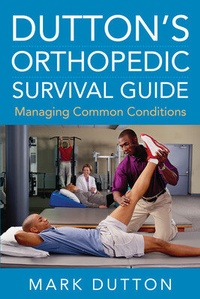
Dutton's Orthopedic Survival Guide: Managing Common Conditions
Managing Common Conditions
1st Edition
Published on 16. March 2011
978-0-07-174125-5 (ISBN)
Description

The ideal handbook for Physical Therapy students going through orthopaedic clinic rotations, with step-by-step guidelines and a convenient size.Market / Audience
Primary Market: 30,000 Physical Therapy students in the US Secondary: 155,000 practicing Physical TherapistsAbout the Book
Physical Therapy students spend a lot of time on clinical rotations, learning how to treat the most common orthopaedic conditions. Presently there is no pocket-sized, handy reference that will guide them through rotations and help prepare them for practice. Clinical Companion: Managing the Most Common Orthopaedic Conditions, is that book. To date, the competition has been bulky textbooks that are comprehensive but far too big to carry on rotations. This will not be a spin-off of Dutton's larger Orthopaedic text, but a practical guide with unique content that students will want. Small in size, but comprehensive in content, it will contain everything the student needs to diagnose and treat the most commonly-seen conditions.With introductory chapters to prep students for treating patients, the book will progress to four Sections covering the conditions: The Upper Quadrant, The Lower Quadrant, The Spine, and Systemic Conditions. We will also make videos available to users of the book via the Dutton Orthopaedics OLC.Key Selling Features - Case studies at the end of each section to enhance the decision-making process for students
- Q&A will test student's ability to determine the stage of healing, decide the best course of treatment, and evaluate results throughout the patient's care.
- Focusing on the 50 most common orthopaedic conditions treated by Physical Therapists, this will be the first handbook-sized reference designed specifically for students on clinical rotation.
Author Profile
Mark Dutton, PT
Allegheny Hospital
West Penn Allegheny Health System (WPAHS)
Adjunct Clinical Assistant Professor
Duquesne Universtiy
School of Health Sciences
Pittsburgh, PAMark Dutton (Bradfordwoods, PA) is an accomplished author who will ensure quality, consistency, and timeliness to this work. His career as a practicing Physical Therapist and Adjunct Assistant Professor helps keep him abreast of advances in the field and gives him an ability to translate that to the educational field. His book Orthopaedic Examination, Evaluation, and Intervention, now in its second edition, has been very successful in the PT market, as has his new title, McGraw-Hill's National Physical Therapy Exam, published in March, 2009, has also been well-received. In addition to his impressive skills and experience, he is also a can-do author who will submit manuscript on time and create questions and quality video assets for this work.Review:
The following is a review of Dutton's second edition of Orthopaedic Examination, Evaluation, and Intervention (2/08):
5 STAR DOODY'S REVIEW!
"Major areas in orthopedics including anatomy, kinesiology, and biomechanics of movement are covered, along with a healthy dose of pathology that impacts patient function. Clinical pearls appear in highlighted boxes throughout, and camera icons indicate where video clips should be viewed. This second edition is more comprehensive than the first. Overall, this is a valuable reference that achieves a nice balance between detailing examination and treatment. Other books tend to be limited to addressing only one of these areas, but not both. This combination makes the book unique." -- Doody's
Primary Market: 30,000 Physical Therapy students in the US Secondary: 155,000 practicing Physical TherapistsAbout the Book
Physical Therapy students spend a lot of time on clinical rotations, learning how to treat the most common orthopaedic conditions. Presently there is no pocket-sized, handy reference that will guide them through rotations and help prepare them for practice. Clinical Companion: Managing the Most Common Orthopaedic Conditions, is that book. To date, the competition has been bulky textbooks that are comprehensive but far too big to carry on rotations. This will not be a spin-off of Dutton's larger Orthopaedic text, but a practical guide with unique content that students will want. Small in size, but comprehensive in content, it will contain everything the student needs to diagnose and treat the most commonly-seen conditions.With introductory chapters to prep students for treating patients, the book will progress to four Sections covering the conditions: The Upper Quadrant, The Lower Quadrant, The Spine, and Systemic Conditions. We will also make videos available to users of the book via the Dutton Orthopaedics OLC.Key Selling Features - Case studies at the end of each section to enhance the decision-making process for students
- Q&A will test student's ability to determine the stage of healing, decide the best course of treatment, and evaluate results throughout the patient's care.
- Focusing on the 50 most common orthopaedic conditions treated by Physical Therapists, this will be the first handbook-sized reference designed specifically for students on clinical rotation.
Author Profile
Mark Dutton, PT
Allegheny Hospital
West Penn Allegheny Health System (WPAHS)
Adjunct Clinical Assistant Professor
Duquesne Universtiy
School of Health Sciences
Pittsburgh, PAMark Dutton (Bradfordwoods, PA) is an accomplished author who will ensure quality, consistency, and timeliness to this work. His career as a practicing Physical Therapist and Adjunct Assistant Professor helps keep him abreast of advances in the field and gives him an ability to translate that to the educational field. His book Orthopaedic Examination, Evaluation, and Intervention, now in its second edition, has been very successful in the PT market, as has his new title, McGraw-Hill's National Physical Therapy Exam, published in March, 2009, has also been well-received. In addition to his impressive skills and experience, he is also a can-do author who will submit manuscript on time and create questions and quality video assets for this work.Review:
The following is a review of Dutton's second edition of Orthopaedic Examination, Evaluation, and Intervention (2/08):
5 STAR DOODY'S REVIEW!
"Major areas in orthopedics including anatomy, kinesiology, and biomechanics of movement are covered, along with a healthy dose of pathology that impacts patient function. Clinical pearls appear in highlighted boxes throughout, and camera icons indicate where video clips should be viewed. This second edition is more comprehensive than the first. Overall, this is a valuable reference that achieves a nice balance between detailing examination and treatment. Other books tend to be limited to addressing only one of these areas, but not both. This combination makes the book unique." -- Doody's
More details
Other editions
Additional editions
Mark Dutton
Dutton's Orthopedic Survival Guide: Managing Common Conditions
Managing Common Conditions
Book
04/2011
McGraw-Hill Medical
€158.30
Shipment within 15-20 days
Person
Content
PART I - THE BASICS
Introductory Chapters
Becoming a clinician versus a technician
Injury classifications
Sources of pain
The importance of making the correct diagnosis
Interpreting imaging study results
Determining the stage of healing
Knowing when to progress a patient
Adjunctive therapies (modalities, manual techniques, etc.)
The design and structure of an exercise program
How to prescribe a home exercise program (HEP)
PART II: THE CONDITIONS
Section I: The Upper Quadrant
THE SHOULDER COMPLEX
THE ELBOW AND FOREARM
THE WRIST AND HAND
Section II: The Lower Quadrant
THE HIP
THE KNEE JOINT AND LOWER LEG
THE ANKLE AND FOOT
Section III: The Spine
THE CERVICAL SPINE
THE THORACIC SPINE
THE LUMBAR SPINE AND SI JOINT
Section IV: Systemic Conditions
Introductory Chapters
Becoming a clinician versus a technician
Injury classifications
Sources of pain
The importance of making the correct diagnosis
Interpreting imaging study results
Determining the stage of healing
Knowing when to progress a patient
Adjunctive therapies (modalities, manual techniques, etc.)
The design and structure of an exercise program
How to prescribe a home exercise program (HEP)
PART II: THE CONDITIONS
Section I: The Upper Quadrant
THE SHOULDER COMPLEX
THE ELBOW AND FOREARM
THE WRIST AND HAND
Section II: The Lower Quadrant
THE HIP
THE KNEE JOINT AND LOWER LEG
THE ANKLE AND FOOT
Section III: The Spine
THE CERVICAL SPINE
THE THORACIC SPINE
THE LUMBAR SPINE AND SI JOINT
Section IV: Systemic Conditions
