

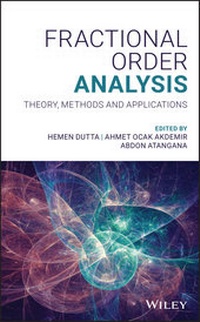
Fractional Order Analysis
Description

Fractional Order Analysis contains the most recent research findings in fractional order analysis and its applications. The authors--noted experts on the topic--offer an examination of the theory, methods, applications, and the modern tools and techniques in the field of fractional order analysis. The information, tools, and applications presented can help develop mathematical methods and models with better accuracy.
Comprehensive in scope, the book covers a range of topics including: new fractional operators, fractional derivatives, fractional differential equations, inequalities for different fractional derivatives and fractional integrals, fractional modeling related to transmission of Malaria, and dynamics of Zika virus with various fractional derivatives, and more. Designed to be an accessible text, several useful, relevant and connected topics can be found in one place, which is crucial for an understanding of the research problems of an applied nature. This book:
* Contains recent development in fractional calculus
* Offers a balance of theory, methods, and applications
* Puts the focus on fractional analysis and its interdisciplinary applications, such as fractional models for biological models
* Helps make research more relevant to real-life applications
Written for researchers, professionals and practitioners, Fractional Order Analysis offers a comprehensive resource to fractional analysis and its many applications as well as information on the newest research.
More details
Other editions
Additional editions

Persons
HEMEN DUTTA, PHD, is Faculty Member in the Department of Mathematics at Gauhati University, Guwahati, India.
AHMET OCAK AKDEMIR, PHD, is Associate Professor, A?ry Ybrahim Çeçen University, Faculty of Science and Letters, Department of Mathematics, A?ry, Turkey.
ABDON ATANGANA, PHD, is Professor, Institute for Groundwater Studies, University of the Free State, Bloemfontein, South Africa.
Content
Preface xi
List of Contributors xv
About the Editors xix
1 On the Fractional Derivative and Integral Operators 1
Mustafa A. Dokuyucu
1.1 Introduction 1
1.2 Fractional Derivative and Integral Operators 2
1.2.1 Properties of the Grünwald-Letnikov Fractional Derivative and Integral 2
1.2.1.1 Integral of Arbitrary Order 6
1.2.1.2 Derivatives of Arbitrary Order 7
1.2.2 Properties of Riemann-Liouville Fractional Derivative and Integral 9
1.2.2.1 Unification of Integer-Order Derivatives and Integrals 10
1.2.2.2 Integrals of Arbitrary Order 12
1.2.2.3 Derivatives of Arbitrary Order 14
1.3 Properties of Caputo Fractional Derivative and Integral 17
1.4 Properties of the Caputo-Fabrizio Fractional Derivative and Integral 20
1.5 Properties of the Atangana-Baleanu Fractional Derivative and Integral 24
1.6 Applications 28
1.6.1 Keller-Segel Model with Caputo Derivative 28
1.6.1.1 Existence and Uniqueness Solutions 28
1.6.1.2 Uniqueness of Solution 31
1.6.1.3 Keller-Segel Model with Atangana-Baleanu Derivative in Caputo Sense 32
1.6.1.4 Uniqueness of Solution 33
1.6.2 Cancer Treatment Model with Caputo-Fabrizio Fractional Derivative 34
1.6.2.1 Existence Solutions 35
1.6.2.2 Uniqueness Solutions 38
1.6.2.3 Conclusion 39
Bibliography 40
2 Generalized Conformable Fractional Operators and Their Applications 43
Muhammad Adil Khan and Tahir Ullah Khan
2.1 Introduction and Preliminaries 43
2.2 Generalized Conformable Fractional Integral Operators 46
2.2.1 Construction of New Integral Operators 47
2.3 Generalized Conformable Fractional Derivative 52
2.4 Applications to Integral Equations and Fractional Differential Equations 60
2.4.1 Equivalence Between the Generalized Nonlinear Problem and the Volterra Integral Equation 61
2.4.2 Existence and Uniqueness of Solution for the Nonlinear Problem 61
2.5 Applications to the Field of Inequalities 63
2.5.1 Inequalities Related to the Left Side of Hermite-Hadamard Inequality 65
2.5.1.1 Applications to Special Means of Real Numbers 74
2.5.1.2 Applications to the Midpoint Formula 75
2.5.2 Inequalities Related to the Right Side of Hermite-Hadamard Inequality 76
2.5.2.1 Applications to Special Means of Real Numbers 84
2.5.2.2 Applications to the Trapezoidal Formula 84
Bibliography 86
3 Analysis of New Trends of Fractional Differential Equations 91
Abdon Atangana and Ali Akgül
3.1 Introduction 91
3.2 Theory 92
3.3 Discretization 101
3.4 Experiments 103
3.5 Stability Analysis 104
3.6 Conclusion 110
Bibliography 111
4 New Estimations for Exponentially Convexity via Conformable Fractional Operators 113
Alper Ekinci and Sever S. Dragomir
4.1 Introduction 113
4.2 Main Results 117
Bibliography 130
5 Lyapunov-type Inequalities for Local Fractional Proportional Derivatives 133
Thabet Abdeljawad
5.1 Introduction 133
5.2 The Local Fractional Proportional Derivatives and Their Generated Nonlocal Fractional Proportional Integrals and Derivatives 135
5.3 Lyapunov-Type Inequalities for Some Nonlocal and Local Fractional Operators 137
5.4 The Lyapunov Inequality for the Sequential Local Fractional Proportional Boundary Value Problem 141
5.5 A Higher-Order Extension of the Local Fractional Proportional Operators and an Associate Lyapunov Open Problem 144
5.6 Conclusion 146
Acknowledgement 146
Bibliography 147
6 Minkowski-Type Inequalities for Mixed Conformable Fractional Integrals 151
Erhan Set and Muhamet E. Özdemir
6.1 Introduction and Preliminaries 151
6.2 Reverse Minkowski Inequality Involving Mixed Conformable Fractional Integrals 158
6.3 Related Inequalities 160
Bibliography 167
7 New Estimations for Different Kinds of Convex Functions via Conformable Integrals and Riemann-Liouville Fractional Integral Operators 169
Ahmet Ocak Akdemir and Hemen Dutta
7.1 Introduction 169
7.2 Some Generalizations for Geometrically Convex Functions 172
7.3 New Inequalities for Co-ordinated Convex Functions 179
Bibliography 191
8 Legendre-Spectral Algorithms for Solving Some Fractional Differential Equations 195
Youssri H. Youssri and Waleed M. Abd-Elhameed
8.1 Introduction 195
8.2 Some Properties and Relations Concerned with Shifted Legendre Polynomials 197
8.3 Galerkin Approach for Treating Fractional Telegraph Type Equation 200
8.4 Discussion of the Convergence and Error Analysis of the Suggested Double Expansion 204
8.5 Some Test Problems for Fractional Telegraph Equation 207
8.6 Spectral Algorithms for Treating the Space Fractional Diffusion Problem 209
8.6.1 Transformation of the Problem 210
8.6.2 Basis Functions Selection 211
8.6.3 A Collocation Scheme for Solving Eq. 8.44 213
8.6.4 An Alternative Spectral Petrov-Galerkin Scheme for Solving Eq. (8.44) 214
8.7 Investigation of Convergence and Error Analysis 214
8.8 Numerical Results and Comparisons 216
8.9 Conclusion 220
Bibliography 220
9 Mathematical Modeling of an Autonomous Nonlinear Dynamical System for Malaria Transmission Using Caputo Derivative 225
Abdon Atangana and Sania Qureshi
9.1 Introduction 225
9.2 Mathematical Preliminaries 227
9.3 Model Formulation 228
9.4 Basic Properties of the Fractional Model 230
9.4.1 Reproductive Number 230
9.4.2 Existence and Stability of Disease-free Equilibrium Points 231
9.4.3 Existence and Stability of Endemic Equilibrium Point 232
9.5 Existence and Uniqueness of the Solutions 233
9.5.1 Positivity of the Solutions 236
9.6 Numerical Simulations 237
9.7 Conclusion 247
Bibliography 250
10 MHD-free Convection Flow Over a Vertical Plate with Ramped Wall Temperature and Chemical Reaction in View of Nonsingular Kernel 253
Muhammad B. Riaz, Abdon Atangana, and Syed T. Saeed
10.1 Introduction 253
10.2 Mathematical Model 254
10.2.1 Preliminaries 256
10.3 Solution 256
10.3.1 Concentration Fields 257
10.3.1.1 Concentration Field with Caputo Time-Fractional Derivative 257
10.3.1.2 Concentration Field with Caputo-Fabrizio Time-Fractional Derivative 257
10.3.1.3 Concentration Field with Atangana-Baleanu Time-Fractional Derivative 257
10.3.2 Temperature Fields 258
10.3.2.1 Temperature Field with Caputo Time-Fractional Derivative 258
10.3.2.2 Temperature Field with Caputo-Fabrizio Time-Fractional Derivative 258
10.3.2.3 Temperature Field with Atangana-Baleanu Time-Fractional Derivative 258
10.3.3 Velocity Fields 259
10.3.3.1 Velocity Field with Caputo Time-Fractional Derivative 259
10.3.3.2 Velocity Field with Caputo-Fabrizio Time-Fractional Derivative 259
10.3.3.3 Velocity Field with Atangana-Baleanu Time-Fractional Derivative 262
10.4 Results and Discussion 263
10.5 Conclusion 263
Bibliography 279
11 Comparison of the Different Fractional Derivatives for the Dynamics of Zika Virus 283
Muhammad Altaf Khan
11.1 Introduction 283
11.2 Background of Fractional Operators 284
11.3 Model Framework 286
11.4 A Fractional Zika Model with Different Fractional Derivatives 287
11.5 Numerical Scheme for Caputo-Fabrizio Model 288
11.5.1 Solutions Existence for the Atangana-Baleanu Model 289
11.5.2 Numerical Scheme for Atangana-Baleanu Model 291
11.6 Numerical Results 293
11.7 Conclusion 303
Bibliography 303
Index 307
Preface
The book covers several new research findings in the area of fractional-order analysis and its applications. Different tools and techniques of fractional-order analysis are presented in the chapters, and several practical applications have also been demonstrated by means of different mathematical methods and models. Readers should find several useful, relevant, and connected topics in the area of fractional-order analysis those are necessary for crucial understanding of various research problems in science and technology. This book should be useful for graduate and PhD students, researchers, and educators interested in fractional-order analysis and its diverse applications. There are 11 chapters in the book, and they are organized as follows:
Chapter "On the Fractional Derivative and Integral Operators" first discussed interesting developments of fractional calculus. Then, it presented the properties of Grünwald-Letnikov, Riemann-Liouville and Caputo fractional derivative and integral operators. Also, comparisons of these operators have been made in detail. The Caputo-Fabrizio derivative operator is obtained by using the exponential function and its features have also been given. Atangana-Baleanu fractional derivative with nonlocal and nonsingular kernel is obtained by using the generalized form of the Mittag-Leffler function. Finally, the Keller-Segel and cancer treatment models were compared by expanding to Caputo, Caputo-Fabrizio, and Atangana-Baleanu fractional derivative operators.
Chapter "Generalized Conformable Fractional Operators and Their Applications" aims to present new generalized fractional integral and derivative operators along with their applications. These operators are known as left-sided and right-sided generalized conformable fractional operators, and they contain several operators of fractional calculus. Then some basic properties such as linearity, continuity, boundedness, etc. of such operators are presented. A nonlinear generalized conformable fractional differential equation is also formed. It is shown that this equation is equivalent to a Volterra integral equation and, then the existence and uniqueness of the solution is demonstrated. Finally, some Hermite-Hadamard-type inequalities for conformable integrals have been presented and discussed their applications for Trapezoidal formula and means.
Chapter "Analysis of New Trends of Fractional Differential Equations" discussed several results related to fractal-fractional derivatives in Caputo sense when the kernels are power law, exponential decay law the generalized Mittag-Leffler functions and presented numerical approximation for each case. It considered partial differential equations with these new differential operators. It also presented numerical analysis in detail and the stability for each case. Numerical simulations have been incorporated to explain the efficiency of the numerical scheme adopted, and also to see the effect of the fractal dimension and fractional order.
Chapter "New Estimations for Exponentially Convexity via Conformable Fractional Operators" discussed different fractional integral operators and their basic properties. It also established some new Hadamard-type integral inequalities for exponentially convex functions via conformable fractional integrals.
Chapter "Lyapunov-type Inequalities for Local Fractional Proportional Derivatives" reviewed some Lyapunov-type inequalities for certain local and nonlocal fractional derivatives and presented a Lyapunov-type inequality for the sequential local fractional proportional derivatives with constant references as the special case a = 2 of the nonlocal fractional proportional derivative aDa,?. An open problem is also presented for a more general sequential local fractional proportional boundary value problem. Then, it presented a higher order extension in order to investigate the ability of proving a Lyapunov inequality, which cannot obtained from the nonlocal one, for the local fractional proportional derivative of order 1 < ? = 2.
Chapter "Minkowski-type Inequalities for Mixed Conformable Fractional Integrals" first presented some fractional integrals and Minkowski-type inequalities obtained for these integrals. Then, the reverse Minkowski inequality and related inequalities for mixed conformable fractional integrals have been presented.
Chapter "New Estimations for Different Kinds of Convex Functions via Conformable Integrals and Riemann-Liouville Fractional Integral Operators" discussed several new fractional bounds involving the functions having geometrical convexity and co-ordinated convexity properties via conformable integrals and Riemann-Liouville fractional integrals. In order to obtain main results, it also derived new fractional integral identities. Then, it generalized some new integral inequalities for GG-convex functions whose second derivative at certain powers are established via conformable integrals. Several new results were further derived by choosing different values of n and a.
Chapter "Legendre-Spectral Algorithms for Solving Some Fractional Differential Equations" discussed some algorithms for treating some kinds of fractional differential equations by utilizing suitable spectral methods. A Galerkin method is employed for solving time-fractional telegraph equation, and a double shifted Legendre expansion is proposed as an approximating polynomial. Further, the spectral methods Petrov-Galerkin and collocation, respectively, are applied for obtaining spectral solutions of space fractional linear diffusion problem. The two suggested algorithms have been built by using a certain double shifted Legendre basis. Investigation for the convergence and error analysis of the two suggested approximate double expansions have also been performed. Numerical results were provided to justify the efficiency of the proposed algorithms.
Chapter "Mathematical Modeling of an Autonomous Nonlinear Dynamical System for Malaria Transmission Using Caputo Derivative" proposed a seven-dimensional Caputo-type fractional-order model describing the dynamics for the spread of malaria virus transmitted to humans (host) by the bite of mosquito (vector), affecting the latter itself. Considering that both underlying populations may not behave exactly the same, the first group of population (human) is assigned the fractional-order e whereas the fractional-order ? is for the second group (mosquito). The model is shown to have globally asymptotically stable steady-state solution with R0 < 1 (disease cannot spread) and an unstable endemic equilibrium point for R0 > 1 (disease can spread), where R0 is the basic reproductive number. Fixed point theory is used for discussing the existence and uniqueness of the solution of the model. Further, it is proved that the non-negative hyperoctant is a positively invariant region for the model. Numerical simulation is also presented to show that the model under Caputo differentiation is more accurate than its classical version to describe the complexity of the dynamics of the disease's transmission.
Chapter "MHD-free Convection Flow Over a Vertical Plate with Ramped Wall Temperature and Chemical Reaction in view of Nonsingular Kernel" aims to study the unsteady MHD-free convection flow of an electrically conducting incompressible generalized Maxwell fluid over an infinite vertical plate with ramped temperature and constant concentration. Fractional-order Caputo, Caputo-Fabrizio, and Atangana-Baleanu time derivatives are used to study the effect of fractional parameters on the dynamics of fluid. The motion of plate is rectilinear translation with an arbitrary time-dependent velocity. It observed that fractional-order model is best to explain the memory effect and flow behavior of the fluid. The influence of transverse magnetic fields is also studied. Moreover, the effects of system parameters on the filed velocity are analyzed through numerical simulation and graphs.
Chapter "Comparison of the Different Fractional Derivatives for the Dynamics of Zika Virus" presented a comparative study of the Zika model with two different operators, viz., the Caputo-Fabrizio (CF) and the Atangana-Baleanu (AB) derivative. It considered a latest mathematical model that considers Zika dynamics with mutation. Then, it presented some basic mathematical results for the model and then applied the CF and AB derivative, and also presented their analysis. Some key results related to fractional order are further incorporated for the appropriateness of CF and AB for modeling purposes.
The editors are grateful to the contributors for their contribution and co-operation throughout the whole process of editing the book. The editors have benefited from the remarks and comments of several experts on the topics of this book. The editors would also like to thank the editors at Wiley and production staff for their support and help. Finally, the editors offer sincere thanks to all those who contributed in some way to complete this...
