

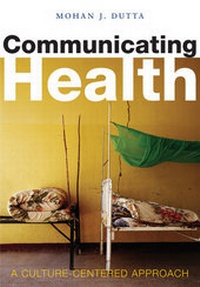
Communicating Health
Description

More details
Other editions
Additional editions
Person
Content
List of Tables
List of Boxes
Acknowledgements
Introduction
1 Culture in Health Communication
2 Culture-Centered Approach to Health Communication
3 Theoretical Approaches to the Study of Culture
4 Culture, Identity and Health
5 Pathways of Curing and Healing: Biomedical Model
6 Culture and Marginalization
7 Health Experiences in Marginalized Sectors
8 Culture, Social Capital and Health
9 Culture and Resistance
10 Health, Culture and Globalization
11 Culture and Praxis
Bibliography
Introduction
In recent years, the concept of culture has received increasing attention in health communication (Airhihenbuwa 1995; Brislin 1993; Dutta-Bergman 2004a, 2004b, 2005a, 2005b; Resnicow, Braithwaite, Dilorio, and Glanz 2002). The call to respond to the varied needs of multicultural societies is evident in the large amounts of funds available for multicultural interventions, and the growth in the number of multicultural health communication programs that seek to serve the needs of multicultural communities. These programs are being designed with the goals of being culturally sensitive, of responding to the diverse cultures in the global context, and of meeting a felt cultural need (Resnicow, Braithwaite, Dilorio and Glanz 2002). Furthermore, globalization processes have foregrounded the relevance of articulating the concept of culture in the context of health communication programs by questioning the universal narratives of healthcare embedded within the biomedical model (Airhihenbuwa 1995; Dutta-Bergman 2004a, 2004b, 2005a, 2005b; Dutta 2007; Dutta and Basu 2007; Dutta and Basnyat, in press). The locally situated nature of health communication processes has become particularly relevant in the context of a growing awareness of the diverse ways in which meanings of health and illness are constituted in diverse societies and cultures. As the grand narratives of health have been ruptured in the backdrop of an increasing realization that the biomedical model provides a limited viewpoint for engaging in issues of global health, there is also an increasing awareness of the need to open up the spaces of health communication to the voices of cultural communities.
Surveying the scope of the field, a new scholar might observe that health communication has become increasingly sensitized to the need to address these cultural shifts in the world. It might seem that the ways in which we traditionally conceptualize health and practice health communication have paved the way for a more humanizing approach by creating spaces for the discussion of cultures and for culture-specific health solutions. This book examines the response of health communication work to culture and suggests criteria for historically situating the study of culture in health communication. Its goal is to provide a historical overview of the ways in which culture has been used in health communication scholarship and to offer the culture-centered approach as an entry point for engaging with the culturally situated nature of health communication processes and meanings (Dutta-Bergman 2004a, 2004b). The historical overview of health communication scholarship using the concept of culture offers a trajectory for locating health communication scholarship and for comparing the various approaches to culture-based health communication (Dutta-Bergman 2005a; Dutta 2007). The culture-centered approach is juxtaposed in the backdrop of other approaches to culturally based health communication, demonstrating points of similarity and points of departure among these approaches. This comparison will ultimately equip the reader with both theoretical and methodological tools to examine the multicultural nature of the different approaches to health communication and to apply these tools in healthcare settings.
In discussing the culture-centered approach, the book suggests that the nature of how and what we communicate about health is embedded in our taken-for-granted assumptions about what it means to be healthy, what it means to be ill, and how we approach disease and illness. In suggesting this, the culture-centered approach is set up in opposition to the dominant approach of health communication, which represents the status quo and uses psychological cognitive theories to predict health attitudes and behaviors. The dominant approach is located within the biomedical model, with its focus on constructs and variables lent by this model, and with an emphasis on promoting and studying beliefs, attitudes, and behaviors within its framework. In the widely circulated biomedical model of health communication, health is treated as a universal concept based on Eurocentric understandings of health, disease and its treatment. Within this model, the way we come to see health is intrinsically built upon a Eurocentric ideology that privileges certain assumptions about health and downplays other approaches. The culture-centered approach locates this Eurocentric ideology by underlying the major approaches to health communication, and offers a criticism of the universal appeal of the dominant approaches that are built upon the culturally-situated Eurocentric notions of health and illness. The criticism of the Eurocentric ideology in health communication is based upon (a) criticism of the biomedical model that offers the foundation to much of the existing health communication scholarship (we will see this in greater detail in chapter 5), and (b) criticism of the basic premises of the health communication theories and applications that are widely circulated in the literature on cognitive behavioral principles (we will engage with these criticisms in chapters 1, 2 and 3). This criticism, both of the biomedical ideology underlying health practices and of the cognitive behavioral basis of health communication theorizing, offers openings for engaging culture in health communication scholarship in ways which are meaningful to the experiences of cultural communities hitherto marginalized; it also creates openings for alternative ways of knowing.
Therefore, in this book, the culture-centered approach is introduced as an alternative lens for understanding health communication. This approach is value-centered and is built on the notion that the various ways of understanding and negotiating the meanings of health are embedded within cultural contexts and the values deeply connected with them. Thus knowledge is embedded within value systems. These systems often remain hidden from the language of universal rationality in health communication scholarship; the culture-centered approach draws our attention to them. This approach questions the very values which underlie the universal logic of the biomedical model and of the cognitive-behavioral model, bringing out the hidden agendas embedded in the top-down frameworks underlying health communication and providing a critical entry point for interrogating them. As it does this, its emphasis is on looking at the erasure of the voice of those communities which have traditionally been rendered silent through treatment as subjects of health communication interventions doled out by the experts. Alternatively, the culture-centered approach proposes to build health communication theories and practices from the vantage point of cultural members, foregrounding their voices in the articulation of problems, the prioritization of problems, and the development of health solutions. The emphasis therefore is on creating opportunities for dialogue that bring out meanings of health articulated through the voices of cultural communities otherwise marginalized and silenced.
Ultimately, the goal of this book is to lay out the foundations for discussing the culture-centered approach and to create openings for its discussion in health communication. Chapter 1 introduces the reader to the concept of culture in health communication and provides a historical overview of the ways in which culture has been incorporated in health communication theory, research, and application. It examines the history of culture in health communication, studies the different models of health communication in the context of culture, compares the different strands of culture-based health communication work, and explores the applications of culture in health communication. Chapter 2 builds on the Introduction to discuss further the culture-centered approach to health communication by locating it in the backdrop of the dominant approach to health communication scholarship. After laying out the foundations and characteristics of the dominant approach to health communication, it explains the basic tenets of the culture-centered approach, which is followed by a discussion of its various applications in health communication theory, research, and practice. Chapter 3 examines and compares the theoretical foundations of the different approaches to the study of culture.
Chapter 4 offers a culture-centered overview of the relationship between culture, identity, and health. It suggests that this relationship is a complex and dynamic, so that the identities of cultural members play important roles in constituting health experiences of cultural members. Chapter 5 locates health and illness experiences in the different realms of healing and curing, thus making the dominant biomedical framework of healthcare into a culturally situated model and comparing it with other approaches to health and healing.
In chapter 6 we will engage with the topic of cultural marginalization and study the ways in which cultures are marginalized in health communication discourse and practices. More specifically, we will focus on what it means to be marginalized and on the kind of material and discursive conditions which create positions at the margins. We will further build on the topic of marginalization in chapter 7, to look at the health experiences of specific marginalized sectors. We will conclude the chapter by discussing marginalization in postcolonial and subaltern contexts.
Chapter 8 connects the culture-centered approach in health communication to the realm of the community. The emphasis on social capital examines the community-building and community-sustaining aspects...
