

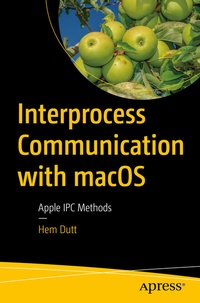
Interprocess Communication with macOS
Apple IPC Methods
Published on 28. May 2021
XVII, 284 pages
978-1-4842-7045-5 (ISBN)
Description

Build highly modular software in macOS that interacts deeply and intuitively with other programs. This book explores all techniques available for Inter-process communications (IPC) from high level macOS layers to deep kernel options while applying theoretical concepts into practical implementations on real world scenarios.
You'll see how IPC techniques are used for exchanging data and messages among multiple threads in one or more processes, which may be running on one or more computers connected by a network or running locally. IPC methods can be divided into methods for message passing, synchronization, shared memory, and remote procedure calls (RPC). A poorly conceived IPC can even expose an entire network to over-the-network attacks. Despite the risks, processes and applications absolutely need to communicate with each other across your system and the network. You'll see how these communications facilitate information sharing, computational speedup, modularity, convenience, and privilege separation.
In macOS, a program has a number of ways to communicate with other programs. These mechanisms for IPC often exist in different layers of the system. You'll examine how each has its own specific purposes, limitations, and intended scenarios. Some are more suitable than others for code written at a certain level of the system. For example, a kernel extension would not make use of Apple events.
Additionally, the book reveals that different users have different rights when it comes to accessing files, changing system wide settings, and so on, depending on whether they are admin users or ordinary users. Running code with root or administrative privileges can intensify the dangers posed by security vulnerabilities. You'll learn that to elevate privileges safely, it is mandatory for the application to perform the task through a secure Helper process.
What You'll Learn
Who This Book Is For
Software engineers and architects designing and developing secure applications for macOS and iOS who have hands-on knowledge of Swift with XCode.
You'll see how IPC techniques are used for exchanging data and messages among multiple threads in one or more processes, which may be running on one or more computers connected by a network or running locally. IPC methods can be divided into methods for message passing, synchronization, shared memory, and remote procedure calls (RPC). A poorly conceived IPC can even expose an entire network to over-the-network attacks. Despite the risks, processes and applications absolutely need to communicate with each other across your system and the network. You'll see how these communications facilitate information sharing, computational speedup, modularity, convenience, and privilege separation.
In macOS, a program has a number of ways to communicate with other programs. These mechanisms for IPC often exist in different layers of the system. You'll examine how each has its own specific purposes, limitations, and intended scenarios. Some are more suitable than others for code written at a certain level of the system. For example, a kernel extension would not make use of Apple events.
Additionally, the book reveals that different users have different rights when it comes to accessing files, changing system wide settings, and so on, depending on whether they are admin users or ordinary users. Running code with root or administrative privileges can intensify the dangers posed by security vulnerabilities. You'll learn that to elevate privileges safely, it is mandatory for the application to perform the task through a secure Helper process.
What You'll Learn
-
Expand the capabilities of your programs by sharing data within multiple applications
-
Understand and dig deep into the world of Helper tools to create apps that need user privilege elevation
-
Enhance the modularity of a system by allowing your applications to interact and share data with a website
Who This Book Is For
Software engineers and architects designing and developing secure applications for macOS and iOS who have hands-on knowledge of Swift with XCode.
More details
Series
Edition
1st ed.
Language
English
Place of publication
Berkeley
United States
Publishing group
APRESS
Target group
Professional and scholarly
Product notice
Reflowable
Illustrations
XVII, 284 p. 73 illus.
File size
5,75 MB
ISBN-13
978-1-4842-7045-5 (9781484270455)
DOI
10.1007/978-1-4842-7045-5
Schweitzer Classification
Other editions
Additional editions
Book
05/2021
APress
€64.19
Shipment within 15-20 days
Person
Hem Dutt
started his software engineering career in 2010 as a macOS (OS X) application developer and thereafter designed and developed numerous native macOS and iOS applications for various clients across the globe while working in multiple MNCs. With more than a continuous decade of experience working in macOS, Hem Dutt has developed applications in multiple domains; including healthcare, insurance, VPN clients, publishing, and IOT. His passion for designing and developing secure, reliable, and modular software is evident from his blogs, client awards/recommendations, and open source projects.
Content
Chapter 1 : Introduction to IPC on macOS.- Chapter 2 : IPC Through Shared Memory.- Chapter 3 : IPC Through Mach Ports.- Chapter 4 : IPC Through Sockets.- Chapter 5 : IPC Through Apple Events.- Chapter 6 : IPC Through Distributed Notifications.- Chapter 7 : IPC Through Pasteboards.- Chapter 8 : IPC Through XPC.- Chapter 9 : IPC Between a Native App and Web App.- Chapter 10 : Privilege Elevation.
