

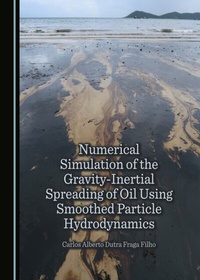
Numerical Simulation of the Gravity-Inertial Spreading of Oil Using Smoothed Particle Hydrodynamics
1st Edition
Published on 5. September 2024
187 pages
978-1-0364-0911-1 (ISBN)
Description

Oil spills at sea are a severe environmental concern. They can occur during the various stages of well-drilling, repair operations or transportation. The spreading of oil occurs due to the pollutant's tendency to flow over itself. Knowledge of its physical properties during the phenomenon, such as velocities and spatial positions, allows the timely adoption of environmental protection measures. This book presents, in a simple and objective way, the development and implementation of purely Lagrangian numerical modelling using the Smoothed Particle Hydrodynamics (SPH) method for the study of the spreading of oil in its first stage (gravity-inertial regime) on a calm sea. The computational code's implementation and validation were carried out through the simulation of classical problems in the scientific literature, i.e., heat diffusion in a homogeneous flat plate, a still volume of water inside an immobile reservoir and a dam failure. From the coupling of the software with a collision detection and response algorithm, numerical results in concordance with the curve adjusted by James Fay (a pioneering scientist in the study of oil spills) for the prediction of oil slick diameters at the end of the gravity-inertial regime were achieved.
More details
Other editions
Additional editions
Carlos Alberto Dutra Fraga Filho
Numerical Simulation of the Gravity-Inertial Spreading of Oil Using Smoothed Particle Hydrodynamics
Book
09/2024
Cambridge Scholars Publishing
€100.46
Shipment within 15-20 days
Content
- Intro
- Contents
- List of Figures
- List of Tables
- List of Symbols and Abbreviations
- Preface
- Chapter 1
- 1.1 Motivation
- 1.2 Brief Considerations on the Scientific Method
- 1.3 Numerical Methods
- 1.4 Eulerian Approach
- 1.4.1 Fay's Spreading Model
- 1.4.1.1 Physical Analysis of the Forces
- 1.4.1.2 Physical-Mathematical Modelling
- 1.4.1.3 Revised Fay's Spreading Model
- 1.4.2 Blokker's Spreading Model
- 1.5 Lagrangian Approach
- 1.6 Hybrid Models
- 1.7 Purely Lagrangian Smoothed Particle Hydrodynamics Method
- 1.8 Final Considerations about the Modelling of Spreading of Oil
- 1.9 Presentation of the Remaining Chapters
- References
- Chapter 2
- 2.1 The Continuum Hypothesis
- 2.2 Mathematical Fundamentals
- 2.2.1 Approximation of the Divergent of a Vectorial Function
- 2.2.2 Approximation of the Gradient of a Scalar Function
- 2.2.3 Approximation of the Laplacian of a Scalar Function
- 2.2.4 Errors in SPH Approximations
- 2.2.5 Smoothing Functions
- 2.3 Conservation Equations and SPH Approximations
- 2.3.1 Physical Conservation Equations
- 2.3.1.1 Pressure Modelling
- 2.3.1.2 Specific Internal Energy
- 2.3.2 SPH Approximations for the Conservation Equations
- 2.3.2.1 Mass Conservation
- 2.3.2.2 Momentum Conservation
- 2.4 Search for Neighbouring Particles
- 2.5 Treatment of the Free Surfaces
- 2.5.1 Continuum Surface Force Method
- 2.5.2 Free Surface Identification Using a Parameter
- 2.5.3 Surface Particle Tracking Using the Divergence of the Particles' Positions
- 2.6 Contact Algorithm for Interface Treatment
- 2.6.1 Inter-Particle Collisions Considerations in SPH Simulations
- 2.7 Turbulence
- 2.8 Diffusive Terms in SPH Approximation for the Momentum Conservation Equation
- 2.9 Temporal Integration
- 2.9.1 Euler Integration Scheme (First Order Runge-Kutta)
- 2.9.2 Leap-Frog Integrator
- 2.9.3 Predictor-Corrector Method
- 2.9.4 Simulation Time Step
- 2.9.4.1 Variable Time Step
- 2.10 Consistency
- 2.10.1 Restoration of the Consistency
- 2.10.1.1 Corrective Smoothed Particle Method (CSPM)
- 2.10.1.2 Mean Least Squares (MLS) Method
- 2.10.1.3 Kernel Gradient Correction Method
- 2.11 Numerical Aspects
- 2.11.1 Support Radius Length (Smoothing Length Update)
- 2.11.2 Numerical Corrections
- 2.11.2.1 Artificial Viscosity
- 2.11.2.2 XSPH Correction
- 2.11.2.3 Tensile Instability
- 2.12 Initial and Boundary Conditions
- 2.12.1 Repulsive Boundary Conditions
- 2.12.2 Dynamic Boundary Conditions
- 2.12.3 Semi-analytical Boundary Conditions
- 2.12.4 Reflective Boundary Conditions
- 2.12.4.1 Algorithmic Methodology
- 2.12.4.2 Newton's Restitution Law and Friction
- 2.12.4.3 Collision Response
- 2.12.5 Periodic Open Boundary Conditions
- 2.13 Numerical Code
- References
- Chapter 3
- 3.1 Heat Diffusion in a Homogeneous Flat Plate
- 3.1.1 Computational Domain and Particle Discretisation
- 3.1.2 Initial Conditions, Boundary Conditions and Simulation Parameters
- 3.1.3 Results and Discussions
- 3.2 Still Liquid inside an Immobile Reservoir
- 3.2.1 Computational Domain and Particle Discretisation
- 3.2.2 Initial and Boundary Conditions
- 3.2.3 Implementation of Boundary Treatment Using Virtual Particles
- 3.2.3.1 Results and Discussions
- 3.2.4 Reflective Boundary Treatment
- 3.2.4.1 Results and Discussions
- 3.3 Dam-Breaking Over a Dry Bed
- 3.3.1 Computational Domain and Particle Discretisation
- 3.3.2 Initial Conditions, Boundary Conditions and Simulation Parameters
- 3.3.3 Results and Discussions
- References
- Chapter 4
- 4.1 Introduction
- 4.2 Simulated Geometry, Initial Conditions and Boundary Conditions
- 4.2.1 Interface Treatment
- 4.3 Results and Discussion
- 4.4 Final Remarks
- References
- Chapter 5
- Appendix
- Index
