

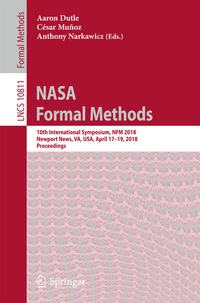
NASA Formal Methods
10th International Symposium, NFM 2018, Newport News, VA, USA, April 17-19, 2018, Proceedings
Published on 6. April 2018
XI, 470 pages
978-3-319-77935-5 (ISBN)
Description

This book constitutes the proceedings of the 10th International Symposium on NASA Formal Methods, NFM 2018, held in Newport News, VA, USA, in April 2018.
The 24 full and 7 short papers presented in this volume were carefully reviewed and selected from 92 submissions. The papers focus on formal techniques and other approaches for software assurance, their theory, current capabilities and limitations, as well as their potential application to aerospace, robotics, and other NASA-relevant safety-critical systems during all stages of the software life-cycle.
The 24 full and 7 short papers presented in this volume were carefully reviewed and selected from 92 submissions. The papers focus on formal techniques and other approaches for software assurance, their theory, current capabilities and limitations, as well as their potential application to aerospace, robotics, and other NASA-relevant safety-critical systems during all stages of the software life-cycle.
More details
Series
Edition
1st ed. 2018
Language
English
Place of publication
Cham
Switzerland
Publishing group
Springer International Publishing
Target group
Professional and scholarly
Product notice
Reflowable
Illustrations
XI, 470 p. 156 illus.
File size
25,65 MB
ISBN-13
978-3-319-77935-5 (9783319779355)
DOI
10.1007/978-3-319-77935-5
Schweitzer Classification
Other editions
Additional editions
Aaron Dutle | César Muñoz | Anthony Narkawicz
NASA Formal Methods
10th International Symposium, NFM 2018, Newport News, VA, USA, April 17-19, 2018, Proceedings
Book
03/2018
Springer
€53.49
Shipment within 10-15 days
Content
- Intro
- Preface
- Organization
- Contents
- Incremental Construction of Realizable Choreographies
- 1 Introduction
- 2 Background and Notations
- 2.1 Model
- 2.2 Realizability
- 3 CCP Language for Realisable CPs
- 3.1 Composition Operators
- 3.2 Realizable-by-Construction CP
- 4 CCP Model: Refinement-Based Realizability
- 4.1 The Refinement Strategy
- 4.2 The Root Model
- 4.3 First Refinement: Synchronous Model
- 4.4 Second Refinement: Asynchronous Model
- 4.5 Instantiation and Axiom Validation
- 4.6 Assessment
- 5 Related Work
- 6 Conclusion
- References
- Formal Assurance for Cooperative Intelligent Autonomous Agents
- 1 Introduction
- 2 Related Work
- 3 Modeling and Formal Verification
- 3.1 Cognitive Architectures and Frameworks: Soar
- 3.2 Formal Languages and Verification: Uppaal
- 4 Example Case Study: Engine Out Contingency During Takeoff
- 5 Automated Translation from Cognitive Architecture to Formal Environment
- 5.1 Automated Translation to Uppaal
- 5.2 Translation Implementation
- 6 Verification and Validation Efforts
- 6.1 Simulation Efforts for Validation of the Autonomous Pilot Agent
- 6.2 Formal Verification of the Autonomous Pilot Agent
- 7 Conclusion and Future Work
- References
- Ghosts for Lists: A Critical Module of Contiki Verified in Frama-C
- 1 Introduction
- 2 The List Module of Contiki
- 3 The Verification Approach
- 3.1 Running Example
- 3.2 List Representation by a Companion Ghost Array
- 3.3 Formal Specification
- 3.4 Ghost Functions
- 3.5 Auxiliary Lemmas and Proofs
- 3.6 Results of the Verification
- 3.7 Validation of Specification
- 4 Related Work
- 5 Conclusion and Future Work
- References
- An Executable Formal Framework for Safety-Critical Human Multitasking
- 1 Introduction
- 2 Preliminaries
- 3 A Formal Model of Human Multitasking
- 3.1 Classes
- 3.2 Dynamic Behavior
- 4 Analyzing Safety-Critical Human Multitasking
- 5 Example: Interacting with a GPS Device While Driving
- 6 Related Work
- 7 Concluding Remarks
- References
- Simpler Specifications and Easier Proofs of Distributed Algorithms Using History Variables
- 1 Introduction
- 2 Specifications Using Message History Variables
- 3 Invariants and Proofs Using Message History Variables
- 4 Multi-Paxos
- 5 Results
- 6 Related Work and Conclusion
- References
- Don't Miss the End: Preventing Unsafe End-of-File Comparisons
- 1 Introduction
- 2 Type System
- 2.1 Type Qualifiers and Qualifier Hierarchy
- 2.2 Type Casting Rules
- 2.3 Default Qualifiers
- 2.4 Data-Flow-Sensitive Type Refinement
- 3 Implementation
- 4 Experiments
- 5 Related Work
- 6 Conclusions
- References
- An Efficient Rewriting Framework for Trace Coverage of Symmetric Systems
- 1 Introduction
- 2 Related Work
- 3 Preliminaries
- 4 Strategy Overview
- 4.1 Rewriting Systems
- 4.2 Abstraction and Coverage Model
- 5 Conservative Abstraction
- 5.1 Abstractable Composed-Systems
- 5.2 Trace Abstraction
- 5.3 Abstract Trace Rewriting
- 5.4 Coverage Holes
- 6 Experiments
- 6.1 The MIST Protocol
- 6.2 Model Viability
- 6.3 Effectiveness
- 6.4 Monitor-Centric Experiments
- 6.5 Experiments on a Large-Scale Verification Environment
- 7 Conclusion
- References
- Verification of Fault-Tolerant Protocols with Sally
- 1 Introduction
- 2 Sally
- 3 Modeling Fault-Tolerant Protocols
- 3.1 Approximate Agreement
- 3.2 Verification Results
- 4 Related Work
- 5 Conclusion
- References
- Output Range Analysis for Deep Feedforward Neural Networks
- 1 Introduction
- 2 Preliminaries
- 2.1 Mixed Integer Linear Programs
- 3 Problem Definition and MILP Encoding
- 3.1 MILP Encoding
- 4 Combining MILP Solvers with Local Search
- 4.1 Overall Approach
- 4.2 Local Search Improvement
- 5 Application: Reachability Analysis
- 6 Experimental Evaluation
- 7 Conclusion
- References
- Formal Dynamic Fault Trees Analysis Using an Integration of Theorem Proving and Model Checking
- 1 Introduction
- 2 Related Work
- 3 Proposed Methodology
- 4 Formalization of Dynamic Fault Trees in HOL
- 4.1 Identity Elements
- 4.2 Temporal Operators
- 4.3 Fault Tree Gates
- 4.4 Formal Verification of the Simplification Theorems
- 5 Experimental Results
- 5.1 Formal Verification of the Reduced Cascaded PAND DFT
- 5.2 Quantitative Analysis Results Using STORM
- 6 Conclusion
- References
- Twenty Percent and a Few Days - Optimising a Bitcoin Majority Attack
- 1 Introduction
- 2 The Bitcoin Protocol
- 3 Model and Strategies
- 4 Analysis
- 5 Conclusion
- References
- An Even Better Approach - Improving the B.A.T.M.A.N. Protocol Through Formal Modelling and Analysis
- 1 Introduction
- 2 The B.A.T.M.A.N. Protocol
- 2.1 Literal Model
- 2.2 Alternative Model
- 3 Uppaal Model
- 4 Simulation Results
- 5 Conclusion
- References
- Towards a Formal Safety Framework for Trajectories
- 1 Introduction
- 2 The Framework
- 3 Trajectory Validation Strategy
- 4 Conclusion and Future Work
- References
- Static Value Analysis of Python Programs by Abstract Interpretation
- 1 Introduction
- 2 The Mini-Python Language
- 2.1 Syntax
- 2.2 Concrete Collecting Semantics
- 3 Value Abstraction
- 3.1 Non-relational Abstraction
- 3.2 Relational Abstraction
- 4 Generator Analysis
- 4.1 Concrete Semantics
- 4.2 Abstractions
- 5 Experimental Evaluation
- 6 Related Work
- 7 Conclusion
- References
- Model-Based Testing for General Stochastic Time
- 1 Introduction
- 2 Background
- 3 Stochastic Testing Theory
- 3.1 Test Cases
- 3.2 Stochastic Input-Output Conformance and Annotations
- 3.3 Test Execution and Sampling
- 3.4 Test Evaluation and Correctness
- 4 Implementing Stochastic Testing
- 4.1 Goodness of Fit
- 4.2 Algorithm Outline
- 5 Experiments
- 6 Conclusion
- References
- Strategy Synthesis for Autonomous Agents Using PRISM
- 1 Introduction
- 2 Background
- 3 Scenarios
- 4 Conclusions and Future Work
- References
- The Use of Automated Theory Formation in Support of Hazard Analysis
- 1 Introduction
- 2 Background
- 3 Experiments with a Simple Design Model
- 3.1 Applying HR to the Laser Control System
- 3.2 Discovering Properties in Support of Hazard Analysis
- 3.3 Breaking Properties
- 4 Future Work and Conclusion
- References
- Distributed Model Checking Using ProB
- 1 Introduction
- 1.1 B and ProB
- 2 Architecture Overview
- 3 Implementation
- 3.1 Socket Patterns and Messages
- 3.2 When is a Model Suitable for Distributed Model Checking?
- 3.3 Passing States to C
- 3.4 Visited States
- 3.5 Work Sharing
- 3.6 Proxy
- 3.7 Bandwidth Reduction
- 4 Evaluation
- 5 Related Work
- 6 Conclusion and Future Work
- References
- Optimal Storage of Combinatorial State Spaces
- 1 Introduction
- 2 An Information Theoretical Lower Bound
- 3 An Analysis of Binary Tree Compression
- 4 A Novel Compact Tree
- 5 Experiments
- 6 Discussion and Conclusion
- References
- Stubborn Transaction Reduction
- 1 Introduction
- 2 Preliminaries
- 3 Stubborn Transaction Reduction
- 3.1 Parametrized Stubborn Sets
- 3.2 Reduced Transaction Systems
- 4 Comparison Between TR and POR
- 5 Experiments
- 6 Related Work
- 7 Conclusion
- References
- Certified Foata Normalization for Generalized Traces
- 1 Introduction
- 2 Traces, Foata Normal Forms and Normalization
- 3 Formalization
- 3.1 Traces
- 3.2 Normal Forms
- 3.3 Normalization
- 3.4 Properties
- 4 Example: Local Reads in TSO
- 5 Related Work
- 6 Conclusion and Future Work
- References
- On the Timed Analysis of Big-Data Applications
- 1 Introduction
- 2 Background
- 2.1 Apache Spark Framework
- 2.2 Constraint LTL over-clocks
- 3 Modeling Spark Applications
- 4 Implementation and Validation of the Model
- 5 Related Works
- 6 Conclusion
- References
- Tuning Permissiveness of Active Safety Monitors for Autonomous Systems
- 1 Introduction
- 2 Related Work
- 3 Baseline and Concepts
- 3.1 Safety Invariants, Margins and States
- 3.2 Safety and Permissiveness Properties
- 3.3 SMOF Tooling
- 3.4 On Tuning Permissiveness Properties
- 4 Defining Custom Permissiveness Properties
- 4.1 A Formal Model for the Permissiveness
- 4.2 Binding Together Invariants and Permissiveness
- 4.3 Restricting Functionalities
- 4.4 Integration in SMOF Tooling
- 5 Application to an Example
- 5.1 SI1: The Arm Must Not Be Extended when the Platform Moves over a Certain Speed
- 5.2 SI2: A Gripped Box Must Not Be Tilted More Than 0
- 5.3 SI3: The Robot Must Not Enter a Prohibited Zone
- 6 Conclusion and Perspectives
- References
- Sound Black-Box Checking in the LearnLib
- 1 Introduction
- 2 Preliminaries
- 2.1 LTL Model Checking
- 2.2 Active Learning
- 2.3 Black-Box Checking
- 3 Sound Black-Box Checking
- 3.1 Validating Lassos with State Equivalence
- 3.2 Implementation in the LearnLib
- 4 Related Work
- 5 Results
- 6 Conclusion
- References
- Model-Checking Task Parallel Programs for Data-Race
- 1 Introduction
- 2 Example
- 3 Task Parallel Programs
- 3.1 Computation Graphs
- 3.2 Programming Model
- 4 Proof of Correctness
- 5 Implementation and Results
- 6 Related Work
- 7 Conclusion and Future Work
- References
- Consistency of Property Specification Patterns with Boolean and Constrained Numerical Signals
- 1 Introduction
- 2 Background and Related Work
- 3 Constraint Property Specification Patterns
- 4 Analysis with Probabilistic Requirement Generation
- 5 Analysis with a Controller for a Robotic Manipulator
- 6 Conclusions
- References
- Automatic Generation of DO-178 Test Procedures
- 1 Introduction
- 2 Industrial Context
- 2.1 Running HLR Example
- 2.2 Software Test Standards
- 2.3 Running Example: TCs for Req1
- 2.4 Running Example: TP Implementation for Req1
- 3 Liebherr Test Specification Language
- 3.1 Syntax
- 3.2 Semantics
- 3.3 Running Example: Req1 TCs Expressed in LTSL
- 4 SCADE Observers Generation
- 4.1 SCADE Automata Syntax
- 4.2 Translation Function
- 5 Illustration of the Approach
- 6 Related Work
- 7 Conclusion
- References
- Using Test Ranges to Improve Symbolic Execution
- 1 Introduction
- 2 The SynergiSE Approach
- 2.1 Traditional Ranges
- 2.2 SynergiSE with Feasible Range
- 2.3 SynergiSE with Unexplored Range
- 3 Evaluation
- 3.1 Implementation and Subjects
- 3.2 SynergiSE with Feasible Ranges
- 3.3 SynergiSE for Integrating Test Generation Tools
- 3.4 SynergiSE for Sharing Constraint Solving Results Among Workers
- 4 Related Work
- 5 Conclusion
- References
- Symbolic Execution and Reachability Analysis Using Rewriting Modulo SMT for Spatial Concurrent Constraint Systems with Extrusion
- 1 Introduction
- 2 Preliminaries
- 3 Spatial Concurrent Constraint Systems with Extrusion
- 4 Symbolic Rewriting Logic Semantics
- 4.1 The Constraint System
- 4.2 System States
- 4.3 System Transitions
- 4.4 Admissibility
- 5 Symbolic Reachability Analysis
- 5.1 Fault-Tolerance and Consistency
- 5.2 Knowledge Inference
- 5.3 Same Knowledge
- 6 Related Work and Concluding Remarks
- References
- Experience Report: Application of Falsification Methods on the UxAS System
- 1 Introduction
- 2 Problem Statement
- 3 Test Generation for UxAS
- 3.1 Case-Study
- 4 Conclusion and Future Work
- References
- MoDeS3: Model-Based Demonstrator for Smart and Safe Cyber-Physical Systems
- 1 Introduction
- 2 Design- and Runtime Assurance
- 2.1 Design-Time Formal V&V of Timing Properties
- 2.2 System-Level Runtime Monitoring
- 3 Smart IoT Technologies
- 4 MoDeS3 in Education
- 5 Project Timeline and Conclusion
- References
- Author Index
