

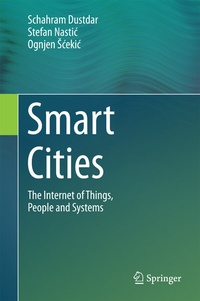
Smart Cities
The Internet of Things, People and Systems
Published on 28. May 2017
XV, 268 pages
978-3-319-60030-7 (ISBN)
Description

This book presents a coherent, novel vision of Smart Cities, built around a value-driven architecture. It describes the limitations of the contemporary notion of the Smart City and argues that the next developmental step must actively include not only the physical infrastructure, but information technology and human infrastructure as well, requiring the intensive integration of technical solutions from the Internet of Things (IoT) and social computing.
The book is divided into five major parts, the first of which provides both a general introduction and a coherent vision that ties together all the components that are required to realize the vision for Smart Cities. Part II then discusses the provisioning and governance of Smart City systems and infrastructures. In turn, Part III addresses the core technologies and technological enablers for managing the social component of the Smart City platform. Both parts combine state-of-the-art research with cutting-edge industrial efforts in the respective fields. Lastly, Part IV details a road map to achieving Cyber-Human Smart Cities. Rounding out the coverage, it discusses the concrete technological advances needed to move beyond contemporary Smart Cities and toward the Smart Cities of the future.
Overall, the book provides an essential overview of the latest developments in the areas of IoT and social computing research, and outlines a research roadmap for a closer integration of the two areas in the context of the Smart City. As such, it offers a valuable resource for researchers and graduate students alike.
The book is divided into five major parts, the first of which provides both a general introduction and a coherent vision that ties together all the components that are required to realize the vision for Smart Cities. Part II then discusses the provisioning and governance of Smart City systems and infrastructures. In turn, Part III addresses the core technologies and technological enablers for managing the social component of the Smart City platform. Both parts combine state-of-the-art research with cutting-edge industrial efforts in the respective fields. Lastly, Part IV details a road map to achieving Cyber-Human Smart Cities. Rounding out the coverage, it discusses the concrete technological advances needed to move beyond contemporary Smart Cities and toward the Smart Cities of the future.
Overall, the book provides an essential overview of the latest developments in the areas of IoT and social computing research, and outlines a research roadmap for a closer integration of the two areas in the context of the Smart City. As such, it offers a valuable resource for researchers and graduate students alike.
More details
Series
Edition
1st ed. 2017
Language
English
Place of publication
Cham
Switzerland
Publishing group
Springer International Publishing
Target group
Professional and scholarly
Illustrations
XV, 268 p. 78 illus., 40 illus. in color.
File size
9,89 MB
ISBN-13
978-3-319-60030-7 (9783319600307)
DOI
10.1007/978-3-319-60030-7
Schweitzer Classification
Other editions
Additional editions
Schahram Dustdar | Stefan Nastic | Ognjen Scekic
Smart Cities
The Internet of Things, People and Systems
Book
06/2017
Springer
€181.89
Shipment within 10-15 days
Persons
Schahram Dustdar
is Full Professor of Computer Science and head of the Distributed Systems Group at the TU Wien, Austria. He is an Associate Editor of IEEE Transactions on Services Computing, ACM Transactions on the Web, and ACM Transactions on Internet Technology and on the editorial board of IEEE Internet Computing and IEEE Computer; and Editor-in-Chief of Computing (Springer). He is recipient of the ACM Distinguished Scientist award (2009), the IBM Faculty Award (2012), a member of the Academia Europaea: The Academy of Europe, and an IEEE Fellow (2016).
Stefan Nastic is a postdoctoral researcher at the Distributed Systems Group, TU Wien. His research interests include Smart City Governance, Internet of Things/Cyber-Physical Systems and Cloud Computing. Currently he is working on SMART-FI, which is EU ERA-NET funded project, with the main focus on developing a comprehensive Smart City platform.
Ognjen Scekic is a researcher at the Distributed Systems Group, TU Wien, where he has obtained his PhD in the area of socio-technical systems, with particular focus on incentive management and programming models for human-based services. His research interests include distributed and parallel computing, and hybrid collective adaptive systems (hCAS).
Stefan Nastic is a postdoctoral researcher at the Distributed Systems Group, TU Wien. His research interests include Smart City Governance, Internet of Things/Cyber-Physical Systems and Cloud Computing. Currently he is working on SMART-FI, which is EU ERA-NET funded project, with the main focus on developing a comprehensive Smart City platform.
Ognjen Scekic is a researcher at the Distributed Systems Group, TU Wien, where he has obtained his PhD in the area of socio-technical systems, with particular focus on incentive management and programming models for human-based services. His research interests include distributed and parallel computing, and hybrid collective adaptive systems (hCAS).
Content
1 Introduction to Smart Cities and a Vision of Cyber-Human Cities.- 2 State Of The Art & Related Work.- 3 Provisioning Smart City Infrastructure.- 4 Middleware for Utility-based Provisioning of Smart City Infrastructure.- 5 Governing Smart City Systems.- 6 State of the Art & Related Work.- 7 Programmatic Management of Human Coordination and Collaboration Activities.- 8 Incentive Management.- 9 A Road Map to the Cyber-Human Smart City.
