

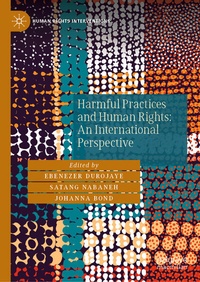
Harmful Practices and Human Rights: An International Perspective
Description

Harmful Practices and Human Rights examines different forms of harmful practices, globally, which constitute human rights violations as guaranteed in international and regional human rights instruments. Drawing examples from Africa, Asia, North America, Europe, and Australasia, it demonstrates how these practices undermine the right to health, including sexual and reproductive health, and also impugn the dignity and autonomy of women and girls. Using diverse harmful practices as case studies, the book critically examines the factors that drive harmful practices in developing and developed countries. Specifically, this book focuses on a selection of harmful practices-including dowry payments, ukuthwala , intimate partner violence, harmful tobacco use and its gendered implications, trafficking in persons, widowhood practices, the chinamwari/khomba practice, and child marriage-from both the Global South and North. Its intent is to demonstrate the prevalence of these abuses and underscore the urgent need for states to take decisive steps toward eradication.
More details
Other editions
Additional editions
Persons
Ebenezer Durojaye is Professor of Law, Centre for Human Rights, University of Pretoria, South Africa. He has published extensively in his areas of research and he is the co-editor of the book COVID-19 and the Right to Health in Africa.
Satang Nabaneh is Assistant Professor of Practice and Director of Programs at the University of Dayton Human Rights Center, USA. She is also Global Fellow at CMI-UiB Centre on Law & Social Transformation, Bergen, Norway.
Johanna Bond is Dean and Professor of Law at Rutgers Law School, The State University of New Jersey, USA. Her scholarship focuses on women's human rights, the United Nations human rights treaty system, and feminist legal theory.
Content
Chapter 1: Harmful practices as a human rights challenge.- Chapter 2: International and regional norms on harmful practices.- Chapter 3: Widowhood practices and human rights in Nigeria.- Chapter 4: Beyond the legal debates: An African legal feminist response to support victims of ukuthwala in South Africa.- Chapter 5: Cultural relativism versus universalism: a critical analysis of the chinamwari/khomba practice in Zimbabwe.- Chapter 6: The conundrum of exchange of bride wealth in customary marriages: is it a harmful practice?.- Chapter 7: Tobacco-related harms & gender: An overview with perspectives from India.- Chapter 8: Child marriage in the United States: A human rights and feminist perspective.- Chapter 9: Intimate partner violence, gender vulnerability and the realisation of women's fundamental rights in Australia.- Chapter 10: The protection of human trafficking victims in the UK: The role of the Palermo Protocol and state obligations in the international law.- Chapter 11: An African feminist analysis of the impact of menstrual taboos in Abrahamic religions on women and girls in Africa.- Chapter 12: Punishing pregnant students through expulsion from school: A case study of Uganda.- Chapter 13: Engaging harmful traditional practices from a supranational perspective: Reflections from the African Committee of Experts on the Rights and Welfare of the Child.- Chapter 14: Cultivating agency and claiming bodily autonomy: A response to the politics of child marriage in the African context.
