

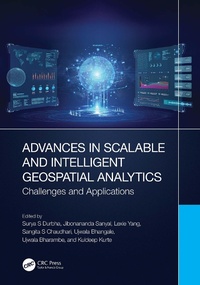
Advances in Scalable and Intelligent Geospatial Analytics
Challenges and Applications
1st Edition
Published on 12. May 2023
421 pages
978-1-000-87754-0 (ISBN)
Description

Geospatial data acquisition and analysis techniques have experienced tremendous growth in the last few years, providing an opportunity to solve previously unsolved environmental- and natural resource-related problems. However, a variety of challenges are encountered in processing the highly voluminous geospatial data in a scalable and efficient manner. Technological advancements in high-performance computing, computer vision, and big data analytics are enabling the processing of big geospatial data in an efficient and timely manner. Many geospatial communities have already adopted these techniques in multidisciplinary geospatial applications around the world. This book is a single source that offers a comprehensive overview of the state of the art and future developments in this domain.
FEATURES
Demonstrates the recent advances in geospatial analytics tools, technologies, and algorithms
Provides insight and direction to the geospatial community regarding the future trends in scalable and intelligent geospatial analytics
Exhibits recent geospatial applications and demonstrates innovative ways to use big geospatial data to address various domain-specific, real-world problems
Recognizes the analytical and computational challenges posed and opportunities provided by the increased volume, velocity, and veracity of geospatial data
This book is beneficial to graduate and postgraduate students, academicians, research scholars, working professionals, industry experts, and government research agencies working in the geospatial domain, where GIS and remote sensing are used for a variety of purposes. Readers will gain insights into the emerging trends on scalable geospatial data analytics.
FEATURES
Demonstrates the recent advances in geospatial analytics tools, technologies, and algorithms
Provides insight and direction to the geospatial community regarding the future trends in scalable and intelligent geospatial analytics
Exhibits recent geospatial applications and demonstrates innovative ways to use big geospatial data to address various domain-specific, real-world problems
Recognizes the analytical and computational challenges posed and opportunities provided by the increased volume, velocity, and veracity of geospatial data
This book is beneficial to graduate and postgraduate students, academicians, research scholars, working professionals, industry experts, and government research agencies working in the geospatial domain, where GIS and remote sensing are used for a variety of purposes. Readers will gain insights into the emerging trends on scalable geospatial data analytics.
More details
Edition
1. Auflage
Language
English
Place of publication
London
United Kingdom
Publishing group
Taylor & Francis Ltd
Target group
College/higher education
Professional and scholarly
Product notice
Reflowable
Illustrations
35 Tables, black and white; 15 Line drawings, color; 58 Line drawings, black and white; 84 Halftones, color; 19 Halftones, black and white; 99 Illustrations, color; 77 Illustrations, black and white
ISBN-13
978-1-000-87754-0 (9781000877540)
Copyright in bibliographic data and cover images is held by Nielsen Book Services Limited or by the publishers or by their respective licensors: all rights reserved.
Schweitzer Classification
Other editions
Additional editions
Surya S. Durbha | Jibonananda Sanyal | Lexie Yang
Advances in Scalable and Intelligent Geospatial Analytics
Challenges and Applications
Book
04/2025
1st Edition
CRC Press
€106.20
Shipment within 10-20 days
Surya S. Durbha | Jibonananda Sanyal | Lexie Yang
Advances in Scalable and Intelligent Geospatial Analytics
Challenges and Applications
Book
05/2023
1st Edition
CRC Press
€226.40
Shipment within 10-20 days
Persons
Dr. Surya Durbha is a Professor at CSRE, Indian Institute of Technology Bombay (IITB). Before joining IITB, he held an adjunct faculty position in the Electrical and Computer Engineering Department at Mississippi State University. He has published over 80 peer reviewed articles and has written a book on the Internet of Things published by Oxford University Press in March 2021.
Dr. Jibonananda Sanyal serves as the Group Leader for Oak Ridge National Laboratory's Computational Urban Sciences research group. He is an IEEE Senior Member, an ACM Distinguished Speaker, and a 2017 Knoxville's 40 under 40 honoree.
Dr. Lexie Yang is a lead research scientist in the GeoAI Group at Oak Ridge National Laboratory. She leads several AI-enabled geoscience data analytics projects with large-scale multi-modality geospatial data. The recent work from her team has been widely used to support national-scale disaster assessment and management by federal and local agencies.
Dr. Sangita S. Chaudhari is a Professor in the Department of Computer Engineering, Ramrao Adik Institute of Technology Nerul, Navi Mumbai, India. She is vice chair of IEEE GRSS Mumbai Chapter and has published several journal articles and book chapters.
Dr. Ujwala Bhangale is an Associate Professor in the Department of Information Technology, at K.J. Somaiya College of Engineering, Somaiya Vidyavihar University, Mumbai, India. She has published several papers in IEEE/ACM publications.
Dr. Ujwala Bharambe is an Assistant Professor in the Department of Computer Engineering, at Thadomal Shahani Engineering College, Mumbai, India. She has published several papers in IEEE/ACM publications.
Dr. Kuldeep Kurte is a research scientist in the Computational Urban Sciences Group (CUSG) at Oak Ridge National Laboratory. He has experience working on various applications on different HPC platforms from NVIDIA Jetson Tk1 to the Summit supercomputer.
Dr. Jibonananda Sanyal serves as the Group Leader for Oak Ridge National Laboratory's Computational Urban Sciences research group. He is an IEEE Senior Member, an ACM Distinguished Speaker, and a 2017 Knoxville's 40 under 40 honoree.
Dr. Lexie Yang is a lead research scientist in the GeoAI Group at Oak Ridge National Laboratory. She leads several AI-enabled geoscience data analytics projects with large-scale multi-modality geospatial data. The recent work from her team has been widely used to support national-scale disaster assessment and management by federal and local agencies.
Dr. Sangita S. Chaudhari is a Professor in the Department of Computer Engineering, Ramrao Adik Institute of Technology Nerul, Navi Mumbai, India. She is vice chair of IEEE GRSS Mumbai Chapter and has published several journal articles and book chapters.
Dr. Ujwala Bhangale is an Associate Professor in the Department of Information Technology, at K.J. Somaiya College of Engineering, Somaiya Vidyavihar University, Mumbai, India. She has published several papers in IEEE/ACM publications.
Dr. Ujwala Bharambe is an Assistant Professor in the Department of Computer Engineering, at Thadomal Shahani Engineering College, Mumbai, India. She has published several papers in IEEE/ACM publications.
Dr. Kuldeep Kurte is a research scientist in the Computational Urban Sciences Group (CUSG) at Oak Ridge National Laboratory. He has experience working on various applications on different HPC platforms from NVIDIA Jetson Tk1 to the Summit supercomputer.
Content
Section I: Introduction to Geospatial Analytics. 1. Geospatial Technology - Developments, Present Scenario and Research Challenges. Section II: Geo-Ai. 2. Perspectives on Geospatial Artificial Intelligence Platforms for Multimodal Spatiotemporal Datasets. 3. Temporal Dynamics of Place and Mobility. 4. Geospatial Knowledge Graph Construction Workflow for Semantics-Enabled Remote Sensing Scene Understanding. 5. Geosemantic Standards-Driven Intelligent Information Retrieval Framework for 3D LiDAR Point Clouds. 6. Geospatial Analytics Using Natural Language Processing. Section III: Scalable Geospatial Analytics. 7. A Scalable Automated Satellite Data Downloading and Processing Pipeline Developed on AWS Cloud for Agricultural Applications. 8. Providing Geospatial Intelligence through a Scalable Imagery Pipeline. 9. Distributed Deep Learning and Its Application in Geo-spatial Analytics. 10. High-Performance Computing for Processing Big Geospatial Disaster Data. Section IV: Geovisualization: Innovative Approaches for Geovisualization and Geovisual Analytics for Big Geospatial Data. 11. Dashboard for Earth Observation. 12. Visual Exploration of LiDAR Point Clouds. Section V: Other Advances in Geospatial Domain. 13. Toward a Smart Metaverse City: Immersive Realism and 3D Visualization of Digital Twin Cities. 14. Current UAS Capabilities for Geospatial Spectral Solutions. 15. Flood Mapping and Damage Assessment Using Sentinel - 1 & 2 in Google Earth Engine of Port Berge & Mampikony Districts, Sophia Region, Madagascar. Section VI: Case Studies from the Geospatial Domain. 16. Fuzzy-Based Meta-Heuristic and Bi-Variate Geo-Statistical Modelling for Spatial Prediction of Landslides. 17. Understanding the Dynamics of the City through Crowdsourced Datasets: A Case Study of Indore City. 18. A Hybrid Model for the Prediction of Land Use/Land Cover Pattern in Kurunegala City, Sri Lanka. 19. Spatio-Temporal Dynamics of Tropical Deciduous Forests under Climate Change Scenarios in India. 20. A Survey of Machine Learning Techniques in Forestry Applications Using SAR Data.
