

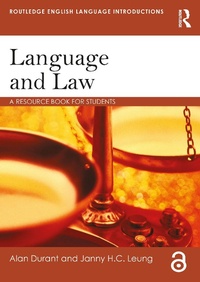
Language and Law
A resource book for students
Published on 8. May 2017
258 pages
978-1-315-43624-1 (ISBN)
Description

Language plays an essential role both in creating law and in governing its implementation. Providing an accessible and comprehensive introduction to this subject, Language and Law:
describes the different registers and genres that make up spoken and written legal language and how they develop over time;
analyses real-life examples drawn from court cases from different parts of the world, illustrating the varieties of English used in the courtroom by speakers occupying different roles;
addresses the challenges presented to our notions of law and regulation by online communication;
discusses the complex role of translation in bilingual and multilingual jurisdictions, including Hong Kong and Canada; and
provides readings from key scholars in the discipline, including Lawrence Solan, Peter Goodrich, Marianne Constable, David Mellinkoff, and Chris Heffer.
With a wide range of activities throughout, this accessible textbook is essential reading for anyone studying language and law or forensic linguistics.
Sections A, B, and C of this book are freely available as a downloadable Open Access PDF under a Creative Commons Attribution-Non Commercial-No Derivatives 4.0 license available at http://www.taylorfrancis.com/books/e/9781315436258
describes the different registers and genres that make up spoken and written legal language and how they develop over time;
analyses real-life examples drawn from court cases from different parts of the world, illustrating the varieties of English used in the courtroom by speakers occupying different roles;
addresses the challenges presented to our notions of law and regulation by online communication;
discusses the complex role of translation in bilingual and multilingual jurisdictions, including Hong Kong and Canada; and
provides readings from key scholars in the discipline, including Lawrence Solan, Peter Goodrich, Marianne Constable, David Mellinkoff, and Chris Heffer.
With a wide range of activities throughout, this accessible textbook is essential reading for anyone studying language and law or forensic linguistics.
Sections A, B, and C of this book are freely available as a downloadable Open Access PDF under a Creative Commons Attribution-Non Commercial-No Derivatives 4.0 license available at http://www.taylorfrancis.com/books/e/9781315436258
Reviews / Votes
"This book fills a vital need in the teaching of Forensic Linguistics - a rapidly developing field that has adequate breadth and depth of teaching resources. The content is well structured, chunked and contextualised to make it digestible for undergraduates, and readily integrated into lectures and tutorial sessions. I heartily commend Durant and Leung for putting this together."Paul Sidwell, Australian National University
"With ample supporting data, a range of topics covering the intersections between language and the law are presented through well written introductory sections, followed by more thought-provoking readings. This is an ideal key text for undergraduate modules but will be equally useful for stimulating postgraduate discussion and research."
Michelle Aldridge, Cardiff University, UK
"Forensic linguistics and the language of the courtroom are becoming increasingly important domains for linguists to investigate, and this handsome volume provides insightful, authoritative analysis of all aspects of language and the law in a student-friendly presentation that includes a wealth of detailed analysis and fascinating material."
David Deterding, Universiti Brunei Darussalam
"An innovative and thoughtful overview of law and linguistics, giving students valuable examples for practice and study. Instructors and students will find this text a cogent and firm basis for an introduction to language and law."
Gail Stygall, University of Washington, USA
More details
Series
Language
English
Place of publication
London
United Kingdom
Publishing group
Taylor & Francis Ltd
Target group
College/higher education
Illustrations
1 Tables, black and white
File size
27,96 MB
ISBN-13
978-1-315-43624-1 (9781315436241)
Copyright in bibliographic data and cover images is held by Nielsen Book Services Limited or by the publishers or by their respective licensors: all rights reserved.
Schweitzer Classification
Other editions
Additional editions
Book
03/2016
1st Edition
Routledge
€215.41
Shipment within 10-20 days
Book
03/2016
1st Edition
Routledge
€68.90
Shipment within 10-20 days
Persons
Alan Durant is Professor of Communication in the School of Law at Middlesex University, London.
Janny HC Leung is an Associate Professor in the School of English at University of Hong Kong.
Janny HC Leung is an Associate Professor in the School of English at University of Hong Kong.
Content
A Introduction: Key Concepts1 What Kind of Variety is 'Legal Language'?
2 The Historical Development of Legal English
3 Legal Genres
4 Participant Roles and Speech Styles in the Courtroom
5 Persuasion in Court
6 Interpreting Meaning in Legislative Texts
7 The Vocabulary of Legal Power
8 Legal Protection and Regulation of Language
9 Forensic Evidence
10 Legal Order and Linguistic Diversity
B Development: Contemporary Approaches
1 Linguistic Features of Legal Language
2 Functions of Legal Language
3 Genre Analysis of Legal Texts
4 Spoken Discourse in the Courtroom
5 Linguistic Strategies Used by Lawyers
6 Pragmatics and Legal Interpretation
7 Legal Speech Acts
8 Disputing 'Ordinary Language'
9 Techniques in Forensic Linguistics
10 Linguistic Challenges in Bilingual and Multilingual Legal Order
C Exploration: Analyses and Examples
1 Attitudes towards Legal Language
2 Reforming Legal Language
3 Reading a Statute
4 Style and Restrictions in Courtroom Interaction
5 Rhetorical Techniques in Legal Advocacy
6 Deciding Legal Meaning
7 Performatives in Speech and Writing
8 Misleading Language in Adverts
9 Language Data as Evidence
10 Same Law, Different Texts
D Extension: Engaging with the Scholarship
1 Law as a Profession of Words
2 Public Understanding of Legal Language
3 The Language of Jury Trial
4 Courtroom Language: Theory and Practice
5 Talking the Language of Lawyers
6 Perspectives on Legal Interpretation
7 Understanding Legal Speech Acts and Rules
8 Language Struggles Online
9 Resolving Disputed Meaning in Court
10 Bilingualism and Jury Service
2 The Historical Development of Legal English
3 Legal Genres
4 Participant Roles and Speech Styles in the Courtroom
5 Persuasion in Court
6 Interpreting Meaning in Legislative Texts
7 The Vocabulary of Legal Power
8 Legal Protection and Regulation of Language
9 Forensic Evidence
10 Legal Order and Linguistic Diversity
B Development: Contemporary Approaches
1 Linguistic Features of Legal Language
2 Functions of Legal Language
3 Genre Analysis of Legal Texts
4 Spoken Discourse in the Courtroom
5 Linguistic Strategies Used by Lawyers
6 Pragmatics and Legal Interpretation
7 Legal Speech Acts
8 Disputing 'Ordinary Language'
9 Techniques in Forensic Linguistics
10 Linguistic Challenges in Bilingual and Multilingual Legal Order
C Exploration: Analyses and Examples
1 Attitudes towards Legal Language
2 Reforming Legal Language
3 Reading a Statute
4 Style and Restrictions in Courtroom Interaction
5 Rhetorical Techniques in Legal Advocacy
6 Deciding Legal Meaning
7 Performatives in Speech and Writing
8 Misleading Language in Adverts
9 Language Data as Evidence
10 Same Law, Different Texts
D Extension: Engaging with the Scholarship
1 Law as a Profession of Words
2 Public Understanding of Legal Language
3 The Language of Jury Trial
4 Courtroom Language: Theory and Practice
5 Talking the Language of Lawyers
6 Perspectives on Legal Interpretation
7 Understanding Legal Speech Acts and Rules
8 Language Struggles Online
9 Resolving Disputed Meaning in Court
10 Bilingualism and Jury Service
