

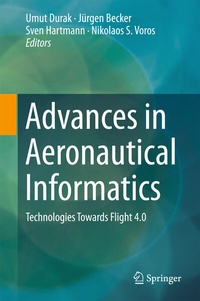
Advances in Aeronautical Informatics
Technologies Towards Flight 4.0
Published on 10. May 2018
XVI, 156 pages
978-3-319-75058-3 (ISBN)
Description

The first publication to offer perspectives on this new, interdisciplinary research areaIntroduces the emerging concept of Flight 4.0Features coverage that bridges advances in information and communication technologies, and aeronautics
Reviews / Votes
"Advances in aeronautical informatics is a work that deserves consideration . . Each chapter is a deep dive into a specific subject, composed in different styles and with different formats, and could be read as a standalone paper. There is a vast body of citations." (A. Squassabia, Computing Reviews, February, 2019)
More details
Series
Edition
1st ed. 2018
Language
English
Place of publication
Cham
Switzerland
Publishing group
Springer International Publishing
Target group
Professional and scholarly
Product notice
Reflowable
Illustrations
XVI, 156 p. 42 illus., 35 illus. in color.
File size
4,90 MB
ISBN-13
978-3-319-75058-3 (9783319750583)
DOI
10.1007/978-3-319-75058-3
Schweitzer Classification
Other editions
Additional editions
Umut Durak | Jürgen Becker | Sven Hartmann
Advances in Aeronautical Informatics
Technologies Towards Flight 4.0
Book
05/2018
Springer
€117.69
Shipment within 10-15 days
Persons
Umut Durak is a research scientist in the Institute of Flight Systems at the German Aerospace Center (DLR). He is also an adjunct faculty in the Department of Informatics at Clausthal University of Technology. His research focus is modeling and simulation based approaches in aeronautics. He received his BS, MS and Ph.D. degrees in Mechanical Engineering from Middle East Technical University (METU) in Turkey. He is a member of the Society for Computer Simulation International (SCS) and Arbeitsgemeinschaft Simulation (ASIM) and a senior member of the American Institute of Aeronautics and Astronautics (AIAA). And, he is a part of AIAA Modeling and Simulation Technical Committee and editorial teams of the Simulation: Transactions of the Society for Modeling and Simulation International; and the International Journal of Modeling, Simulation, and Scientific Computing.
Jürgen Becker received the Diploma and Ph.D. (Dr.-Ing.) degree from Technical University Kaiserslautern, Germany. He is a full professor for embedded electronic systems and Head of the Institute for Information Processing Technologies (ITIV) at the Karlsruhe Institute of Technology (KIT). From 2005-2009 he has been appointed as Vice President for Education at Universitaet Karlsruhe (TH) and Chief Higher Education Officer (CHEO) at KIT from 2009-2012. Since 2012 till 2014 he served as Secretary General of CLUSTER, an association of 12 leading technical universities in Europe. In 2013 Prof. Becker received the Honorary Doctor award (Dr. h.c.) from Technical University Budapest (Hungary). His research interests include Hardware/Software Systems-on-Chip (SoC), Cyber-Physical Systems (CPS), Heterogenous Multicore (MC) Architectures, Reconfigurable Computing, Fast Data Acquisition, Filtering and Storage for Semiconductor Detectors. He authored more than 400 papers in international journals and conferences.
Sven Hartman received his Ph.D. in 1996 and his D.Sc.in 2001, both from the University of Rostock (Germany). From 2002-2007 he worked first as an associate professor, then full professor for information systems at Massey University (New Zealand). Since 2008 he is a full professor of computer science and chair of databases and information systems at Clausthal University of Technology (Germany). There he is also serving as academic dean at the Faculty of Mathematics/Informatics and Mechanical Engineering since 2013. His research interests include databases and data management, conceptual modelling, big data, optimal discrete structures and algorithms, and information systems and services.
Nikolaos S. Voros received his Diploma in Computer and Informatics Engineering, in 1996, and his PhD degree, in 2001, from University of Patras, Greece. His research interests fall in the area of Cyberphysical/embedded system design, and include specification techniques, hardware-software co-design, formal refinement techniques, and reuse practices. Dr Voros is Associate Professor at Technological Institute of Western Greece, Department of Computer and Informatics Engineering where he is leading the Embedded Systems Design and Applications Laboratory (http://esda-lab.cied.teiwest.gr). During the last years, Dr Voros has participated in more than 30 research projects funded by European Commission either as project manager or as scientific advisor. He has served as scientific coordinator of FP7 STREP Project 287733 ALMA and ICT coordinator for FP7 STREP Project 287720 ARMOR; currently, Prof. Voros is the scientific coordinator of Horizon 2020 Project ARGO and the technical coordinator of Horizon 2020 Project RADIO. Dr Voros has published significant number of books and referred articles in international journals and conferences, while he is also editor of the books «System Level Design with Reuse of System IP», «System Level Design of Reconfigurable Systems-on-Chip» and «Components and Services for IoT platforms:paving the way for IoT standards» published by Springer. He has also served as General Chair in well-known international conferences like the IEEE Computer Society Annual Symposium on VLSI (2010) and the 14th International Symposium on Applied Reconfigurable Computing (2018). He was also the Program Co-Chair for 24th International Conference on Field Programmable Logic and Applications (2014) and for the 7th International Workshop on Reconfigurable and Communication-centric Systems-on-Chip (2012).
Jürgen Becker received the Diploma and Ph.D. (Dr.-Ing.) degree from Technical University Kaiserslautern, Germany. He is a full professor for embedded electronic systems and Head of the Institute for Information Processing Technologies (ITIV) at the Karlsruhe Institute of Technology (KIT). From 2005-2009 he has been appointed as Vice President for Education at Universitaet Karlsruhe (TH) and Chief Higher Education Officer (CHEO) at KIT from 2009-2012. Since 2012 till 2014 he served as Secretary General of CLUSTER, an association of 12 leading technical universities in Europe. In 2013 Prof. Becker received the Honorary Doctor award (Dr. h.c.) from Technical University Budapest (Hungary). His research interests include Hardware/Software Systems-on-Chip (SoC), Cyber-Physical Systems (CPS), Heterogenous Multicore (MC) Architectures, Reconfigurable Computing, Fast Data Acquisition, Filtering and Storage for Semiconductor Detectors. He authored more than 400 papers in international journals and conferences.
Sven Hartman received his Ph.D. in 1996 and his D.Sc.in 2001, both from the University of Rostock (Germany). From 2002-2007 he worked first as an associate professor, then full professor for information systems at Massey University (New Zealand). Since 2008 he is a full professor of computer science and chair of databases and information systems at Clausthal University of Technology (Germany). There he is also serving as academic dean at the Faculty of Mathematics/Informatics and Mechanical Engineering since 2013. His research interests include databases and data management, conceptual modelling, big data, optimal discrete structures and algorithms, and information systems and services.
Nikolaos S. Voros received his Diploma in Computer and Informatics Engineering, in 1996, and his PhD degree, in 2001, from University of Patras, Greece. His research interests fall in the area of Cyberphysical/embedded system design, and include specification techniques, hardware-software co-design, formal refinement techniques, and reuse practices. Dr Voros is Associate Professor at Technological Institute of Western Greece, Department of Computer and Informatics Engineering where he is leading the Embedded Systems Design and Applications Laboratory (http://esda-lab.cied.teiwest.gr). During the last years, Dr Voros has participated in more than 30 research projects funded by European Commission either as project manager or as scientific advisor. He has served as scientific coordinator of FP7 STREP Project 287733 ALMA and ICT coordinator for FP7 STREP Project 287720 ARMOR; currently, Prof. Voros is the scientific coordinator of Horizon 2020 Project ARGO and the technical coordinator of Horizon 2020 Project RADIO. Dr Voros has published significant number of books and referred articles in international journals and conferences, while he is also editor of the books «System Level Design with Reuse of System IP», «System Level Design of Reconfigurable Systems-on-Chip» and «Components and Services for IoT platforms:paving the way for IoT standards» published by Springer. He has also served as General Chair in well-known international conferences like the IEEE Computer Society Annual Symposium on VLSI (2010) and the 14th International Symposium on Applied Reconfigurable Computing (2018). He was also the Program Co-Chair for 24th International Conference on Field Programmable Logic and Applications (2014) and for the 7th International Workshop on Reconfigurable and Communication-centric Systems-on-Chip (2012).
Content
Part I: Introduction.- Chapter 1. Flight 4.0: The Changing Technology Landscape of Aeronautics (Umut Durak).- Part II: Information and Communication Technologies supporting Flight 4.0.- Chapter 2. Advances in Avionic Platforms: Multi-Core Systems (Falco K. Bapp).- Chapter 3. Emerging Trends in Avionics Networking (Andreas Reinhardt).- Chapter 4. IoT and Service Oriented Infrastructures for Flight 4.0 (Christos P. Antonopoulos).- Chapter 5. Big Data and Data Analytics in Aeronautics (Gerrit Burmester).- Chapter 6. Ontologies in Aeronautics (Carlos Insaurralde).- Chapter 7. Advances in Software Engineering and Aeronautics (Shafagh Jafer).- Part III: The Challenges.- Chapter 8. Towards Autonomy and Safety For Unmanned Aircraft Systems (Christoph Torens).- Chapter 9. Keeping up with Real Time (Reinhard Wilhelm).- Chapter 10. Aerospace Engineering Curricular Expansion in Information Systems (Ella M. Atkins).
