

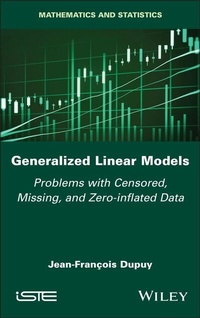
Generalized Linear Models
Description

Since they were first formulated in 1972, generalized linear models have enjoyed a veritable boom, with numerous applications in insurance, economics and biostatistics. Today, they are still the subject of a great deal of research.
This book provides an overview of the theory of generalized linear models. Particular attention is paid to the problems of censoring, missing data and excess zeros. Didactic and accessible, Generalized Linear Models is illustrated with exercises and numerous R codes.
With all the necessary prerequisites introduced in a step-by-step fashion, this book is aimed at students (at master's or engineering school level), as well as teachers and practitioners of mathematics and statistical modeling.
More details
Other editions
New editions
Additional editions
Person
Jean-François Dupuy is Professor of Applied Mathematics at the University of Rennes and is a member of the Institut de recherche mathématique de Rennes, France. His research focuses on statistical modeling, generalized linear models and duration models.
Content
Preface ix
Notation and Acronyms xi
Chapter 1 Exponential Families 1
1.1. Definition 1
1.2. Mean, variance, and variance function 3
1.3. Examples of exponential families 4
1.4. Maximum likelihood estimation 9
1.5. Technical appendix 18
1.5.1. Some useful results from probability 18
1.5.2. Negative binomial distribution and Poisson-gamma mixtures 19
1.6. Exercises 20
Chapter 2. From Linear Models to GLMs 25
2.1. Reminders on the linear model 27
2.1.1. Matrix form of the linear model 28
2.1.2. Some examples of linear models 29
2.1.3. Least-squares approximation 31
2.1.4. Asymptotics of the LSE 34
2.1.5. Linear Gaussian model 37
2.2. Three components of a generalized linear model 43
2.2.1. The random component 43
2.2.2. The linear predictor 44
2.2.3. The link function 45
2.3. Estimation in generalized linear models 46
2.3.1. Maximum likelihood 46
2.3.2. Asymptotic properties and inference 48
2.3.3. Estimating the dispersion parameter 50
2.4. Some examples 52
2.4.1. Logistic regression model 52
2.4.2. Poisson regression model 59
2.4.3. Gamma regression model 60
2.5. Generalized linear models in R: Poisson regression example 61
2.5.1. Confidence intervals and hypothesis tests 65
2.5.2. AIC and BIC, variable selection 68
2.5.3. Prediction, confidence intervals for a prediction 69
2.6. Technical appendix 71
2.6.1. Some probability distributions 71
2.6.2. Cochran's theorem 72
2.7. Exercises 72
Chapter 3. Censored and Missing Data in GLMs 83
3.1. Censored data 83
3.1.1. Introduction 83
3.1.2. Poisson regression with a right-censored response 85
3.1.3. Gamma regression with a right-censored response 93
3.2. Missing data problems 101
3.2.1. Introduction 101
3.2.2. Missing data typology 102
3.2.3. Methods for treating missing data 103
3.2.4. A missing data problem in the Poisson model 113
3.2.5. A missing data problem in the gamma regression model 127
3.3. Technical appendix 135
3.3.1. Two lemmas 135
3.3.2. Proof of theorem 3.3 140
3.3.3. Proof of theorem 3.4 143
3.3.4. Proof of theorem 3.5 145
3.3.5. Proof of theorem 3.6 149
3.3.6. Elements of empirical processes 150
3.4. Exercises 154
Chapter 4. Zero-Inflated Models 159
4.1. Introduction 159
4.1.1. Overdispersion 159
4.1.2. Excess of zeros 163
4.2. Zero-inflated Poisson models and extensions 166
4.2.1. The zero-inflated Poisson model 166
4.2.2. Semi-parametric ZIP models 170
4.2.3. Zero-inflated generalized Poisson model 174
4.2.4. A zero-inflation test 177
4.3. Zero-inflated negative binomial model 183
4.3.1. Negative binomial model 183
4.3.2. ZINB model 184
4.3.3. The ZIP model versus the ZINB model 186
4.4. Zero-inflated binomial model 187
4.5. Censored and missing data: examples of problems 190
4.5.1. Censored ZIP model 190
4.5.2. Missing covariables in the ZIB model 192
4.5.3. Missing covariables in the ZIP model 195
4.6. Marginal zero-inflated models 200
4.6.1. Introduction 200
4.6.2. MZIP and MZINB models 203
4.7. Exercises 204
References 209
Index 217
