

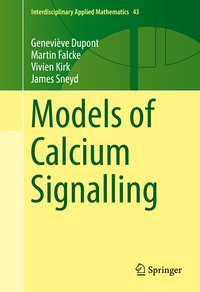
Models of Calcium Signalling
Description

This book discusses the ways in which mathematical, computational, and modelling methods can be used to help understand the dynamics of intracellular calcium. The concentration of free intracellular calcium is vital for controlling a wide range of cellular processes, and is thus of great physiological importance. However, because of the complex ways in which the calcium concentration varies, it is also of great mathematical interest.This book presents the general modelling theory as well as a large number of specific case examples, to show how mathematical modelling can interact with experimental approaches, in an interdisciplinary and multifaceted approach to the study of an important physiological control mechanism.
Genevi è ve Dupont is FNRS Research Director at the Unit of Theoretical Chronobiology of the Université Libre de Bruxelles; Martin Falcke is head of the Mathematical Cell Physiology group at the Max Delbrück Center for Molecular Medicine, Berlin; Vivien Kirk is an Associate Professor in the Department of Mathematics at the University of Auckland, New Zealand; James Sneyd is a Professor in the Department of Mathematics at The University of Auckland, New Zealand.
Reviews / Votes
"This book is entirely focused on the modelling aspects: how quantitative models of calcium signalling are constructed, 'and how they can help build bridges between seemingly unrelated observations' . . The book is intended for people who are familiar with the basic theory of differential equations. ... A selected list of literature for further productive reading on different levels of knowledge is given." (Luisa Consiglieri, zbMATH 1350.92002, 2017)More details
Other editions
Additional editions
Persons
Vivien Kirk is Associate Professor of Mathematics at the University of Auckland.
James Sneyd is Professor of Mathematics at the University of Auckland.
