

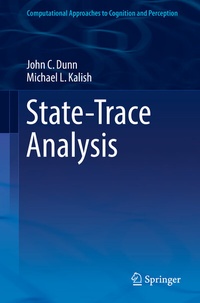
State-Trace Analysis
Description

This book provides an introduction to the theory, method, and practice of State-Trace Analysis (STA), and includes a detailed tutorial on the statistical analysis of state-trace designs. The book offers instructions on how to perform state-trace analysis using the authors' own publicly-available software in both Matlab and R.
The book begins by discussing the general framework for thinking about the relationships between independent variables, latent variables, and dependent variables. Subsequent chapters provide a software package that can be used to fit state-trace models as well as additional designs and examples. The book concludes with a discussion on potential extensions of STA and additional aspects of its application.
State-Trace Analysis will be of interest to researchers and graduate students working in experimental, applied, and cognitive psychology.
More details
Other editions
Additional editions
Persons
John C. Dunn, BA, Ph.D., is an Emeritus Professor in the School of Psychological Science at the University of Western Australia. Dr Dunn's research has focused on the application of mathematical models to recognition memory, decision making, reasoning, categorization, and eyewitness testimony. He has published over 100 papers in numerous journals including Psychological Review, Proceedings of the National Academy of Science, and the Journal of Experimental Psychology: Learning, Memory, and Cognition.
Michael L. Kalish, M.S., Ph.D., is a Professor in the Department of Psychology at Syracuse University. He has published in numerous journals, including: Psychological Review, Cognitive Science, and several sections of the Journal of Experimental Psychology. Dr. Kalish's research involves describing the cognitive mechanisms responsible for the nature of human learning and memory, with a particular focus on categorization and dimensional attention.
