

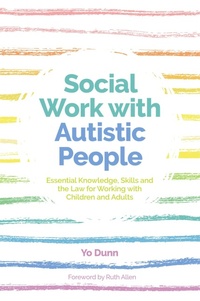
Social Work with Autistic People
Essential Knowledge, Skills and the Law for Working with Children and Adults
Published on 21. September 2020
256 pages
978-1-78450-339-0 (ISBN)
Description

This book will help social workers and practitioners to find achievable solutions to support autistic people - including those with complex needs - to live fulfilling lives in their communities.
Far too many autistic people are currently in inappropriate institutional placements, putting their basic human rights at risk and experiencing a poor quality of life. Good quality support for autistic people is achievable, even in a social care system under pressure. This book will help practitioners to develop high quality community support to facilitate discharges and prevent admissions, by providing them with effective, practical strategies to communicate with and more effectively support autistic people right across the spectrum.
Common assumptions and beliefs are challenged, including the idea that 'behaviours' are an inevitable part of autism, and practical approaches are offered to promote autonomy, respect for human rights and empathy with autistic perspectives as a basis for preventing distressed behaviour. This will enable practitioners to support and empower all autistic people to achieve a good quality of life in their communities.
Far too many autistic people are currently in inappropriate institutional placements, putting their basic human rights at risk and experiencing a poor quality of life. Good quality support for autistic people is achievable, even in a social care system under pressure. This book will help practitioners to develop high quality community support to facilitate discharges and prevent admissions, by providing them with effective, practical strategies to communicate with and more effectively support autistic people right across the spectrum.
Common assumptions and beliefs are challenged, including the idea that 'behaviours' are an inevitable part of autism, and practical approaches are offered to promote autonomy, respect for human rights and empathy with autistic perspectives as a basis for preventing distressed behaviour. This will enable practitioners to support and empower all autistic people to achieve a good quality of life in their communities.
More details
Edition
Digital original
Language
English
Place of publication
London
United Kingdom
Target group
College/higher education
Professional and scholarly
Edition type
Digital original
ISBN-13
978-1-78450-339-0 (9781784503390)
Copyright in bibliographic data and cover images is held by Nielsen Book Services Limited or by the publishers or by their respective licensors: all rights reserved.
Schweitzer Classification
Other editions
Additional editions
Yo Dunn
Social Work with Autistic People
Essential Knowledge, Skills and the Law for Working with Children and Adults
Book
09/2020
Jessica Kingsley Publishers
€29.00
Shipment within 15-20 days
Persons
Yo Dunn is an independent trainer and consultant who works across the public sector, specialising in autism and law. She creates and delivers high level training for social workers on the legal frameworks of social care, safeguarding and autism for a variety of clients, including many English local authorities.
Content
- Cover
- Of related interest
- Title Page
- Copyright
- Contents
- Foreword by Alex Ruck Keene
- Foreword by Ruth Allen
- Acknowledgements
- 1. Where Does Autism Fit from a Social Work Perspective?
- 1.1 Autism in the context of social work
- 1.2 Why do I need to do anything differently for autism?
- 1.3 Autism and co-occurring conditions
- 1.4 Undiagnosed autism
- 1.5 How can this book help social workers?
- 2. Social Care Assessment and Autism
- 2.1 Before the assessment
- 2.2 During the assessment
- 2.3 Chapter summary and key points
- 3. Social Care Eligibility and Autism
- 3.1 Assumptions
- 3.2 Thresholds or barriers?
- 3.3 Autistic needs in daily living
- 3.4 Chapter summary and key points
- 4. Person-Centred Care Planning and Autism
- 4.1 Person-centred approaches, needs-led planning and the wider context
- 4.2 What does good care look like? Goals
- 4.3 What does good care look like? A framework
- 4.4 Chapter summary and key points
- 5. Life Stages, Aging, Transition Planning and Autism
- 5.1 Introduction
- 5.2 Autism and attachment difficulties
- 5.3 Human development and developmental delay in autism
- 5.4 Autistic identity development
- 5.5 Managing transitions
- 5.6 Chapter summary and key points
- 6. Assessing Mental Capacity and Autism
- 6.1 Introduction
- 6.2 Who does the assessment?
- 6.3 Assumptions
- 6.4 Autistic people and the development of decision-making skills
- 6.5 Providing all relevant information
- 6.6 Types of decision
- 6.7 Timing
- 6.8 The functional test
- 6.9 Chapter summary and key points
- 7. Supporting Decision Making and Autism
- 7.1 Introduction
- 7.2 Lack of experience
- 7.3 Adapting communication
- 7.4 Providing information
- 7.5 Weighing information and making a decision
- 7.6 Communicating and executing the decision
- 7.7 Chapter summary and key points
- 8. Safeguarding and Autism
- 8.1 How big is the risk?
- 8.2 Types of abuse
- 8.3 Prevention
- 8.4 Safeguarding enquiries
- 8.5 Chapter summary and key points
- 9. Behaviour which May Challenge and Autism
- 9.1 Overload: fight, freeze or flight
- 9.2 Managing behaviour: reaction
- 9.3 Managing behaviour: prevention
- 9.4 The wider context: preventing the breakdown of community placements and ending the inappropriate use of inpatient settings
- 9.5 Crisis planning
- 9.6 Chapter summary and key points
- References
- Endnotes
- Subject Index
- Author Index
