

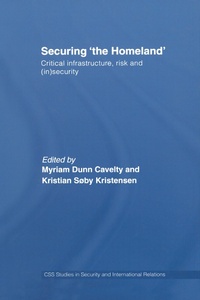
Securing 'the Homeland'
Critical Infrastructure, Risk and (In)Security
1st Edition
Published on 28. April 2020
224 pages
978-1-134-06920-0 (ISBN)
Description

This edited volume uses a 'constructivist/reflexive' approach to address critical infrastructure protection (CIP), a central political practice associated with national security.
The politics of CIP, and the construction of the threat they are meant to counter, effectively establish a powerful discursive connection between that the traditional and normal conditions for day-to-day politics and the exceptional dynamics of national security. Combining political theory and empirical case studies, this volume addresses key issues related to protection and the governance of insecurity in the contemporary world. The contributors track the transformation and evolution of critical infrastructures (and closely related issues of homeland security) into a security problem, and analyze how practices associated with CIP constitute, and are an expression of, changing notions of security and insecurity. The book explores aspects of 'securitisation' as well as at practices, audiences, and contexts that enable and constrain the production of the specific form of governmentality that CIP exemplifies. It also explores the rationalities at play, the effects of these security practices, and the implications for our understanding of security and politics today.
The politics of CIP, and the construction of the threat they are meant to counter, effectively establish a powerful discursive connection between that the traditional and normal conditions for day-to-day politics and the exceptional dynamics of national security. Combining political theory and empirical case studies, this volume addresses key issues related to protection and the governance of insecurity in the contemporary world. The contributors track the transformation and evolution of critical infrastructures (and closely related issues of homeland security) into a security problem, and analyze how practices associated with CIP constitute, and are an expression of, changing notions of security and insecurity. The book explores aspects of 'securitisation' as well as at practices, audiences, and contexts that enable and constrain the production of the specific form of governmentality that CIP exemplifies. It also explores the rationalities at play, the effects of these security practices, and the implications for our understanding of security and politics today.
Reviews / Votes
'[This book] provides a thorough, engaging and much overdue account of the key issues at the intersection between critical infrastructure and the field of Security Studies.' Lene Hansen, University of CopenhagenMore details
Series
Edition
1. Auflage
Language
English
Place of publication
London
United Kingdom
Publishing group
Taylor & Francis Ltd
Target group
College/higher education
Professional and scholarly
Illustrations
1 Tables, black and white; 1 Line drawings, black and white
File size
14,87 MB
ISBN-13
978-1-134-06920-0 (9781134069200)
Copyright in bibliographic data and cover images is held by Nielsen Book Services Limited or by the publishers or by their respective licensors: all rights reserved.
Schweitzer Classification
Other editions
Additional editions
Myriam Anna Dunn | Kristian Soby Kristensen
Securing 'the Homeland'
Critical Infrastructure, Risk and (In)Security
Book
12/2014
1st Edition
Routledge
€89.32
Shipment within 15-20 days
Myriam Anna Dunn | Kristian Soby Kristensen
Securing 'the Homeland'
Critical Infrastructure, Risk and (In)Security
Book
10/2007
1st Edition
Routledge
€231.50
Shipment within 15-20 days
Persons
Myriam Dunn Cavelty is lecturer and head of the new risks research unit at the Center for Security Studies (CSS), ETH Zurich.
Kristian Soby Kristensen is a PhD candidate working with the Research Unit on Defence and Security at the Danish Institute for International Studies.
Kristian Soby Kristensen is a PhD candidate working with the Research Unit on Defence and Security at the Danish Institute for International Studies.
Content
Foreword Ole Waever . Introduction: Securing the Homeland: Critical Infrastructure, Risk, and (In)Security Myriam Dunn Cavelty and Kristian Soby Kristensen Part 1: Origins, Conceptions, and the Public-Private Rationale The Vulnerability of Vital Systems: How 'Critical Infrastructure' Became a Security Problem Stephen J. Collier and Andrew Lakoff. Like a Phoenix from the Ashes: The Reinvention of Critical Infrastructure Protection as Distributed Security Myriam Dunn Cavelty. 'The Absolute Protection of our Citizens': Critical Infrastructure Protection and the Practice of Security Kristian Soby Kristensen. Critical Infrastructures and Network Pathologies: The Semiotics and Biopolitics of a Heteropolar World Order James Der Derian and Jesse Finkelstein. Part 2: Terrorism and the Politics of Protecting the Homeland Media, Fear, and the Hyperreal: The Construction of Cyberterrorism as the Ultimate Threat to Critical Infrastructures Maura Conway. Homeland Security Through Traceability: Technologies of Control as Critical Infrastructures Philippe Bonditti. The Gendered Narratives of Homeland Security: Anarchy at the Front Door Makes Home a Haven Elgin M. Brunner. Conclusion: The Biopolitics of Critical Infrastructure Protection Julian Reid
