

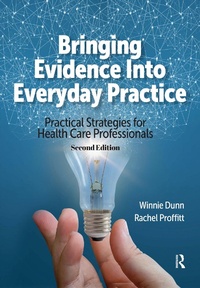
Bringing Evidence Into Everyday Practice
Practical Strategies for Healthcare Professionals
2nd Edition
Published on 1. June 2024
186 pages
978-1-040-14138-0 (ISBN)
Description

Bringing Evidence Into Everyday Practice: Practical Strategies for Health Care Professionals, Second Edition provides a step-by-step process for learning how to use literature to inform quality practices in an accessible workbook format.
Bringing Evidence Into Everyday Practice simplifies analyzing research through repetition of core strategies and the systematic introduction of increasingly complex techniques for interpreting literature. Students, early career professionals, and interdisciplinary teams alike can build a common language and structure for selecting and evaluating evidence to incorporate into their practices.
What's included in Bringing Evidence Into Everyday Practice:
* Worksheets to guide learning, available in print and as writable PDFs online
* Ample opportunities to repeat and practice skills
* Summary articles, emerging practices, and data collection
* How to search databases, examine quality features, and identify the parts of a research article
* A library of articles that learners can access from their libraries or the internet
Included with the text are online supplemental materials for faculty use in the classroom.
Bringing Evidence Into Everyday Practice: Practical Strategies for Health Care Professionals, Second Edition walks readers through each step of reviewing articles in the literature-providing them with a scaffolding of understanding how to evaluate and incorporate evidence into their practice.
Bringing Evidence Into Everyday Practice simplifies analyzing research through repetition of core strategies and the systematic introduction of increasingly complex techniques for interpreting literature. Students, early career professionals, and interdisciplinary teams alike can build a common language and structure for selecting and evaluating evidence to incorporate into their practices.
What's included in Bringing Evidence Into Everyday Practice:
* Worksheets to guide learning, available in print and as writable PDFs online
* Ample opportunities to repeat and practice skills
* Summary articles, emerging practices, and data collection
* How to search databases, examine quality features, and identify the parts of a research article
* A library of articles that learners can access from their libraries or the internet
Included with the text are online supplemental materials for faculty use in the classroom.
Bringing Evidence Into Everyday Practice: Practical Strategies for Health Care Professionals, Second Edition walks readers through each step of reviewing articles in the literature-providing them with a scaffolding of understanding how to evaluate and incorporate evidence into their practice.
More details
Edition
2nd edition
Language
English
Place of publication
London
United Kingdom
Publishing group
Taylor & Francis Ltd
Target group
College/higher education
Professional and scholarly
ISBN-13
978-1-040-14138-0 (9781040141380)
Copyright in bibliographic data and cover images is held by Nielsen Book Services Limited or by the publishers or by their respective licensors: all rights reserved.
Schweitzer Classification
Other editions
Additional editions
Winnie Dunn | Rachel Proffitt
Bringing Evidence Into Everyday Practice
Practical Strategies for Healthcare Professionals
Book
11/2024
2nd Edition
Routledge
€215.40
Shipment within 10-20 days
Winnie Dunn | Rachel Proffitt
Bringing Evidence Into Everyday Practice
Practical Strategies for Healthcare Professionals
Book
12/2023
2nd Edition
SLACK Incorporated
€66.40
Shipment within 3-4 weeks
Persons
Winnie Dunn, PhD, OTR, FAOTA, is a Distinguished Professor in the Department of Occupational Therapy Education at the University of Missouri and is a Certified Positive Psychology Coach. She was the Eleanor Clarke Slagle lecturer in 2001, received the Award of Merit from the American Occupational Therapy Association, received the A. Jean Ayres research award and the Chancellor's teaching and research awards, served as a Kemper Teaching Fellow, and is a member of the Academy of Research of the American Occupational Therapy Foundation. She has contributed research and other writings to professional literature across her career. Currently she is studying the impact of evidence-based coaching practices on family, education, and child outcomes.
Believing that researchers must also translate their findings for the public, she has also published her book Living Sensationally: Understanding Your Senses, which is available in several languages. Its focus is to demonstrate how sensory processing is part of everyone's choices throughout their daily routines. The book is written in everyday language so that everyone can understand their own, their family's, their coworkers', and their friends' behaviors a little better.
Rachel Proffitt, OTD, OTR/L, is an Associate Professor in the Department of Occupational Therapy at the University of Missouri. She received her OTD from Washington University in St. Louis and completed a T32 post-doctoral fellowship at the University of Southern California. She has a Certificate in Clinical, Translational, and Biomedical Investigations and was awarded the ASA/ACRM Young Investigator Award in Post-Acute Stroke Rehabilitation in 2020. Her research spans the breadth of technology, including virtual reality and ambient sensors to support individuals post-stroke and older adults living in the community. She has received foundation and federal funding to support her research, including an Intervention Research Grant from the American Occupational Therapy Foundation. She is the principal investigator of a 3-year R01 exploring a technology-supported intervention for rural community-dwelling older adults with disabilities.
Believing that researchers must also translate their findings for the public, she has also published her book Living Sensationally: Understanding Your Senses, which is available in several languages. Its focus is to demonstrate how sensory processing is part of everyone's choices throughout their daily routines. The book is written in everyday language so that everyone can understand their own, their family's, their coworkers', and their friends' behaviors a little better.
Rachel Proffitt, OTD, OTR/L, is an Associate Professor in the Department of Occupational Therapy at the University of Missouri. She received her OTD from Washington University in St. Louis and completed a T32 post-doctoral fellowship at the University of Southern California. She has a Certificate in Clinical, Translational, and Biomedical Investigations and was awarded the ASA/ACRM Young Investigator Award in Post-Acute Stroke Rehabilitation in 2020. Her research spans the breadth of technology, including virtual reality and ambient sensors to support individuals post-stroke and older adults living in the community. She has received foundation and federal funding to support her research, including an Intervention Research Grant from the American Occupational Therapy Foundation. She is the principal investigator of a 3-year R01 exploring a technology-supported intervention for rural community-dwelling older adults with disabilities.
Content
Dedication Master List of Worksheets Acknowledgments About the Authors Preface Introduction How to Use This Book Section I Learning the Basics Unit 1 Introduction to Evidence-Based Practice Unit 2 Characterizing Responses to Evidence Unit 3 Understanding and Using the Basic Parts of Research Articles Section II Practice Using Evidence to Design Best Practices Unit 4 Examining Evidence Related to Assistive Devices and Environmental Adaptations Unit 5 Examining Evidence Related to the Use of Compensatory Strategies Unit 6 Examining Evidence Related to Caregiving Unit 7 Examining Evidence Related to Sensory Processing Patterns Unit 8 Examining Evidence Related to Constraint-Induced Therapy Interventions Unit 9 Examining Evidence Related to Upper Extremity Fractures Section III Expanding Your Knowledge and Skills for Evidence-Based Practice Unit 10 Understanding Summary and Meta-Analysis Articles Unit 11 Examining Evidence Related to Emerging and Controversial Practices Unit 12 Creating Evidence Within Your Own Practice Unit 13 Communicating Evidence: Critical Conversations Appendix Master List of Worksheets by Unit References in Alphabetical Order References by Unit Index
