

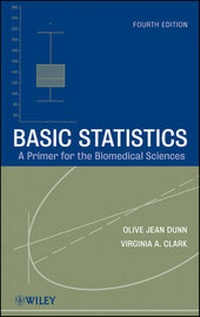
Basic Statistics
Description

Reviews / Votes
"The book is ideal for courses on biostatistics, medicine, andpublic health at the upper-undergraduate and graduate levels. It isalso appropriate as a reference for researchers and practitionerswho would like to refresh their fundamental understanding ofstatistical techniques." (Zentralblatt MATH, 1 August2013)"This fourth edition has retained all the appeal of itspredecessors." (Journal of Tropical pediatrics, 1 March 2011)More details
Other editions
Additional editions
Persons
Content
1 Initial Steps.
1.1 Reasons for Studying Biostatistics.
1.2 Initial Steps in Designing a Biomedical Study.
1.3 Common Types of Biomedical Studies.
Problems.
References.
2 Populations and Samples.
2.1 Basic Concepts.
2.2 Definitions of Types of Samples.
2.3 Methods of Selecting Simple Random Samples.
2.4 Application of Sampling Methods in Biomedical Studies.
Problems.
References.
3 Collecting and Entering Data.
3.1 Initial Steps.
3.2 Data Entry.
3.3 Screening the Data.
3.4 Code Book.
Problems.
References.
4 Frequency Tables and Their Graphs.
4.1 Numerical Methods of Organizing Data.
4.2 Graphs.
Problems.
References.
5 Measures of Location and Variability.
5.1 Measures of Location.
5.2 Measures of Variability.
5.3 Sampling Properties of the Mean and Variance.
5.4 Considerations in Selecting Appropriate Statistics.
5.5 A Common Graphical Method for Displaying Statistics.
Problems.
References.
6 The Normal Distribution.
6.1 Properties of the Normal Distribution.
6.2 Areas Under the Normal Curve.
6.3 Importance of the Normal Distribution.
6.4 Examining Data for Normality.
6.5 Transformations.
Problems.
References.
7 Estimation of Population Means: Confidence Intervals.
7.1 Confidence Intervals.
7.2 Sample Size Needed for a Desired Confidence Interval.
7.3 The t Distribution.
7.4 Confidence Interval for the Mean, Using the t Distribution.
7.5 Estimating the Difference Between Two Means: Unpaired Data.
7.6 Estimating the Difference Between Two Means: Paired Comparison.
Problems.
References.
8 Tests of Hypotheses on Population Means.
8.1 Tests of Hypotheses for a Single Mean.
8.2 Tests for Equality of two Means: Unpaired Data.
8.3 Testing for Equality of Means: Paired Data.
8.4 Concepts Used in Statistical Testing.
8.5 Sample Size.
8.6 Confidence Intervals Versus Tests.
8.7 Correcting for Multiple Testing.
8.8 Reporting the Results.
Problems.
References.
9 Variances: Estimation and Tests.
9.1 Point Estimates for Variances and Standard Deviations.
9.2 Testing Whether Two Variances Are Equal: F Test.
9.3 Approximate t Test.
9.4 Other Tests.
Problems.
References.
10 Categorical Data: Proportions.
10.1 Single Population Proportion.
10.2 Samples from Categorical Data.
10.3 The Normal Approximation to the Binomial.
10.4 Confidence Intervals for a Single Population Proportion.
10.5 Confidence Intervals for the Difference in Two Proportions.
10.6 Tests of Hypothesis for Population Proportions.
10.7 Sample Size for Testing Two Proportions.
10.8 Data Entry and Analysis Using Statistical Programs.
Problems.
References.
11 Categorical Data: Analysis of Two-Way Frequency Tables.
11.1 Different Types of Tables.
11.2 Relative Risk and Odds Ratio.
11.3 Chi-Square Tests for Frequency Tables: two-by-two Tables.
11.4 Chi-Square Tests for Larger Tables.
11.5 Remarks.
Problems.
References.
12 Regression and Correlation.
12.1 The Scatter Diagram: Single Sample.
12.2 Linear Regression: Single Sample.
12.3 The Correlation Coefficient for two Variables from a Single Sample.
12.4 Linear Regression Assuming the Fixed-X Model.
12.5 Other Topics in Linear Regression.
Problems.
References.
13 Nonparametric Statistics.
13.1 The Sign Test.
13.2 The Wilcoxon Signed Rank Test.
13.3 The Wilcoxon-Mann-Whitney Test.
13.4 Spearman's Rank Correlation.
Problems.
References.
14 Introduction to Survival Analysis.
14.1 Survival Analysis Data.
14.2 Survival Functions.
14.3 Computing Estimates of f(t), S(t), and h(t).
14.4 Comparison of Clinical Life Tables and the Kaplan-Meier Method.
14.5 Additional Analyses Using Survival Data.
Problems.
References.
Appendix A: Statistical Tables.
Appendix B: Answers to Selected Problems.
Appendix C: Computer Statistical Program Resources.
C.1 Computer Systems for Biomedical Education and Research.
C.2 A Brief Indication of Statistics Computer Program Advances and Some Relevant Publications Since 2000.
C.3 Choices of Computer Statistical Software.
Bibliography.
Index.
