

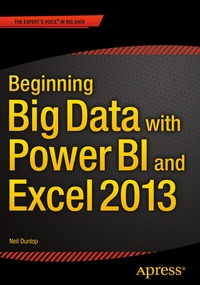
Beginning Big Data with Power BI and Excel 2013
Description

In Beginning Big Data with Power BI and Excel 2013 , you will learn to solve business problems by tapping the power of Microsoft's Excel and Power BI to import data from NoSQL and SQL databases and other sources, create relational data models, and analyze business problems through sophisticated dashboards and data-driven maps.
While Beginning Big Data with Power BI and Excel 2013 covers prominent tools such as Hadoop and the NoSQL databases, it recognizes that most small and medium-sized businesses don't have the Big Data processing needs of a Netflix, Target, or Facebook. Instead, it shows how to import data and use the self-service analytics available in Excel with Power BI. As you'll see through the book's numerous case examples, these tools-which you already know how to use-can perform many of the same functions as the higher-end Apache tools many people believe are required to carry out in Big Data projects.
Through instruction, insight, advice, andcase studies, Beginning Big Data with Power BI and Excel 2013 will show you how to:
- Import and mash up data from web pages, SQL and NoSQL databases, the Azure Marketplace and other sources.
- Tap into the analytical power of PivotTables and PivotCharts and develop relational data models to track trends and make predictions based on a wide range of data.
- Understand basic statistics and use Excel with PowerBI to do sophisticated statistical analysis-including identifying trends and correlations.
- Use SQL within Excel to do sophisticated queries across multiple tables, including NoSQL databases.
- Create complex formulas to solve real-world business problems using Data Analysis Expressions (DAX).
More details
Other editions
Additional editions
Person
Content
Introduction
Chapter 1: Tools for Big Data Intake, Processing, and Analysis
Chapter 2: Excel as a Database and Data Aggregator
Chapter 3: Pivot Tables and Pivot Charts
Chapter 4: Data Models
Chapter 5: SQL in Excel
Chapter 6: NoSQL Databases in Excel
Chapter 7: Statistical Analysis in Excel
Chapter 8: Data Analysis Expressions
Chapter 9: Reports and Dashboards
Chapter 10: Data Visualizations
Chapter 11: Summary and Review
