

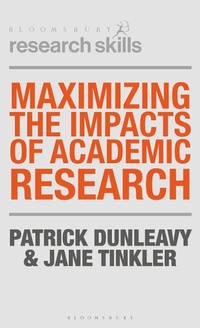
Maximizing the Impacts of Academic Research
1st Edition
Published on 10. October 2020
409 pages
978-1-350-31528-0 (ISBN)
Description

This is an invaluable guide to better research communication within and beyond academia. With many years of research experience, the authors provide scholars and scientists with systematic advice on how to ensure their research reaches its potential, and grows the recognition, influence, practical application and public understanding of science and scholarship. It begins by examining how citations work and evaluating the different measures of academic influence, from legacy bibliometric systems to altmetrics and digital metrics. Subsequent chapters show readers how to craft impactful journal articles, work effectively with co-authors, create a portfolio of publications and build a digital strategy that promotes knowledge exchange. Checklists help readers decide how and in what format to publish, enabling them to get their research in front of the right people. Throughout, the authors illustrate impact with data drawn from a wide range of disciplines.
Maximizing the Impacts of Academic Research is ideal for PhD students and early career researchers taking their first steps into academic research, experienced researchers mentoring the next generation of scholars and scientists and established academics looking to systematically review and upgrade their existing impact practices.
Maximizing the Impacts of Academic Research is ideal for PhD students and early career researchers taking their first steps into academic research, experienced researchers mentoring the next generation of scholars and scientists and established academics looking to systematically review and upgrade their existing impact practices.
More details
Series
Edition
1. Auflage
Language
English
Place of publication
London
United Kingdom
Publishing group
Bloomsbury Publishing PLC
Target group
College/higher education
ISBN-13
978-1-350-31528-0 (9781350315280)
Copyright in bibliographic data and cover images is held by Nielsen Book Services Limited or by the publishers or by their respective licensors: all rights reserved.
Schweitzer Classification
Other editions
Additional editions
Patrick Dunleavy | Jane Tinkler
Maximizing the Impacts of Academic Research
Book
10/2020
Bloomsbury Academic
€49.50
Shipment within 15-20 days
Persons
Patrick Dunleavy is Professor of Political Science at the London School of Economics, and a Fellow of the Academy of Social Sciences. In addition to his disciplinary work, he is well known for his successful guide, Authoring a PhD (Red Globe Press, 2003) and for the LSE Writing for Research blog. His Twitter feed @Write4Research has 68,000 followers from many countries and disciplines. His widely cited 2014 research study of The Impact of the Social Sciences (co-authored with Simon Bastow and Jane Tinkler) provided part of the foundation for this book.
Jane Tinkler is Senior Prize Manager at the Nine Dots Prize for innovation in the social sciences. She is also studying for a PhD in public policy at Stirling University. She previously managed LSE Public Policy Group for many years and co-authored The Impact of the Social Sciences (2014). She has also been a researcher in the UK's Parliamentary Office of Science and Technology, and before London School of Economics worked at UCL and Birkbeck College, London.
Jane Tinkler is Senior Prize Manager at the Nine Dots Prize for innovation in the social sciences. She is also studying for a PhD in public policy at Stirling University. She previously managed LSE Public Policy Group for many years and co-authored The Impact of the Social Sciences (2014). She has also been a researcher in the UK's Parliamentary Office of Science and Technology, and before London School of Economics worked at UCL and Birkbeck College, London.
Content
PART 1: ACADEMIC IMPACTS
Chapter 1: How citations work
1.1 The role citations play
1.2 Citation rates across disciplines
1.3 Time lags and citation profiles
1.4 What shapes researchers' overall citation profiles across their careers?
1.5 Handling self-citation
Chapter 2: Tracking and understanding your citations
2.1 The 'legacy' citation tracking systems
2.2 Google Scholar's tracking systems
2.3 Web-based citation plus full text
2.4 Altmetrics
2.5 Digital metrics and academic citing behaviours
Chapter 3: Planning journal articles
3.1 Getting papers from research projects
3.2 Working with co-authors and research teams
3.3 Deciding where to submit an article
3.4 Understanding the peer review process
3.5 Maintaining a flow of research and papers
Chapter 4: Crafting better journal articles
4.1 Choosing an article structure suitable for each discipline
4.2 Writing better -avoiding 'academese'
4.3 Helping other researchers to cite you
4.4 Writing informative titles and abstracts for journal articles
Chapter 5: Producing books and chapters
5.1 Books as academic outputs and their citation rates
5.2 Getting your book known
5.3 Edited books
5.4 Chapters in books
PART 2: ACADEMIC AND EXTERNAL IMPACTS
Chapter 6: Applied work, 'grey' literature and choosing across projects
6.1 Applied work
6.2 'Grey' literature and other publications
6.3 A choice canvass for research and publications options
Chapter 7: Digital era scholarship- bigger, better, shorter, faster, free
7.1 Bigger data
7.2 Bigger search
7.3 Better communicated
7.4 Shorter publication forms
7.5 Faster research
7.6 Free access and open access to knowledge
Chapter 8: Improving impacts at department and university level
8.1 Committing to knowledge exchange
8.2 Choosing a blogging/digital strategy
8.3 Integrating department and university impact efforts
8.4 University leadership and information flows
PART 3: EXTERNAL IMPACTS
Chapter 9: Impacts, intermediaries and academic purpose
9.1 What an external impact is (and is not)
9.2 Academia and modern professions
9.3 The impacts interface
Chapter 10: Working with other organizations. 10.1 Which academics can link to outside bodies. 10.2 The variety of university links to businesses and other organizations
10.3 How working with outside organizations can benefit research
10.4 The costs and possible risks of working externally
Chapter 11: Public engagement and impacts
11.1 Intuitive explanations, research narrative and 'maths dread'
11.2 Who can do public engagement?
11.3 The benefits of getting involved
11.4 Mitigating costs and potential risks
Afterword: How the impacts agenda boosts academic progress and democratizes knowledge
References.
Chapter 1: How citations work
1.1 The role citations play
1.2 Citation rates across disciplines
1.3 Time lags and citation profiles
1.4 What shapes researchers' overall citation profiles across their careers?
1.5 Handling self-citation
Chapter 2: Tracking and understanding your citations
2.1 The 'legacy' citation tracking systems
2.2 Google Scholar's tracking systems
2.3 Web-based citation plus full text
2.4 Altmetrics
2.5 Digital metrics and academic citing behaviours
Chapter 3: Planning journal articles
3.1 Getting papers from research projects
3.2 Working with co-authors and research teams
3.3 Deciding where to submit an article
3.4 Understanding the peer review process
3.5 Maintaining a flow of research and papers
Chapter 4: Crafting better journal articles
4.1 Choosing an article structure suitable for each discipline
4.2 Writing better -avoiding 'academese'
4.3 Helping other researchers to cite you
4.4 Writing informative titles and abstracts for journal articles
Chapter 5: Producing books and chapters
5.1 Books as academic outputs and their citation rates
5.2 Getting your book known
5.3 Edited books
5.4 Chapters in books
PART 2: ACADEMIC AND EXTERNAL IMPACTS
Chapter 6: Applied work, 'grey' literature and choosing across projects
6.1 Applied work
6.2 'Grey' literature and other publications
6.3 A choice canvass for research and publications options
Chapter 7: Digital era scholarship- bigger, better, shorter, faster, free
7.1 Bigger data
7.2 Bigger search
7.3 Better communicated
7.4 Shorter publication forms
7.5 Faster research
7.6 Free access and open access to knowledge
Chapter 8: Improving impacts at department and university level
8.1 Committing to knowledge exchange
8.2 Choosing a blogging/digital strategy
8.3 Integrating department and university impact efforts
8.4 University leadership and information flows
PART 3: EXTERNAL IMPACTS
Chapter 9: Impacts, intermediaries and academic purpose
9.1 What an external impact is (and is not)
9.2 Academia and modern professions
9.3 The impacts interface
Chapter 10: Working with other organizations. 10.1 Which academics can link to outside bodies. 10.2 The variety of university links to businesses and other organizations
10.3 How working with outside organizations can benefit research
10.4 The costs and possible risks of working externally
Chapter 11: Public engagement and impacts
11.1 Intuitive explanations, research narrative and 'maths dread'
11.2 Who can do public engagement?
11.3 The benefits of getting involved
11.4 Mitigating costs and potential risks
Afterword: How the impacts agenda boosts academic progress and democratizes knowledge
References.
