

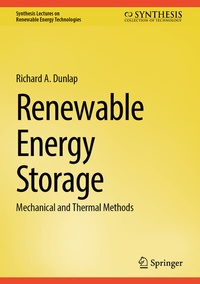
Renewable Energy Storage
Description

Energy use is not uniform throughout the day and year. Renewable energy resources such as hydroelectric, wind, and solar energy, generate different amounts of energy over time and space, and are not always available when and where they are needed. A storage mechanism is often required to allow generated energy to be utilized effectively.
This book reviews some of the important technologies for energy storage that utilize mechanical methods and thermal methods. In the first part of the book, mechanical energy storage methods are considered. These methods include pumped hydroelectric energy storage, gravitational potential of solid masses, and flywheels. In the second part, various methods of storing thermal energy are discussed. These include the use of the sensible heat of materials, the latent heat associated with phase transitions, and heat associated with chemical reactions.
More details
Other editions
Additional editions
Person
Richard A. Dunlap received a B.S. in Physics (Worcester Polytechnic Institute 1974), an A.M. in Physics (Dartmouth College 1976) and a Ph.D. in Physics (Clark University 1981). Since receiving his Ph.D., he has been on the Faculty at Dalhousie University where he currently holds an appointment as Research Professor in the Department of Physics and Atmospheric Science. Prof. Dunlap has more than 300 refereed research publications in fields that include critical phenomena, magnetic materials, amorphous alloys, quasicrystals, hydrogen storage and advanced battery materials. His previously published books include Experimental Physics: Modern Methods (Oxford 1988), The Golden Ratio and Fibonacci Numbers (World Scientific 1997), Sustainable Energy (Cengage, 1st ed. 2015, 2nd ed. 2019), Novel Microstructures for Solids (IOP/Morgan & Claypool 2018), Particle Physics (IOP/Morgan & Claypool 2018), Energy from Nuclear Fusion (IOP Publishing 2021), Transportation Technologies for a Sustainable Future (IOP Publishing 2023), Lasers and their Application in the Cooling and Trapping of Atoms - 2nd ed. (IOP Publishing 2023), An Introduction to the Physics of Nuclei and Particles - 2nd ed. (IOP Publishing 2023) and The Mössbauer Effect - 2nd ed. (IOP Publishing 2023).
Content
Pumped hydroelectric energy storage.- Compressed air energy storage.- Energy storage using solid masses.- Sensible heat energy storage.- Solar ponds.- Latent heat and thermochemical energy storage.
