

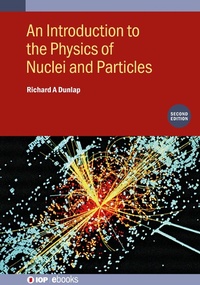
An Introduction to the Physics of Nuclei and Particles (Second Edition)
Description

The study of nuclear and particle physics provides insight into the basic behaviour of systems governed by quantum mechanics. It also has a number of practical applications including energy production by nuclear reactors and medical diagnostic and treatment techniques.
This second edition of 'An Introduction to the Physics of Nuclei and Particles' is intended as a textbook for a one semester third or fourth year undergraduate course and requires a basic background in quantum mechanics. The text covers the basic properties of nuclei and the models of nuclear structure. It also covers nuclear stability, nuclear decay processes and nuclear reactions. In particular, fission and fusion reactions are covered. The basic properties of subatomic particles are presented, and the standard model of hadronic structure is covered.
The book covers recent developments in both nuclear and particle physics. In the field of nuclear physics, these developments include alpha-clustering models and double beta decay. Recent advances in the development of nuclear fission and fusion reactors are also discussed. In the area of particle physics, the recent discovery of the Higgs boson and advancements in our knowledge of neutrino masses and oscillations are presented. The text also includes appendices describing the operation of the major categories of particle accelerators and with full solutions to the even-numbered end-of-chapter problems.
More details
Other editions
Additional editions
Person
Richard A Dunlap is a Research Professor at Dalhousie University in Canada. He joined Dalhousie University in 1981 and became a full professor in 1990. He was the director of the Dalhousie University Institute for Research in Materials from 2009 to 2015. Having published more than 300 refereed research papers, his research interests include nuclear spectroscopies, magnetic materials, quasicrystals, critical phenomena and advanced batteries materials. He is the author of thirteen books, including six with IOP ebooks.
Content
Preface
Acknowledgments
Author biography
Part I Introduction
1 Basic concepts
2 Particles and interactions
Part II Nuclear properties and models
3 Nuclear composition and size
4 Binding energy and the liquid drop model
5 The shell model
6 Properties of the nucleus
Part III Nuclear decays and reactions
7 General properties of decay processes
8 Alpha decay
9 Beta decay
10 Gamma decay
11 Nuclear reactions
12 Fission reactions
13 Fusion reactions
Part IV Particle physics
14 Particles and interactions
15 The standard model
16 Particle reactions and decays
17 The Higgs boson
18 Proton decay
19 Neutrino oscillations and masses
Appendix A: Physical constants and conversion factors
Appendix B: Properties of nuclides
Appendix C: An overview of particle accelerators
Appendix D: Solutions to even numbered problems
