

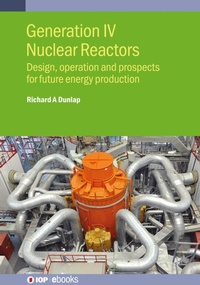
Generation IV Nuclear Reactors
Description

Nuclear fission is a low-carbon energy source that has potential application for mitigating global climate change that results from greenhouse gas emissions. At present, virtually all commercial power reactors are Generation II or Generation III thermal neutron reactors. There are a number of concerns for the continued use of such reactors.
This book provides an overview of the physics of nuclear power reactors and describes the technology behind each of the six Generation IV design. It describes past progress in each of these technologies and summarizes current research and development activities. It gives an evaluation of the advantages and disadvantages of each design and summarizes the ways in which each satisfies the criteria specified by the Generation IV International Forum. This book offers an overview of the environmental aspects of nuclear power, an introduction to the physics of fission reactors and a summary of the drawbacks of current reactor designs.
Nuclear fission power may be a more direct replacement for coal fired generating stations. However, the development of Generation IV reactors that offer improved safety and resource longevity is essential. This book uniquely fills the need for an overview of these Generation IV reactors at a level that is both understandable and informative for science and engineering students and professionals.
More details
Other editions
Additional editions
Person
Richard A. Dunlap is a Research Professor at Dalhousie University in Canada. He joined Dalhousie University after receiving his PhD in Physics from Clark University in 1981 and became a full professor in 1990. He was the director of the Dalhousie University Institute for Research in Materials from 2009 to 2015. His research interests include nuclear spectroscopies, magnetic materials, quasicrystals, critical phenomena and advanced batteries materials.
Content
Chapter 1: Our energy needs and the case for nuclear fission
Chapter 2: Some introductory nuclear physics
Chapter 3: Principles of nuclear fission reactors
Chapter 4: The early history of nuclear fission energy
Chapter 5: Curernt fission designs and teh use of nuclear energy
Chapter 6: Risks associated with nuclear energy
Chapter 7: Very-high-temperature reactors (VHTR)
Chapter 8: Molten-salt reactors (MSR)
Chapter 9: Supercritical-water-cooled reactors (SCWR)
Chapter 10: Gas-cooled fast reactors (GFR)
Chapter 11: Sodium-cooled fast reactors (SFR)
Chapter 12: Lead-cooled fast reactors (LFR)
Chapter 13: The future of nuclear energy
