

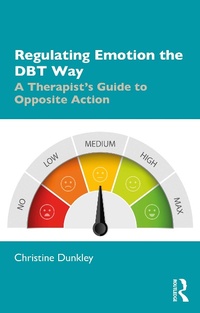
Regulating Emotion the DBT Way
A Therapist's Guide to Opposite Action
1st Edition
Published on 22. September 2020
198 pages
978-1-000-17696-4 (ISBN)
Description

Regulating Emotion the DBT Way is a practical guide to the DBT skill of 'Opposite Action', which helps clients develop the skill of up- or down-regulating their emotions when necessary. It is the skill that fosters emotional literacy in clients who have learned to fear or avoid painful feelings.
Part A of the text introduces emotion theory, describes how to validate emotions, and explains how Linehan's 'Opposite Action' skill is used to regulate problematic responses. There are examples and analogies that can be shared with clients, and clinical examples to demonstrate the key points. There is a description of how DBT therapists contextualise emotion using chain analysis. Part B dedicates a chapter to each of the basic emotions and describes its signature features. A session scenario is included allowing the reader to see how the therapist coaches the skill of opposite action, elicits behavioural rehearsal, and gives corrective feedback. There are some tips on handling common issues specific to that emotion, based on the author's extensive experience.
This book will be of interest to any therapist who wants to learn more about a behavioural approach to emotion such as psychologists, nurses, social workers, psychiatrists, counsellors, cognitive therapists, prison staff, and occupational therapists. It is an accessible explanation of emotion regulation for people who have already undertaken DBT training.
Part A of the text introduces emotion theory, describes how to validate emotions, and explains how Linehan's 'Opposite Action' skill is used to regulate problematic responses. There are examples and analogies that can be shared with clients, and clinical examples to demonstrate the key points. There is a description of how DBT therapists contextualise emotion using chain analysis. Part B dedicates a chapter to each of the basic emotions and describes its signature features. A session scenario is included allowing the reader to see how the therapist coaches the skill of opposite action, elicits behavioural rehearsal, and gives corrective feedback. There are some tips on handling common issues specific to that emotion, based on the author's extensive experience.
This book will be of interest to any therapist who wants to learn more about a behavioural approach to emotion such as psychologists, nurses, social workers, psychiatrists, counsellors, cognitive therapists, prison staff, and occupational therapists. It is an accessible explanation of emotion regulation for people who have already undertaken DBT training.
Reviews / Votes
'If you have ever struggled to help your clients emerge from their emotional pain, at last your struggles are over! In this gem of a book Christine Dunkley inducts you into the nuances of emotion regulation. She accessibly describes the underpinning theories and strategies to emotion regulation from DBT and then, in a series of simple steps, walks you through the application of these strategies for all the major families of emotions. In her clear, approachable writing style she highlights how to use DBT strategies dialectically to maximise their impact for client problems. Clinical examples are provided to illustrate the key points. This book, from an international expert trainer, will transform how you teach and shape your clients' emotion regulation skills.'Prof Michaela Swales, Consultant Clinical Psychologist and Director North Wales Clinical Psychology Program, Bangor University.
"If you have not been lucky enough to attend training where Christine imparts her wisdom about emotions, this is the next best thing! A 'must have' for anyone wanting to understand more about emotions or teach emotion regulation skills to clients."
Dr Emily Fox, Chair, Society for DBT, UK and Ireland
This is THE book for any clinician who is truly committed to helping their clients free themselves from intense emotional pain and suffering. The form and function of each emotion is beautifully described in user friendly terms that are easily transmitted to clients. The case vignettes are realistic and helpful, encompassing many scenarios a clinician and client might encounter in the journey to increased emotion regulation skills.
Amy Gaglia, Senior Trainer British Isles DBT Training team.
The genius accessibility of this book will come as no surprise to anyone who has heard Christine speak about emotional regulation. This text should become a core read for any clinician, novice or expert, in developing greater emotional fluency to work effectively with clients who are emotionally phobic. The anecdotes and scenarios allow the reader a glimpse into the therapy session, to learn how to engage the client in behavioural rehearsal after walking through the steps of discerning, raising or lowering their affect to the required level.
Pamela Henderson Consultant Clinical Psychologist and Head of Psychological Services, locked rehabilitation hospital
"No other book I have read explains so clearly and succinctly how to teach a client to regulate their emotions. This book stands out for its ability to explain opposite action, using client scenarios that enhance the therapist's ability to replicate the techniques in therapy. This book will transform how opposite action is taught and is a must read for all therapists."
Dr.Rebecca Wallace, Area Lead NHS CMHT Principal Clinical Psychologist. 'If you have ever struggled to help your clients emerge from their emotional pain, at last your struggles are over! In this gem of a book Christine Dunkley inducts you into the nuances of emotion regulation. She accessibly describes the underpinning theories and strategies to emotion regulation from DBT and then, in a series of simple steps, walks you through the application of these strategies for all the major families of emotions. In her clear, approachable writing style she highlights how to use DBT strategies dialectically to maximise their impact for client problems. Clinical examples are provided to illustrate the key points. This book, from an international expert trainer, will transform how you teach and shape your clients' emotion regulation skills.'
Prof Michaela Swales, Consultant Clinical Psychologist and Director North Wales Clinical Psychology Program, Bangor University.
'If you have not been lucky enough to attend training where Christine imparts her wisdom about emotions, this is the next best thing! A "must have" for anyone wanting to understand more about emotions or teach emotion regulation skills to clients.'
Dr Emily Fox, Chair, Society for DBT, UK and Ireland
'This is THE book for any clinician who is truly committed to helping their clients free themselves from intense emotional pain and suffering. The form and function of each emotion is beautifully described in user friendly terms that are easily transmitted to clients. The case vignettes are realistic and helpful, encompassing many scenarios a clinician and client might encounter in the journey to increased emotion regulation skills.'
Amy Gaglia, Senior Trainer British Isles DBT Training team.
'The genius accessibility of this book will come as no surprise to anyone who has heard Christine speak about emotional regulation. This text should become a core read for any clinician, novice or expert, in developing greater emotional fluency to work effectively with clients who are emotionally phobic. The anecdotes and scenarios allow the reader a glimpse into the therapy session, to learn how to engage the client in behavioural rehearsal after walking through the steps of discerning, raising or lowering their affect to the required level.'
Pamela Henderson Consultant Clinical Psychologist and Head of Psychological Services, locked rehabilitation hospital
'No other book I have read explains so clearly and succinctly how to teach a client to regulate their emotions. This book stands out for its ability to explain opposite action, using client scenarios that enhance the therapist's ability to replicate the techniques in therapy. This book will transform how opposite action is taught and is a must read for all therapists.'
Dr Rebecca Wallace, Area Lead NHS CMHT Principal Clinical Psychologist
More details
Edition
1. Auflage
Language
English
Place of publication
London
United Kingdom
Publishing group
Taylor & Francis Ltd
Target group
College/higher education
Professional and scholarly
Illustrations
2 Tables, black and white; 1 Line drawings, black and white; 1 Illustrations, black and white
File size
2,29 MB
ISBN-13
978-1-000-17696-4 (9781000176964)
Copyright in bibliographic data and cover images is held by Nielsen Book Services Limited or by the publishers or by their respective licensors: all rights reserved.
Schweitzer Classification
Other editions
Additional editions
Book
09/2020
1st Edition
Routledge
€175.40
Shipment within 15-20 days
Book
09/2020
1st Edition
Routledge
€37.50
Shipment within 15-20 days
Person
Christine Dunkley, DClinP, is a consultant trainer with the British Isles DBT training team, and a fellow of the Society for DBT in the UK and Ireland. She has 20 years of working experience with self-harming patients in the NHS.
Content
Part A Emotion Regulation Theory 1 Emotion Regulation and Dialectics; 2 Emotion Functions and Forms; 3 The Theory of 'Opposite Action'; 4 Emotion Validation; 5 Problem-solving; Part B Regulating Specific Emotions 6 Sadness; 7 Anger; 8 Fear and Anxiety; 9 Joy; 10 Guilt; 11 Shame; 12 Disgust; 13 Envy and Jealousy; 14 Secondary Emotions and Contingencies
