

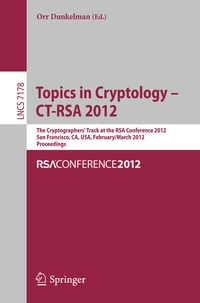
Topics in Cryptology - CT-RSA 2012
The Cryptographers' Track at the RSA Conference 2012, San Francisco, CA, USA, February 27 - March 2, 2012, Proceedings
Published on 23. February 2012
XI, 434 pages
978-3-642-27954-6 (ISBN)
Description

This book constitutes the refereed proceedings of the Cryptographers' Track at the RSA Conference 2012, CT-RSA 2012, held in San Francisco, CA, USA, in February/March 2012. The 26 revised full papers presented were carefully reviewed and selected from 113 submissions. The papers are organized in topical sections on side channel attacks, digital signatures, public-key encryption, cryptographic protocols, secure implementation methods, symmetric key primitives, and secure multiparty computation.
More details
Other editions
Additional editions
Orr Dunkelman
Topics in Cryptology - CT-RSA 2012
The Cryptographers' Track at the RSA Conference 2012, San Francisco, CA, USA, February 27 - March 2, 2012, Proceedings
Book
01/2012
1st Edition
Springer
€53.49
Shipment within 7-9 days
Content
- Title
- Preface
- Table of Contents
- Side Channel Attacks I
- Black-Box Side-Channel Attacks Highlight the Importance of Countermeasures: An Analysis of the Xilinx Virtex-4 and Virtex-5 Bitstream Encryption Mechanism
- Introduction
- Content of This Paper
- Introduction to FPGAs
- FPGA Security
- Bitstream Vulnerabilities
- IP Protection for FPGAs
- Real-World Attacks
- Side-Channel Analysis Attacks
- Introduction to Side-Channel Analysis Attacks
- Measurement Setup
- Introductory Experiments
- Implemented Attack
- Countermeasures
- Implementing the Attack
- Employing nVidia's CUDA
- Attack Results
- Differences to Virtex-5
- Conclusion
- References
- Power Analysis of Atmel CryptoMemory - Recovering Keys from Secure EEPROMs
- Introduction
- Background
- Developing an Attack Path
- Experimental Setup
- Initial Investigation of Power Traces
- Overcoming Authentication Attempt Counters
- Power Analysis Attack
- Implications and Countermeasures
- Conclusions
- References
- Digital Signatures I
- Short Transitive Signatures for Directed Trees
- Introduction
- Preliminaries
- Collision-Resistant Hashing with Common-Prefix Proofs
- Short Transitive Signatures for Directed Trees
- Basic Construction
- Full Construction
- Conclusion
- References
- Short Attribute-Based Signatures for Threshold Predicates
- Introduction
- Background
- Complexity Assumptions
- Groth-Sahai Proof Systems
- Syntax of Threshold Attribute-Based Signatures
- Security of Threshold Attribute-Based Signatures
- A First Short Attribute-Based Signature Scheme for Threshold Predicates
- A Second Short Attribute-Based Signature Scheme for Threshold Predicates
- More General Signing Predicates
- Extensions for the First Scheme
- Extensions for the Second Scheme
- References
- Public-Key Encryption I
- Reducing the Key Size of Rainbow Using Non-commutative Rings
- Introduction
- Related Works
- OriginalRainbow
- Scheme
- Rainbow Key Sizes
- Attacks against Rainbow
- Our Proposed Scheme
- Non-commutative Rings
- Our Construction
- Key Size in NC-Rainbow
- Security Analysis
- Reducing NC-Rainbow to Rainbow
- Security against Known Attacks
- Key Size in Our NC-Rainbow
- Reason for Secret Key Size Reduction
- Secure Parameters and Their Key Size
- Efficiency Comparison
- Concluding Remarks
- References
- A Duality in Space Usage between Left-to-Right and Right-to-Left Exponentiation
- Introduction
- Notation and Addition Chains
- The Dual of a Location-Aware Chain
- Example
- Preserving the Number of Multiplications
- Preserving the Chain Output under Duality
- Mixed Base Representations
- A New Compact Exponentiation Algorithm
- Miscellaneous Space Issues for Dual Chains
- Conclusion
- References
- Optimal Eta Pairing on Supersingular Genus-2 Binary Hyperelliptic Curves
- Introduction
- Background Material and Notations
- Reminder on Hyperelliptic Curves
- Hyperelliptic Tate Pairing
- Eta Pairing on Supersingular Genus-2 Binary Curves
- Curve Definition and Basic Properties
- Distortion Maps
- Modified Tate Pairing on Cd
- Choosing an Efficient Pairing
- Eta Pairing on Cd
- Optimal Eta Pairing on Cd
- Construction and Definition
- Computing [c0,c1]
- Evaluation of the Complexity
- Software Implementation
- FPGA Implementation
- Conclusion and Perspectives
- References
- Cryptographic Protocols I
- On the Joint Security of Encryption and Signature in EMV
- Introduction
- An Attack on Combined Signature and Encryption Schemes from EMV
- Application of the Attack to EMV
- Security Analysis of Combined Encryption and Signature for Elliptic Curve Algorithms
- Security Models for Joint Security
- ECIES, EC-Schnorr and EC-DSA in a Nutshell
- On the Joint Security of ECIES and EC-Schnorr
- On the Joint Security of ECIES and EC-DSA
- Conclusions
- References
- New Constructions of Efficient Simulation-Sound Commitments Using Encryption and Their Applications
- Introduction
- Simulation-Sound Commitments
- Our Results
- Preliminaries
- Simulation-Sound Trap-Door Commitment Scheme
- (Tag-Based) Key Encapsulation Mechanisms
- Sigma-Protocol
- Generic Construction of cMiM Secure IDs
- Weak Extractable Sigma-Protocol
- TheSSTC Schemes
- The 2-Round SSTC Scheme from Publicly Verifiable OW-ftCCA Tag-KEM
- The 5-Round SSTC Scheme from OW-ftCCA Tag-KEM
- Applications
- Instantiations
- 2-Round, CDH-Based Implementation
- 5-Round, Factoring-Based Implementation
- Comparison
- References
- Secure Implementation Methods
- A First-Order Leak-Free Masking Countermeasure
- Introduction
- Preliminaries
- Secure Computation against 1O-DPA Using ROMs
- Detailed Description of GLUT Method
- Leakage of the ROM-Based 1O-DPA Protection Implementation
- Towards a New Masking Function
- Study in the Idealized Model
- Our Proposal
- Security Evaluation
- Application to the Software Implementation Case
- Study in the Imperfect Model
- Conclusion and Perspectives
- References
- Practical Realisation and Elimination of an ECC-Related Software Bug Attack
- Introduction
- Background and Analysis
- OpenSSL Implementation of NIST Standard Curves
- ECC Cipher Suites for TLS
- OpenSSL Implementation of the ECC Cipher Suites
- An Attack on ECDH in OpenSSL
- Approaches to Formal Verification
- Conclusions
- References
- Symmetric Key Primitives
- A New Pseudorandom Generator from Collision-Resistant Hash Functions
- Introduction
- Related Work
- Our Result
- Preliminaries
- Hash Functions and Their Security
- Hardcore Predicate
- Pseudorandom Generator
- PRG from Iterates
- Our PRG Construction
- Proof of Theorem 5
- Relaxing the Regularity Assumption
- Conclusion
- References
- PMAC with Parity: Minimizing the Query-Length Influence
- Introduction
- Preliminaries
- Description of the New Mode
- Security Proofs
- Smaller-Rate Versions
- Concluding Remarks
- References
- Boomerang Attacks on Hash Function Using Auxiliary Differentials
- Introduction
- The Boomerang Attack
- Amplified Probabilities
- Related-Key Boomerang
- Application to the Known-Key Setting
- Application to Hash Function
- Boomerang Attack Using Auxiliary Differentials
- Application to Skein
- Round-Reduced Differential Trails in Skein-256
- Description of the Attack on Skein-256
- Extensions and Limitations
- Extension to More Rounds
- Application to Skein-512
- Conclusions
- References
- Side Channel Attacks II
- Localized Electromagnetic Analysis of Cryptographic Implementations
- Introduction
- Localized EM Analysis
- Attacking Binary Exponentiation Algorithms
- ECC Case Study - A Proof-of-Concept
- ECSM Implementation
- Measurement Setup
- Template Attack
- Countermeasures
- Conclusion
- References
- Towards Different Flavors of Combined Side Channel Attacks
- Introduction
- Power Analysis: General Background
- The Principle
- Combination of Distinguishers
- Mathematical Background
- Gini Correlation: A Mixture of Pearson and Spearman Coefficients
- Pearson-Spearman Combination: An Empirical Approach
- Experimental Results and Discussion
- Combination of Measurements
- Theoretical Background
- Practical Results
- Conclusion
- References
- Digital Signatures II
- Two-Dimensional Representation of Cover Free Families and Its Applications: Short Signatures and More
- Introduction
- Preliminaries
- Number Theoretic Assumptions
- Syntax and Security Notions
- Programmable Hash Functions (HK08)
- Our Basic Idea and Its Direct Applications
- Two-Dimensional Representation of Cover Free Family
- q-Resilient IBKEM
- IND-q-CCA Secure KEM with Shorter Public Keys
- Multiple-Time Signature with Shorter Public Key
- Short Signature with Smaller Public Key Size
- Construction
- Security
- Comparison with the Previous Scheme
- References
- Secure Computation, I/O-Efficient Algorithms and Distributed Signatures
- Introduction
- Preliminaries
- The Main Functionality
- The Protocols
- Passively Secure Implementation of F
- Implementation for Malicious Servers and Players
- A Scalable Method for Handling Malicious Players and Servers
- Implementation of FRand
- Running Oblivious Algorithms on F
- Example Applications
- References
- Cryptographic Protocols II
- Delegatable Homomorphic Encryption with Applications to Secure Outsourcing of Computation
- Introduction
- Delegatable Homomorphic Encryption
- Verifiable Functional Encryption
- MACs with Chameleon Keys
- Details of the VFE Construction
- A Strongly Secure DHE Scheme
- Secure Verifiable Computation from DHE
- Concluding Remarks
- References
- Efficient RSA Key Generation and Threshold Paillier in the Two-Party Setting
- Introduction
- Preliminaries
- A Distributed Generation of an RSA Composite
- The Biprimality Test
- A Complete Threshold Paillier Cryptosystem
- A Distributed Decryption for Paillier
- The Efficiency of Our Protocols
- References
- Public-Key Encryption II
- Plaintext-Checkable Encryption
- Introduction
- Plaintext-Checkable Encryption
- Definition of Plaintext-Checkable Encryption
- A Taxonomy of Indistinguishability
- Generic Constructions for PCE in the ROM
- A PCE Based on a Probabilistic Encryption Scheme
- A PCE Based on a Deterministic Encryption Scheme
- Practical Constructions in the Standard Model
- An ElGamal-Based Construction
- Security Arguments
- Application to VLR Group Signature
- Definitions for Group Signatures with VLR
- Using PCE for Group Signatures with VLR
- Our Concrete Instantiation
- Backward-Unlinkable Anonymity
- Comparison with Related Work
- Conclusion
- References
- Generic Construction of Chosen Ciphertext Secure Proxy Re-Encryption
- Introduction
- Preliminaries
- Public Key Encryption
- Strongly Unforgeable Signature
- Single Use Unidirectional Proxy Re-Encryption
- Difference from Previous Security Definitions
- Resplittable Threshold Public Key Encryption
- Resplittability in Threshold Public Key Encryption
- Concrete Resplittable Threshold Public Key Encryption
- Generic Construction of SUPRE Based on TPKE
- References
- Side Channel Attacks III
- A New Difference Method for Side-Channel Analysis with High-Dimensional Leakage Models
- Introduction
- Extrinsic and Environmental Influences on Side-Channel Evaluation Process
- Impact of Environmental Conditions
- A Novel Method for Effective Offset Elimination
- The 'Normal' Stochastic Approach: A Brief Summary
- SA-OTM: A New Variant of SA
- On the Selection of Stochastic Leakage Models
- High-Dimensional Subspaces for SA-OTM
- Leakage Models for the Stochastic Approach
- Symmetry
- Experimental Analysis
- Conclusion
- References
- Getting More from PCA: First Results of Using Principal Component Analysis for Extensive Power Analysis
- Introduction
- Principal Component Analysis
- Example
- PCA Transformation
- Assumptions and Properties of PCA-Transformed Data
- Multiple Leakage Points and PCA
- Noise Reduction
- Experiments
- Noise Reduction
- PCA Transformation
- PCA on Misaligned Traces
- Comparison to Other Alignment Techniques
- Conclusions
- References
- Secure Multiparty Computation
- An Efficient Protocol for Oblivious DFA Evaluation and Applications
- Introduction
- Our Contributions
- Related Work
- Preliminaries
- Notations
- DFA and Its Matrix Representation
- DFA
- DFA Matrix
- Permuted DFA Matrix
- An Efficient Protocol for Oblivious DFA Evaluation
- A High Level Overview
- The Protocol 1
- Security Proof
- Using OT Extension
- A Different Presentation of Our Protocol
- Efficiency
- Counting Accepting States and Secure Pattern Matching
- Third Variant: Number of Locations of p in T
- Implementation and Experimental Results
- OT Implementation
- Experiments
- References
- Secure Multi-Party Computation of Boolean Circuits with Applications to Privacy in On-Line Marketplaces
- Introduction
- Our Contributions
- Other Related Work
- MPC Implementation
- Overview of the GMW Protocol
- Oblivious-Transfer Protocols
- Implementation Details
- Circuit Example
- Problem Definitions
- P2P Content-Distribution Services
- Cloud Computing
- Mobile Social Networks
- Boolean-Circuit Constructions
- Performance Evaluation
- Local-Area Network
- Wide-Area Network
- Conclusions
- References
- Author Index
