

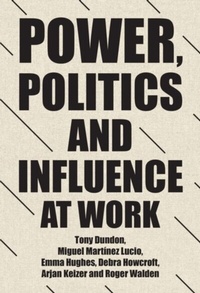
Power, Politics and Influence at Work
1st Edition
Published on 1. September 2020
168 pages
978-1-5261-5711-9 (ISBN)
Description

This book explores how power operates in workplace settings at local, national and transnational levels. It argues that how people are valued in and out of work is a political dynamic, which reflects and shapes how societies treat their citizens.
Offering vital resources for activists and students on labour rights, employment issues and trade unions, this book argues that the influence workers can exert is changing dramatically and future challenges for change can be positive and progressive. -- .
Offering vital resources for activists and students on labour rights, employment issues and trade unions, this book argues that the influence workers can exert is changing dramatically and future challenges for change can be positive and progressive. -- .
Reviews / Votes
'The authors have provided an important contribution to the crucial debates of our time: what is happening to workers in our rapidly transforming world of work; and more importantly, what can be done to move it in the right direction so that we steer digital, climate and demographic transitions towards decent work for all.'Guy Ryder, Director-General, International Labour Organization
'This new book on work and employment does what it says in the title and puts power, politics and influence at the heart of the analysis of changing employment relations. This is a welcome antidote to the often depoliticised actions of labour market change as the inevitable consequence of unstoppable forces of globalisation or new technologies. This is a book that should be read not only by students and academics but also by labour activists and trade union representatives as it has a two-fold ambition, first to develop a more politically-informed understanding of changing employment relations but second to offer insights into how to try to shape a better future for labour through new political strategies, new alliances and new forms of collectivism.'
Jill Rubery, Professor of Comparative Employment Systems, University of Manchester
'In today's globalised world corporations have been able to reorganise work in ways that transfers risk away from capital and onto working people. The result is more inequality, more insecure work and persistently low wage growth. This book is a welcome and accessible contribution to understanding what's happening and examines pathways for unions and collective action to swing the pendulum back towards working people.'
Sally McManus, Secretary of the Australian Council of Trade Unions
'Written explicitly for activists and those with a commitment to the labour movement, this valuable book provides a concise guide to the challenges facing trade unions and the strategies they can use to improve the experience of work. Power, Politics and Influence at Work is bang-up-to-date, well-informed, clearly written and provocative. It is an essential resource for all those seeking to build power for working people.'
Edmund Heery, Professor of Employment Relations, Cardiff University -- .
More details
Series
Language
English
Place of publication
Manchester
United Kingdom
Target group
College/higher education
Professional and scholarly
Edition type
Digital original
Illustrations
14 black & white illustrations; 5 tables
14 black & white illustrations; 5 tables
ISBN-13
978-1-5261-5711-9 (9781526157119)
Copyright in bibliographic data and cover images is held by Nielsen Book Services Limited or by the publishers or by their respective licensors: all rights reserved.
Schweitzer Classification
Other editions
Additional editions
Tony Dundon | Miguel Martinez Lucio | Emma Hughes
Power, Politics and Influence at Work
Book
08/2020
Manchester University Press
€24.30
Shipment within 15-20 days
Persons
Tony Dundon is Professor of Human Resource Management (HRM) and Employment Relations for the Kemmy Business School at the University of Limerick, Ireland and Visiting Professor for the Work and Equalities Institute at the University of Manchester
Miguel Martinez Lucio is Professor in the HRM, Employment Relations and Employment Law Group for the Work and Equalities Institute at the University of Manchester
Emma Hughes is a Lecturer in HRM at the University of Liverpool Management School
Debra Howcroft is Professor of Technology and Organisation for the Work and Equalities Institute at the University of Manchester
Arjan Keizer is a Senior Lecturer in Comparative HRM and Industrial Relations in the HRM, Employment Relations and Employment Law Group for the Work and Equalities Institute at the University of Manchester
Roger Walden is an Honorary Lecturer in Labour and Employment Law at Alliance Manchester Business School at the University of Manchester -- .
Miguel Martinez Lucio is Professor in the HRM, Employment Relations and Employment Law Group for the Work and Equalities Institute at the University of Manchester
Emma Hughes is a Lecturer in HRM at the University of Liverpool Management School
Debra Howcroft is Professor of Technology and Organisation for the Work and Equalities Institute at the University of Manchester
Arjan Keizer is a Senior Lecturer in Comparative HRM and Industrial Relations in the HRM, Employment Relations and Employment Law Group for the Work and Equalities Institute at the University of Manchester
Roger Walden is an Honorary Lecturer in Labour and Employment Law at Alliance Manchester Business School at the University of Manchester -- .
Content
1 Work, power and politics
2 History, global capitalism and contexts
3 The State, law and equality
4 Who speaks for whom?
5 The futures of work: power, politics and influence
Bibliography
Index -- .
2 History, global capitalism and contexts
3 The State, law and equality
4 Who speaks for whom?
5 The futures of work: power, politics and influence
Bibliography
Index -- .
