

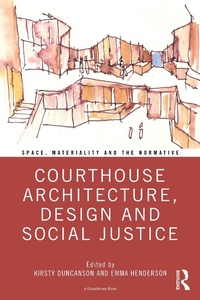
Courthouse Architecture, Design and Social Justice
1st Edition
Published on 28. September 2021
246 pages
978-0-429-59608-7 (ISBN)
Description

This collection interrogates relationships between court architecture and social justice, from consultation and design to the impact of material (and immaterial) forms on court users, through the lenses of architecture, law, socio-legal studies, criminology, anthropology, and a former senior federal judge.
International multidisciplinary collaborations and single-author contributions traverse a range of methodological approaches to present new insights into the relationship between architecture, design, and justice. These include praxis, photography, reflections on process and decolonising practice, postcolonial, feminist, and poststructural analysis, and theory from critical legal scholarship, political science, criminology, literature, sociology, and architecture. While the opening contributions reflect on establishing design principles and architectural methodologies for ethical consultation and collaboration with communities historically marginalised and exploited by law, the central chapters explore the textures and affects of built forms and the spaces between; examining the disjuncture between design intention and use; and investigating the impact of architecture and the design of space. The collection finishes with contemplations of the very real significance of material presence or absence in courtroom spaces and what this might mean for justice.
Courthouse Architecture, Design and Social Justice provides tools for those engaged in creating, and reflecting on, ethical design and building use, and deepens the dialogue across disciplinary boundaries towards further collaborative work in the field. It also exists as a new resource for research and teaching, facilitating undergraduate critical thought about the ways in which design enhances and restricts access to justice.
International multidisciplinary collaborations and single-author contributions traverse a range of methodological approaches to present new insights into the relationship between architecture, design, and justice. These include praxis, photography, reflections on process and decolonising practice, postcolonial, feminist, and poststructural analysis, and theory from critical legal scholarship, political science, criminology, literature, sociology, and architecture. While the opening contributions reflect on establishing design principles and architectural methodologies for ethical consultation and collaboration with communities historically marginalised and exploited by law, the central chapters explore the textures and affects of built forms and the spaces between; examining the disjuncture between design intention and use; and investigating the impact of architecture and the design of space. The collection finishes with contemplations of the very real significance of material presence or absence in courtroom spaces and what this might mean for justice.
Courthouse Architecture, Design and Social Justice provides tools for those engaged in creating, and reflecting on, ethical design and building use, and deepens the dialogue across disciplinary boundaries towards further collaborative work in the field. It also exists as a new resource for research and teaching, facilitating undergraduate critical thought about the ways in which design enhances and restricts access to justice.
More details
Series
Edition
1. Auflage
Language
English
Place of publication
London
United Kingdom
Publishing group
Taylor & Francis Ltd
Target group
College/higher education
Illustrations
1 Tables, black and white; 1 Line drawings, black and white; 28 Halftones, color; 13 Halftones, black and white; 42 Illustrations, black and white
ISBN-13
978-0-429-59608-7 (9780429596087)
Copyright in bibliographic data and cover images is held by Nielsen Book Services Limited or by the publishers or by their respective licensors: all rights reserved.
Schweitzer Classification
Other editions
Additional editions
Kirsty Duncanson | Emma Henderson
Courthouse Architecture, Design and Social Justice
Book
09/2021
1st Edition
Routledge
€226.00
Shipment within 15-20 days
Kirsty Duncanson | Emma Henderson
Courthouse Architecture, Design and Social Justice
Book
09/2021
1st Edition
Routledge
€70.83
Shipment within 10-20 days
Persons
Kirsty Duncanson is Senior Lecturer in the Department of Social Inquiry at La Trobe University, Australia.
Emma Henderson is Director of Graduate Research in the Law School at La Trobe University, Australia.
Emma Henderson is Director of Graduate Research in the Law School at La Trobe University, Australia.
Content
Foreword (Judith Resnik) Introduction (Kirsty Henderson and Emma Duncanson Part I: Building Justice 1. The Kununurra Courthouse (Martyn Hook and Elizabeth Grant) 2. The architecture of law courts: How concepts of justice - light, transparency, access and equality - drove the design of new and renovated courthouses for federal courts in Australia (Michael Black) Part II: Justice Buildings 3. Refractions of Legal Justice (forensic precinct Series 2) (Peter Rush) 4. Indigenous courthouse and courtroom design in Australia: Case studies, design paradigms and the issue of cultural agency Murphy, Grant and Anthony 5. Interpellation By Design: Could Court Buildings Influence Jury Decision Making? (Kirsty Duncanson and Emma Henderson) 6. The Child Sexual Assault Trials: Reconceptualising the Design of Court Spaces According to Trauma Informed Principles (Annie Cossins and Emma Rowden) Part III: Justice Outwith Buildings 7. 'And that's why street wise complainants now always give evidence behind screens, live': Exploring the Intensive Affects of the Court Room (Anna Carline, Clare Gunby and Jamie Murray) 8. Digital Justice and Video Links: Connecting and Conflating courtroom and carceral space (Carolyn McKay)
