

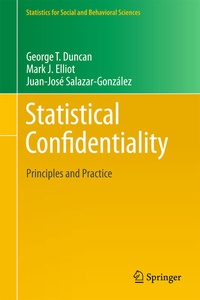
Statistical Confidentiality
Description

<font face="Arial"><font face="Arial">Because statistical confidentiality embraces the responsibility for both protecting data and ensuring its beneficial use for statistical purposes, those working with personal and proprietary data can benefit from the principles and practices this book presents. Researchers can understand why an agency holding statistical data does not respond well to the demand, “Just give me the data; I’m only going to do good things with it.” Statisticians can incorporate the requirements of statistical confidentiality into their methodologies for data collection and analysis. Data stewards, caught between those eager for data and those who worry about confidentiality, can use the tools of statistical confidentiality toward satisfying both groups.
The eight chapters lay out the dilemma of data stewardship organizations (such as statistical agencies) in resolving the tension between protecting data from snoopers while providing data to legitimate users, explain disclosure risk and explore the types of attack that a data snooper might mount, present the methods of disclosure risk assessment, give techniques for statistical disclosure limitation of both tabular data and microdata, identify measures of the impact of disclosure limitation on data utility, provide restricted access methods as administrative procedures for disclosure control, and finally explore the future of statistical confidentiality.</font></font>
Reviews / Votes
From the reviews:
"This is an interesting book that should be read not only by statisticians but by every person involved with managing large amounts of data. . The book is aimed at people looking for protecting their statistical data bases. . The authors quote the importance of the problems that academics ought to study for aiding the research that governmental statisticians are doing. A glossary with more than 60 terms is given at the end of the book together with more than bibliographic 200 entries." (Carlos Narciso Bouza Herrera, Zentralblatt MATH, Vol. 1233, 2012)
"This book deals with a highly sensitive issue which is growing more and more important as data capture and analysis technologies continue to advance. . It is very accessible, and would be an ideal entry portal for anyone concerned with statistical confidentiality or who is about to begin work in this area. . given the importance of the area, many others not working directly on such matters would benefit from an awareness of the topics it discusses." (David J. Hand, International Statistical Review, Vol. 80 (3), 2012)
More details
Other editions
Additional editions
Persons
<font face="Arial">George T. Duncan is Professor of Statistics, Emeritus, Carnegie Mellon University. He chaired the National Academy of Sciences Panel on Confidentiality and Data Access. Mark Elliot is lecturer in social statistics at Manchester University in the UK, consultant to data stewardship organisations worldwide, and inventor of methods for assessing disclosure risk. J.J. Salazar is Professor of Statistics and Operations Research at University of La Laguna (Tenerife, Spain). He has participated in several EU research projects and his algorithms to protect tabular data. are available through the software τ-ARGUS He has taught courses on data protection for several national statistical offices.</font>
Content
Why statistical confidentiality?- Concepts of statistical disclosure limitation.- Assessment of disclosure risk.- Protecting tabular data.- Providing and protecting microdata.- Disclosure rRisk and data utility.- Restrictions on data access.- Thoughts on the future.
