

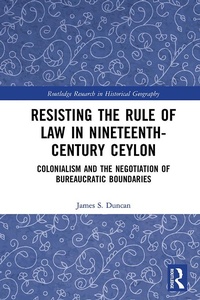
Resisting the Rule of Law in Nineteenth-Century Ceylon
Colonialism and the Negotiation of Bureaucratic Boundaries
1st Edition
Published on 9. June 2020
278 pages
978-1-000-08982-0 (ISBN)
Description

This book offers in-depth insights on the struggles implementing the rule of law in nineteenth century Ceylon, introduced into the colonies by the British as their "greatest gift." The book argues that resistance can be understood as a form of negotiation to lessen oppressive colonial conditions, and that the cumulative impact caused continual adjustments to the criminal justice system, weighing it down and distorting it.
The tactical use of rule of law is explored within the three bureaucracies: the police, the courts and the prisons. Policing was often "governed at a distance" due to fiscal constraints and economic priorities and the enforcement of law was often delegated to underpaid Ceylonese. Spaces of resistance opened up as Ceylon was largely left to manage its own affairs. Villagers, minor officials, as well as senior British government officials, alternately used or subverted the rule of law to achieve their own goals. In the courts, the imported system lacked political legitimacy and consequently the Ceylonese undermined it by embracing it with false cases and information, in the interests of achieving justice as they saw it. In the prisons, administrators developed numerous biopolitical techniques and medical experiments in order to punish prisoners' bodies to their absolute lawful limit. This limit was one which prison officials, prisoners, and doctors negotiated continuously over the decades.
The book argues that the struggles around rule of law can best be understood not in terms of a dualism of bureaucrats versus the public, but rather as a set of shifting alliances across permeable bureaucratic boundaries. It offers innovative perspectives, comparing the Ceylonese experiences to those of Britain and India, and where appropriate to other European colonies. This book will appeal to those interested in law, history, postcolonial studies, cultural studies, cultural and political geography.
The tactical use of rule of law is explored within the three bureaucracies: the police, the courts and the prisons. Policing was often "governed at a distance" due to fiscal constraints and economic priorities and the enforcement of law was often delegated to underpaid Ceylonese. Spaces of resistance opened up as Ceylon was largely left to manage its own affairs. Villagers, minor officials, as well as senior British government officials, alternately used or subverted the rule of law to achieve their own goals. In the courts, the imported system lacked political legitimacy and consequently the Ceylonese undermined it by embracing it with false cases and information, in the interests of achieving justice as they saw it. In the prisons, administrators developed numerous biopolitical techniques and medical experiments in order to punish prisoners' bodies to their absolute lawful limit. This limit was one which prison officials, prisoners, and doctors negotiated continuously over the decades.
The book argues that the struggles around rule of law can best be understood not in terms of a dualism of bureaucrats versus the public, but rather as a set of shifting alliances across permeable bureaucratic boundaries. It offers innovative perspectives, comparing the Ceylonese experiences to those of Britain and India, and where appropriate to other European colonies. This book will appeal to those interested in law, history, postcolonial studies, cultural studies, cultural and political geography.
More details
Series
Edition
1. Auflage
Language
English
Place of publication
London
United Kingdom
Publishing group
Taylor & Francis Ltd
Target group
College/higher education
Illustrations
6 Tables, black and white; 6 Line drawings, black and white; 4 Halftones, black and white; 10 Illustrations, black and white
ISBN-13
978-1-000-08982-0 (9781000089820)
Copyright in bibliographic data and cover images is held by Nielsen Book Services Limited or by the publishers or by their respective licensors: all rights reserved.
Schweitzer Classification
Other editions
Additional editions
James S. Duncan
Resisting the Rule of Law in Nineteenth-Century Ceylon
Colonialism and the Negotiation of Bureaucratic Boundaries
Book
04/2022
1st Edition
Routledge
€52.07
Shipment within 15-20 days
James S. Duncan
Resisting the Rule of Law in Nineteenth-Century Ceylon
Colonialism and the Negotiation of Bureaucratic Boundaries
Book
07/2020
1st Edition
Routledge
€206.60
Shipment within 15-20 days
James Stuart Duncan
Resisting the Rule of Law in Nineteenth Century Ceylon
Colonialism and the Negotiation of Bureaucratic Boundaries
Book
07/2020
Taylor & Francis
Unfortunately, price unknown
Available (delivery time upon request)
Person
James S. Duncan was Reader in Cultural Geography, University of Cambridge until his retirement. He is now Emeritus Fellow of Emmanuel College. His research interests are cultural and historical geography, South Asian history and history of law.
Content
Part 1: Introduction. 1. Introduction. 2. Criminological Theories and the "Men on the Spot". Part 2: The Police and the Arts of Subterfuge. 3. Struggles in Time and Space: Policing the Towns. 4. Governing at a Distance: Policing the Countryside. Part 3: The Courts and the Arts of Dissembling. 5. Taking Liberties: The Court Bureaucracy and its Discontents. 6. Speaking Lies to Power: How the Ceylonese Used the Courts. Part 4: The Prison and the Arts of Dark Biopower. 7. Creating Spaces of Deterrence. 8. Experiments in the Production of Bodily Suffering. 9. Determining the Limits of Bare Life. 10. Conclusion. Bibliography. Index.
