

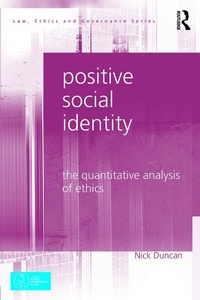
Positive Social Identity
The Quantitative Analysis of Ethics
1st Edition
Published on 18. May 2017
270 pages
978-1-317-07762-6 (ISBN)
Description

Despite considerable work the answer to basic questions such as 'what are our ethics and our moral norms now?' 'Have they changed since last year?', 'If so why?' remain surprisingly illusive.
This book argues that progress towards answering these questions is possible through a grounded analytical account of the cultivation of ethics and moral norms in social groups, in particular places and times.
Departing from the evolutionary theory of why we gain value from pro-social behaviour, we argue that a coherent thread exists for how we do so through evolved social capacities that are united in the pursuit of a Positive Social Identity.
Drawing on a unique quantitative dataset from Sierra Leone this book offers a theoretical framework and a preliminary guide to the systematic quantitative analysis of ethics and moral norms and how these may relate to the long term success of organisations.
The results directly challenge a 'one-size-fits-all', universal understanding of both ethics and moral norms both within and between organisations. The costs and challenges influencing the development of ethics and moral norms and their ultimate conception of pro-sociality vary dramatically according to situation. Nowhere is this more starkly illustrated than between economically developed and developing countries.
In analysing the relationship between agency and situation, the role of diversity, conflict, inefficiency and failure to cooperate prove to be essential components of the solution of social dilemmas on which Positive Social Identity depends.
This book argues that progress towards answering these questions is possible through a grounded analytical account of the cultivation of ethics and moral norms in social groups, in particular places and times.
Departing from the evolutionary theory of why we gain value from pro-social behaviour, we argue that a coherent thread exists for how we do so through evolved social capacities that are united in the pursuit of a Positive Social Identity.
Drawing on a unique quantitative dataset from Sierra Leone this book offers a theoretical framework and a preliminary guide to the systematic quantitative analysis of ethics and moral norms and how these may relate to the long term success of organisations.
The results directly challenge a 'one-size-fits-all', universal understanding of both ethics and moral norms both within and between organisations. The costs and challenges influencing the development of ethics and moral norms and their ultimate conception of pro-sociality vary dramatically according to situation. Nowhere is this more starkly illustrated than between economically developed and developing countries.
In analysing the relationship between agency and situation, the role of diversity, conflict, inefficiency and failure to cooperate prove to be essential components of the solution of social dilemmas on which Positive Social Identity depends.
Reviews / Votes
'Blending insights from psychology, organisational theory and economics, Nick Duncan provides a powerful account of the ethical basis of organisational change. This book will be an important reference for scholars interested in understanding why and how organisations change.'Kunal Sen, Professor of Development Economics, Global Development Institute, University of Manchester, UK
'Like some before him, Nick Duncan is not reluctant to ask the difficult questions regarding how and why we, humans, often but often not act in altruistic, positive and empathetic ways. Unlike many before him, however, he eschews simple reductionist answers. Instead, he develops a complex theory of ethical behaviour that builds on insights from evolutionary biology, identity theory, descriptive ethics and organizational theory emphasising the importance of social and organizational contexts and situations that we encounter in our lives. In this way, he is able to account for how humans can be both social and anti-social, moral and amoral. This is a probing and profound book that deserves to be read very widely by everyone who is concerned about the big moral issues of our age.'
Yiannis Gabriel, Professor of Organizational Theory, University of Bath, UK and University of Lund, Sweden
More details
Series
Edition
1. Auflage
Language
English
Place of publication
London
United Kingdom
Publishing group
Taylor & Francis Ltd
Target group
College/higher education
Illustrations
28 Tables, black and white
File size
3,51 MB
ISBN-13
978-1-317-07762-6 (9781317077626)
Copyright in bibliographic data and cover images is held by Nielsen Book Services Limited or by the publishers or by their respective licensors: all rights reserved.
Schweitzer Classification
Other editions
Additional editions
Book
06/2020
1st Edition
Routledge
€35.89
Shipment within 15-20 days
Book
05/2017
1st Edition
Routledge
€133.69
Shipment within 10-20 days
Person
Dr Nick Duncan has directed both commercial and NGO organisations with activities in over 20 countries. Nick has specialised over the last 15 years in corruption, anti-corruption and organisational ethics. During this period, he has specifically focussed on issues of measurement, both as a practitioner and researcher. He has published, and lectured internationally on these subjects.
Nick is currently lead consultant at Strategic Organisational Ethics in Cambridge UK.
Nick is currently lead consultant at Strategic Organisational Ethics in Cambridge UK.
Content
Introduction
Chapter 1: Evolutionary Motivations Towards Pro-Social Moral Norms
Chapter 2 The Social Brain and Moral Self-Identity
Chapter 3 Situation and Transformation in the Resolution of Social Dilemmas
Chapter 4 Intrapersonal Identity Positivity
Chapter 5 Positive Social Identity
Chapter 6: A Situational Model of Positive Social Identity
Chapter 7: A Situational Analysis of Positive Social Identity
Chapter 8: Conclusion: The Distinct Importance of Positive Social Identity
Bibliography
Appendix 1: Data Collected
Appendix 2: Correlation between Indicators of PSID Pro-social Behviour and Social Resources
Appendix 3: Equations Used for Graph Level Indicators
Index
Chapter 1: Evolutionary Motivations Towards Pro-Social Moral Norms
Chapter 2 The Social Brain and Moral Self-Identity
Chapter 3 Situation and Transformation in the Resolution of Social Dilemmas
Chapter 4 Intrapersonal Identity Positivity
Chapter 5 Positive Social Identity
Chapter 6: A Situational Model of Positive Social Identity
Chapter 7: A Situational Analysis of Positive Social Identity
Chapter 8: Conclusion: The Distinct Importance of Positive Social Identity
Bibliography
Appendix 1: Data Collected
Appendix 2: Correlation between Indicators of PSID Pro-social Behviour and Social Resources
Appendix 3: Equations Used for Graph Level Indicators
Index
