

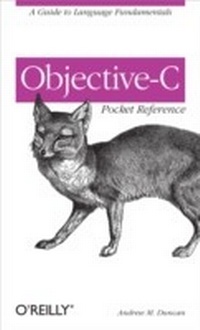
Objective-C Pocket Reference
A Guide to Language Fundamentals
1st Edition
Published on 19. December 2002
130 pages
978-0-596-55219-0 (ISBN)
Description

Objective-C is an exciting and dynamic approach to C-based object-oriented programming; it's the approach adopted by Apple as the foundation for programming under Mac OS X, a Unix-based operating system gaining wide acceptance among programmers and other technologists. Objective-C is easy to learn and has a simple elegance that is a welcome breath of fresh air after the abstruse and confusing C++. To help you master the fundamentals of this language, you'll want to keep the Objective-C Pocket Reference close at hand. This small book contains a wealth of valuable information to speed you over the learning curve.In this pocket reference, author Andrew Duncan provides a quick and concise introduction to Objective-C for the experienced programmer. In addition to covering the essentials of Objective-C syntax, Andrew also covers important faces of the language such as memory management, the Objective-C runtime, dynamic loading, distributed objects, and exception handling.O'Reilly's Pocket References have become a favorite among programmers everywhere. By providing important details in a succinct, well-organized format, these handy books deliver just what you need to complete the task at hand. When you've reached a sticking point in your work and need to get to a solution quickly, the new Objective-C Pocket Reference is the book you'll want to have.
More details
Other editions
Additional editions
Book
01/2003
O'Reilly
€10.00
Article not available at the moment
Content
- Intro
- Contents
- Objective-C Pocket Reference
- Introduction
- Typographic Conventions
- Acknowledgments
- What Is Objective-C?
- Dynamic Dispatch
- Dynamic Typing
- Dynamic Loading
- Which Objective-C?
- How Do I Get Started?
- Elements of the Language
- Objects
- Classes
- Declaring an interface
- Implementing a class
- Inheritance and Subtyping
- Fields
- Access modifiers
- Methods
- Declaring a method
- Implementing a method
- Calling a method
- Naming collisions
- Private methods
- Accessors
- Message search paths
- Special receivers
- Selectors
- Categories
- Declaring a category
- Implementing a category
- Protocols
- Declaring a protocol
- Adopting a protocol
- Checking for conformity to a protocol
- Informal protocols
- Declarations
- Dynamic typing
- Static typing
- Type qualifiers
- Predefined Types, Constants, and Variables
- Types
- Constants
- Variables
- Compiler and Preprocessor Directives
- Class Declarations and Definitions
- Forward Declarations
- Expanding Directives
- Using @encode
- Using @defs
- Using @"string
- Preprocessor Symbols
- Compiler Flags
- Remote Messaging
- Pointer Parameter Qualifiers
- Return Value Qualifiers
- Object Qualifiers
- Object Lifecycle
- Creating an Object
- Calling creation methods
- Writing creation methods
- Sample code for initialization
- Initializing classes
- Copying an Object
- Calling copy methods
- Writing copy methods
- Deallocating an Object
- Calling deallocation methods
- Writing deallocation methods
- Runtime Errors
- Object Error Handling
- Exceptions in Cocoa
- Keywords for handling exceptions
- A Cocoa exception handling example
- Runtime Environment
- Class Objects
- Metaclass Objects
- Selectors
- Protocol Objects
- Root Classes
- Fields
- Methods
- The Object Class
- Creating, copying, and freeing objects
- Identifying objects and classes
- Testing object type
- Testing inheritance and conformance
- Information about methods
- Sending messages
- Posing
- Enforcing intentions
- Error handling
- Archiving
- The NSObject Class
- Creating, copying, and freeing objects
- Identifying objects and classes
- Testing inheritance and conformance
- Information about methods
- Sending messages
- Posing
- Error handling
- Archiving
- Reference counting
- Forwarding Messages
- Object Forwarding
- NSObject Forwarding
- Memory Management
- Manual Memory Management
- Reference Counting
- Maintaining an object's reference count
- Creating a new object
- Receiving an object from another scope
- Returning an already-stored object
- Replacing an already-stored object
- Deallocating an object
- Retain cycles
- Garbage Collection
- Archiving Objects
- Archiving Descendants of Object
- Archiving Descendants of NSObject
- Key-Value Coding
- Access Permissions
- NSKeyValueCoding Methods
- Handling Key Lookup Failures
- Optimizing Method Calls
- Objective-C++
- Objective-C Resources
- Index
