

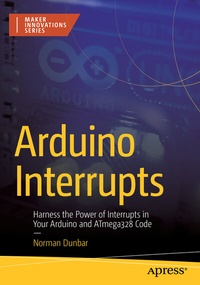
Arduino Interrupts
Description

Improve your projects by leveraging the power of interrupts. This comprehensive guide makes it easy to understand and use interrupts with the ATmega328P microcontroller found on Arduino boards.
With over 20 interrupts available, this book covers almost all of them and provides background information on how they work. You'll work through the steps and code examples required to configure each of the covered interrupts. You'll also learn how to use them with Arduino, AVR C++ and with other development systems, like PlatformIO.
Interrupts can be intimidating, but by the end of this book, you will have the knowledge and skills to take full advantage of them and improve the performance and efficiency of your Arduino projects.
What You'll Learn
- Understand interrupts and how they work
- Make interrupts easier to use in code
- Use interrupts in their Arduino sketches or AVR C++ applications
- See how to use interrupts in the Arduino Language and in AVR C++
- Avoid common pitfalls when working with interrupts
Who This Book Is For
Intermediate to advanced-level programmers who want to learn how to use interrupts in their Arduino sketches or AVR C++ applications..
More details
Other editions
Additional editions
Person
Norman Dunbar is a retired Oracle Database Administrator. Norman has had a long-running relationship with Electronics since childhood and computers since the late 1970s, and the Arduino was a perfect marriage of the two interests. With a love of learning new things, and finding out how things work, examining and explaining the Arduino Language and the hardware became a bit of a hobby. As piles of notes expanded, and after the publication of his first book, Arduino Software Internals , he collected some more of his notes into another book.
Content
Chapter 1: Code Listings.- Chapter 2:Arduino and AVR Code.- Chapter 3: Admonitions.- Chapter 4: Reset.- Chapter 5: External Interrupts INTO/INT1.- Chapter 6: Pin Change Interrupts.- Chapter 7: Contents.- Chapter 8: Timer/Counter Interrupts.- Chapter 9: SPI Interrupt.- Chapter 10 USART Interrupts.- Chapter 12: Reading from the EEPROM.- Chapter 13: Analog Comparator Interrupt.- Chapter 14: TWI Interrupt.- Chapter 15:A Real World Example.
