

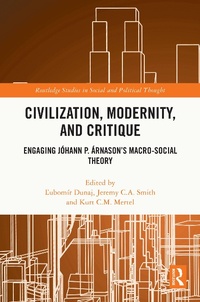
Civilization, Modernity, and Critique
Engaging Johann P. Arnason's Macro-Social Theory
1st Edition
Published on 25. May 2023
274 pages
978-1-000-88146-2 (ISBN)
Description

Civilization, Modernity, and Critique provides the first comprehensive, cutting-edge engagement with the work of one of the most foundational figures in civilizational analysis: Johann P. Arnason. In order to do justice to Arnason's seminal and wide-ranging contributions to sociology, social theory and history, it brings together distinguished scholars from a variety of disciplinary backgrounds and geographical contexts. Through a critical, interdisciplinary dialogue, it offers an enrichment and expansion of the methodological, theoretical, and applicative scope of civilizational analysis, by addressing some of the most complex and pressing problems of contemporary global society. A unique and timely contribution to the ongoing task of advancing the project of a critical theory of society, this volume will appeal to scholars of sociology and social theory with interests in historical sociology, critical theory and civilizational analysis.
Reviews / Votes
'Johann Arnason is a leader in the historical sociology of civilizations, the theorization of multiple modernities, and indeed social theory generally. The interest and importance of his work has attracted engagement from a remarkable range of leading social scientists - as this book demonstrates. Authors bring new insights to Arnason's own work and to many of the themes and historical questions with which he has engaged. Their chapters are significant on their own and invaluable as a guide to Arnason's contributions and their continuing importance.' - Craig Calhoun, William Kelly, Jr. Professor of Sociology, Princeton University, USA'This exciting volume builds from the work of Johann Arnason to offer a sophisticated and thoughtful extension, in its own right, of the debate about cultural values, including their significance for how societies, economies, and international orders develop.' - Leigh K. Jenco, Professor of Political Theory, The London School of Economics and Political Science, UK
'Finally, through this collection of excellent essays, one of the most erudite and multilingual historical sociologists and social theorists of our time receives the recognition he deserves. No contemporary attempt to understand modernity and its multiple civilizational variants can afford to ignore Johann Arnason's lifework and the discussions about it.' - Hans Joas, Ernst Troeltsch Professor for the Sociology of Religion at the Humboldt University of Berlin, Germany, and Visiting Professor of Sociology and Social Thought at the University of Chicago, USA
'Truly engaging Johann Arnason's writings, this volume is an impressive collective and interdisciplinary intellectual achievement. It is not only a tribute to Arnason's outstanding contribution to comparative historical macrosociology and civilizational analysis, but also a stimulating invitation to reflect upon his lesser-known contribution to general sociological and cultural theory, and its strong anchor in an unusually broad and persistent engagement with history and philosophy. Emerging from the chapters by eminent scholars of diverse disciplinary and intellectual bent, and from Arnason's own constructive replies, is the value of a staunchly processual, relational, contextualizing, historicizing and cultural hermeneutic approach, challenging any overly homogenizing, holistic or systemic mode of interpretations, even as it also no less staunchly cultivates conceptualizing and combining multiple levels and scales of analysis. Stretching from micro- to meso- and macro-, local to global, past to present and grappling with major matters of comparative analysis-such as the nature of action and institutions, dynamics of world-making and opening, civilizations and cultural worlds, regions, religion, culture and cultural worlds, multiple and alternative modernities, politics and the political, world-making and world-opening, points of rupture, continuity and transformation, etc.-it is thus a volume that still conveys, as does Arnason's opus itself, the hope of perhaps illuminating what might otherwise seem at times, and pressingly so in our own times, as just an intractable, vertiginous whirlpool of overwhelming cultural differences and historical developments.' - Ilana Silber, Associate Professor of Sociology, Department of Sociology and Anthropology, Bar-Ilan University, Israel.
' ... this is a really exceptional volume, both in the quality and expertise of its contributors and in its range, which matches that of its subject.' - William Outhwaite, European Journal of Social Theory
More details
Series
Edition
1. Auflage
Language
English
Place of publication
London
United Kingdom
Publishing group
Taylor & Francis Ltd
Target group
College/higher education
ISBN-13
978-1-000-88146-2 (9781000881462)
Copyright in bibliographic data and cover images is held by Nielsen Book Services Limited or by the publishers or by their respective licensors: all rights reserved.
Schweitzer Classification
Other editions
Additional editions
Lubomir Dunaj | Jeremy Smith | Kurt Mertel
Civilization, Modernity, and Critique
Engaging Johann P. Arnason's Macro-Social Theory
Book
10/2024
1st Edition
Routledge
€65.60
Shipment within 10-20 days
Lubomir Dunaj | Jeremy Smith | Kurt Mertel
Civilization, Modernity, and Critique
Engaging Johann P. Arnason's Macro-Social Theory
Book
05/2023
1st Edition
Routledge
€205.80
Shipment within 10-20 days
Persons
Lubomir Dunaj (University of Vienna)
Lubomir Dunaj is University Assistant at the Department of Philosophy, University of Vienna and Research Fellow at the Institute of Philosophy, Czech Academy of Sciences in Prague. He is associated editor of Pragmatism Today and published his work in Human Affairs, Berlin Journal of Critical Theory and Polylog. Zeitschrift fuer interkulturelles Philosophieren.
Jeremy C.A. Smith (Federation University Australia)
Jeremy Smith is in the Institute of Education, Arts and Community at Federation University. He is author of three research monographs, five coedited books, and articles in European Journal of Social Theory, Current Sociology, Critical Horizons, Journal of Intercultural Studies, Thesis Eleven, Atlantic Studies and Political Power and Social Theory. He is also a Managing Editor of the International Journal of Social Imaginaries (Brill).
Kurt C.M. Mertel (American University of Sharjah)
Kurt C.M. Mertel is currently Assistant Professor of Philosophy at the American University of Sharjah. He is the co-editor of three books in critical social theory and his work appears in the European Journal of Philosophy, Philosophy and Social Criticism and Critical Horizons, among others.
Lubomir Dunaj is University Assistant at the Department of Philosophy, University of Vienna and Research Fellow at the Institute of Philosophy, Czech Academy of Sciences in Prague. He is associated editor of Pragmatism Today and published his work in Human Affairs, Berlin Journal of Critical Theory and Polylog. Zeitschrift fuer interkulturelles Philosophieren.
Jeremy C.A. Smith (Federation University Australia)
Jeremy Smith is in the Institute of Education, Arts and Community at Federation University. He is author of three research monographs, five coedited books, and articles in European Journal of Social Theory, Current Sociology, Critical Horizons, Journal of Intercultural Studies, Thesis Eleven, Atlantic Studies and Political Power and Social Theory. He is also a Managing Editor of the International Journal of Social Imaginaries (Brill).
Kurt C.M. Mertel (American University of Sharjah)
Kurt C.M. Mertel is currently Assistant Professor of Philosophy at the American University of Sharjah. He is the co-editor of three books in critical social theory and his work appears in the European Journal of Philosophy, Philosophy and Social Criticism and Critical Horizons, among others.
Content
1 Axel Honneth (Columbia University) - Preface. 2 Lubomir Dunaj (University of Vienna) - Introduction. QUESTIONS OF THEORY AND METHODOLOGY. 3 Suzi Adams (Flinders University, Adelaide) - The Being of the Political and Instituting Doing in Question: Reflections on Johann P. Arnason's Thought. 4 Jiri Subrt (Charles University in Prague) - Long-term Developmental Processes as an Unintended Consequence of Human Action: Some Theoretical and Methodological Questions of Historical Sociology. 5 Said Amir Arjomand (Stony Brook University) - World Regions and the Unpacking of Multiple Modernities: A Pluralistic View of Global Sociological Theory. RE-THINKING THE CONCEPT OF MODERNITY/IES THROUGH THE LENS OF CIVILIZATIONAL ANALYSIS. 6 Peter Wagner (Catalan Institute for Research and Advanced Study [ICREA]; University of Barcelona; University of Central Asia) - Ways Out of the Modern Labyrinth: Normative Expectations and Subsequent Social Change. 7 Wolfgang Knoebl (Hamburg Institute for Social Research) - Politics and the Social Imaginary: The Problem of the State - and the Problem of Modernity. 8 Kurt C.M. Mertel (American University of Sharjah) - Situating Johann P. Arnason's Civilizational Analysis within Left-Heideggerianism. MODERNITY IN THE PLURAL: CIVILIZATIONAL ANALYSIS AND THE AXIAL AGE DEBATE. 9 Hans Schelkshorn (University of Vienna) - The Axial Age and Multiple Modernities: Philosophical reflections on the universal claims of European civilization. 10 Hans-Herbert Koegler (University of North Florida) - Traditions of Transcendence. A Hermeneutic Appropriation of the Axial Age Discourse. 11 Christoph Kleine (Leipzig University) and Monika Wohlrab-Sahr (Leipzig University) - A Secularity Sui Generis? On the Historical Development of Conceptual Distinctions and Institutional Differentiations in Japan. MAKING THEORY CONTEXTUAL THROUGH CIVILIZATIONAL ANALYSIS: PLACE, POLITICS, SITUATEDNES. 12 Armando Salvatore (McGill University) and Kieko Obuse (Kobe City University of Foreign Studies) - Overwriting the Orient and the Islamosphere: Religio-Civilizational Imaginaries Via East-West Entanglements. 13 Yulia Prozorova (Russian Academy of Sciences, Saint Petersburg) - Religious-Political Problematic in Civilizational Analysis: Reflections on Russia's Trajectory. 14 Jeremy Smith (Federation University Australia) - Regionality and Civilizations in the Americas: Considerations on Civilizational Analysis in the Context of American Modernities. JOHANN P. ARNASON'S REPLIES. 15 Johann P. Arnason (La Trobe University) - Replies to criticisms and suggestions
