

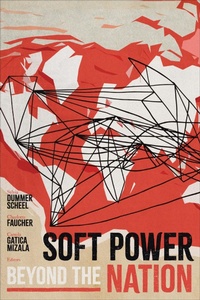
Soft Power beyond the Nation
Description

An innovative, interdisciplinary perspective on soft power in history, moving beyond the framework of the nation-state
Starting in the nineteenth century, as world events became more interconnected than ever, and as public opinion began to weigh on democratic governments, nations employed new communication strategies and propaganda to gain global influence and prestige. Soft power strategies were used by different nation-states, and by supranational and nonstate actors, that wanted to gain influence on the international stage.
Soft Power Beyond the Nation takes a distinct approach to the study of soft power in history, moving beyond the framework of the nation-state. The volume editors use "soft power" to refer to the processes through which persuasion, the search for influence and power, and public opinion converge in the international arena. The book is organized on the basis of three central themes: the transnational circulation of knowledge and strategies of public diplomacy across borders, collaboration of intermediary actors of soft power whose interests did not always coincide with those of the state, and the role played by nonnational identities, such as gender and race, in soft power.
Soft Power Beyond the Nation enriches the historiographical study of soft power, broadening its temporal and spatial scope and refreshing it with new perspectives on transnationalism, gender, and race. This book will be of interest to scholars and students of history and international relations.
More details
Other editions
Additional editions
Persons
Charlotte Faucher is a lecturer in modern French history at the University of Bristol. She is the author of Propaganda, Gender and Cultural Power (2022). Camila Gatica Mizala is assistant professor in the Universidad de Chile's History Department. She is the author of Modernity at the Movies (2023). Sylvia Dummer Scheel is an assistant adjunct professor in the History Department and the School of Design at the Pontificia Universidad Católica de Chile. She is the author of Sin tropicalismos ni exageraciones (2012).
Content
Foreword by Chandrika Kaul
Acknowledgments
Introduction: Rethinking Soft Power in History through a Transnational and Pericentered Approach, Sylvia Dummer Scheel, Charlotte Faucher, and Camila Gatica Mizala
1: Race for Power: Science and the Creation of White Supremacy in the Nineteenth Century, Michael L. Krenn
2: Karuizawa and Naka Karuizawa: An Origin of Modern Hybrid Japanese Soft Power, "Omotenashi" Rui Kohiyama
3: Refusing to be Soft on U.S. Racism: African Americans in the Soviet Union as Soft Power Agents of Black Liberation in the Interwar Era, Meredith L. Roman
4: Tensions between Soft Power and Domestic Propaganda: Public Diplomacy towards the Mexican Diaspora in the United States, 1934-1940, Sylvia Dummer Scheel
5: A Universal Mission: The Propaganda and Folklore of Robert Boutet between Morocco and occupied Germany, 1931-49, Drew Flanagan
6: Brigitte Bardot, Bikini Bodies, and the Bottom Line: Soft Power and the Creation of a Global French Feminine Ideal in the 1950s and 1960s, Kelly R. Colvin
7: Soft power or propaganda? China's "people-to-people" diplomacy during the Cold War, Cyril Cordoba
8: Honors and Dishonors: Table Tennis Champions Representing Ghana Abroad, Claire Nicolas
9: Non-Linear Cultural Diplomacy: A Latin American Traveler to China during the Cold War, Maria Montt Strabucchi
10: Art exhibitions under the Presidency of Léopold Sédar Senghor and the Construction of a Senegalese Soft Power: Metissage and Decentering, Coline Desportes
Conclusion, Sylvia Dummer Scheel, Charlotte Faucher, and Camila Gatica Mizala
List of Contributors
Index
