

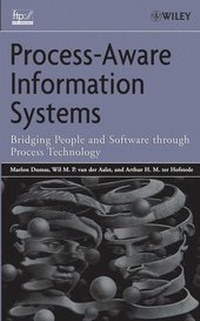
Process-Aware Information Systems
Description

Reviews / Votes
"...well-written and edited, and includes a brief appendix anda word index, both useful aids." (Computing Reviews.com,January 9, 2007) "...a comprehensive overview of the technical aspects ofbuilding PAIS...it is a recommended starting resource."(Computing Reviews.com, May 17, 2006)More details
Other editions
Additional editions
Persons
Content
Contributors.
PART I Concepts.
1 Introduction (Marlon Dumas, Wil van der Aalst, and Arthur H. M. ter Hofstede).
1.1 From Programs and Data to Processes.
1.2 PAIS: Definition and Rationale.
1.3 Techniques and Tools.
1.4 Classifications.
1.5 About the Book.
References.
2 Person-to-Application Processes: Workflow Management (Andreas Oberweis).
2.1 Introduction.
2.2 Workflow Terminology.
2.3 Workflow Modeling.
2.4 Workflow Management Systems.
2.5 Outlook.
2.6 Exercises.
References.
3 Person-to-Person Processes: Computer-Supported Collaborative Work (Clarence A. Ellis, Paulo Barthelmess, Jun Chen, and Jacques Wainer).
3.1 Introduction.
3.2 Characterization of Person-to-Person Interactions.
3.3 Characterization of Person-to-Person Systems.
3.4 Example Systems.
3.5 Summary and Conclusions.
3.6 Exercises.
References.
4 Enterprise Application Integration and Business-to-Business Integration Processes (Christoph Bussler).
4.1 Introduction.
4.2 Examples of EAI and B2B Processes.
4.3 Concepts, Architectures, and Tools.
4.4 Future Developments.
4.5 Exercises.
References.
PART II Modeling Languages.
5 Process Modeling Using UML (Gregor Engels, Alexander Förster, Reiko Heckel, and Sebastian Thöne).
5.1 Introduction.
5.2 Modeling Control Flow with Activity Diagrams.
5.3 Modeling Objects and Object Flow.
5.4 Modeling Organizational Structure.
5.5 Modeling Business Partner Interactions.
5.6 System-Specific Process Models.
5.7 Summary.
5.8 Exercises.
References.
6 Process Modeling Using Event-Driven Process Chains (August-Wilhelm Scheer, Oliver Thomas, and Otmar Adam).
6.1 Introduction.
6.2 Overview of EPC.
6.3 The ARIS Business Process Meta-Model.
6.4 How to Correctly Model EPCs.
6.5 The ARIS Architecture.
6.6 Future Extensions.
6.7 Exercises.
References.
7 Process Modeling Using Petri Nets (Jörg Desel).
7.1 Introduction.
7.2 Petri Nets.
7.3 Petri Net Classes and Behavior.
7.4 Modeling Single Processes Without Resources.
7.5 Modeling Processes with Resources.
7.6 Behavior and Refinement.
7.7 Analysis.
7.8 Net Classes.
Exercises.
References.
8 Patterns of Process Modeling (Wil van der Aalst, Arthur H. M. ter Hofstede, and Marlon Dumas).
8.1 Introduction.
8.2 Classification of Patterns.
8.3 Examples of Control-Flow Patterns.
8.4 Conclusion.
8.5 Exercises.
Acknowledgments.
References.
PART III Techniques.
9 Process Design and Redesign (Hajo A. Reijers).
9.1 Introduction.
9.2 Methodologies, Techniques, and Tools.
9.3 Business Process Performance Indicators.
9.4 Redesigning Processes Using Best Practices.
9.5 Information-Based Business Process Design.
9.6 Conclusion.
9.7 Exercises.
References.
10 Process Mining (Wil van der Aalst and A.J.M.M. (Ton) Weijters).
10.1 Introduction.
10.2 Process Mining: An Overview.
10.3 Process Mining with the Algorithm.
10.4 Limitations of the Alpha Approach and Possible Solutions.
10.5 Conclusion.
10.6 Exercises.
Acknowledgments.
References.
11 Transactional Business Processes (Gustavo Alonso).
11.1 Introduction.
11.2 Transactional Consistency.
11.3 Atomicity.
11.4 Infrastructure for Implementing Atomicity.
11.5 Outlook.
11.6 Exercises and Assignments.
Acknowledgments.
References.
PART IV Standards and Tools.
12 Standards for Workflow Definition and Execution (Jan Mendling, Michael zur Muehlen, and Adrian Price).
12.1 Introduction.
12.2 Standardization Bodies Relevant to PAIS.
12.3 WfMC Reference Model and WfMC Glossary.
12.4 Process Definition in XPDL.
12.5 Process Invocation Using WF-XML.
12.6 Trends.
12.7 Exercises.
References.
13 The Business Process Execution Language for Web Services (Rania Khalaf, Nirmal Mukhi, Francisco Curbera, and Sanjiva Weerawarana).
13.1 Introduction to Web Services.
13.2 BPEL4WS.
13.3 Summary.
13.4 Exercises.
References.
14 Workflow Management in Staffware (Charles Brown).
14.1 Introduction.
14.2 Architecture.
14.3 Integration Tools.
14.4 Methodology.
14.5 Resourcing.
14.6 Conclusion.
14.7 Exercises.
References.
15 The FLOWer Case-Handling Approach: Beyond Workflow Management (Paul Berens).
15.1 Outline.
15.2 Overview of Case Handling and FLOWer.
15.3 Conceptual Integrity of FLOWer.
15.4 Golden Rules of Process Management.
15.5 Conclusion.
Acknkowledgment.
References.
Appendix: Readings and Resources.
Index.
