

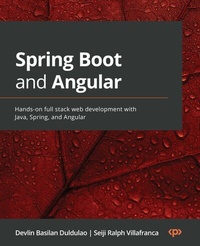
Spring Boot and Angular
Description

All prices
More details
Other editions
Additional editions
Persons
Devlin Basilan Duldulao is a full-stack engineer with over 8 years of web, mobile, and cloud development experience. He has been a recipient of Microsoft's Most Valuable Professional (MVP) award since 2018 and earned the title of Auth0 Ambassador for his passion for sharing best practices in application security. Devlin has passed some prestigious software and cloud development exams, such as MSCD, Azure Associate Developer, AWS Associate Developer, and Terraform Associate. He has also authored the book ASP.NET Core and Vue.js and coauthored the book Practical Enterprise React in 2020 and 2021, amid the pandemic.Villafranca Seiji Ralph :
Seiji Ralph Villafranca graduated Cum Laude with a degree of Bachelor of Science In Computer Science at University of Santo Tomas in the Philippines. He has 6 years of experience in Web and Mobile Development and has also earned the title of Auth0 Ambassador for having passions in application securities, He holds several certifications in Angular Development from Beginner to Expert Level. Seiji is also one of the Community Leaders of Angular Philippines which is the largest Angular group in the Philippines, the community has lead him to speak in different meetups of tech communities, workshops and even local and international conferences, he is enthusiastic in sharing knowledge in coding, organizing events and meetups for the community as well as writing content for students and professionals. He also has been a mentor in several hackathons as he loves the startup community. Seiji loves to develop new projects that are on web or mobile, he is currently a senior software engineer in a company based in Malaysia, He is not just a coder but also a mentor, teacher and trainer for students, professionals and companies.
Content
- Setting Up the Development Environment
- Moving into Spring Boot
- Setting Up the Database and Spring Data JPA
- Building APIs with Spring
- Documenting APIs with OpenAPI Specification
- Adding Spring Boot Security with JWT
- Logging Events in Spring Boot
- Writing Tests in Spring Boot
- Setting Up Our Angular Project and Architecture
- Building Reactive Forms
- Managing States with NgRx
- Saving, Deleting, and Updating with NgRx
- Adding Authentication in Angular
- Writing Tests in Angular
- Packaging Backend and Frontend with Maven
- Deploying Spring Boot and the Angular App
Preface
Spring Boot provides JavaScript users with a platform to get an application up and running with just a few lines of code. At the same time, Angular is a component-based framework that makes building a web application's frontend easy. This book explains how Spring Boot and Angular work together to help you create full-stack applications quickly and effectively.
In this book, you will begin by exploring why Spring Boot and Angular are in-demand frameworks, before being guided by expert solutions and best practices to build your own web application. Regarding the backend, you will see how Spring Boot allows you to build applications efficiently by letting the Spring Framework and Spring Boot extension do the heavy lifting, while using Spring Data JPA and Postgres dependencies in your project to save or persist data in a database. With the frontend, you will use Angular to construct a project architecture, build Reactive forms, and add authentication to avoid malicious users stealing data from the application.
Finally, you will see how to test services with Mockito, deploy applications using continuous integration and continuous deployment, and integrate Spring Boot and Angular to create a single package so that, by the end of the book, you will be able to build your very own full-stack web application.
Who this book is for
The book is for busy Java web developers and TypeScript developers with little experience of developing Angular and Spring Boot apps who want to learn about the best practices for building full-stack web apps.
What this book covers
Chapter 1, Spring Boot and Angular - The Big Picture, serves as a short recap regarding Spring Boot and Angular's current state to give you a glimpse of what lies ahead in the web development of Java Spring Boot and Angular. You will also see how stable and reliable Vue.js is as an app and the team behind writing and maintaining the Vue.js framework.
Chapter 2, Setting Up the Development Environment, teaches you how to set up your computer's development environment to build backend and frontend web applications. We will turn to different IDEs and text editors to write the code and make sure everything has been set up before we proceed in the app development.
Chapter 3, Moving into Spring Boot, uncovers the inner workings of Spring Boot and how to start a project using Spring Initializr. This chapter will also teach you about the concept of dependency injection and the IoC container. This chapter will also tackle how Beans and annotations work.
Chapter 4, Setting Up the Database and Spring Data JPA, helps you to connect the Java Spring Boot to a database. This chapter will describe Spring Data JPA and how to add Spring Data JPA and Postgres dependencies in the project. This chapter will also show how to use a config file to connect the Java Spring Boot to a Postgres database instance.
Chapter 5, Building APIs with Spring, shows you how to start and run a Java Spring Boot application. This chapter will also show how to add models for the application and use them when writing routers and controllers. Afterward, this chapter will explain how to use Redis for caching to improve the performance of an application.
Chapter 6, Documenting APIs with OpenAPI Specification, covers the documentation part of the APIs of the Java Spring Boot application. This chapter will also show you how to include the Swagger UI in the application to provide graphical interfaces in the documentation of APIs.
Chapter 7, Adding Spring Boot Security with JWT, details what CORS is and how to add a CORS policy in the Spring Boot application. This chapter describes Spring security, authentication, and authorization. This chapter will also demonstrate how JSON web tokens work and what Identity as a Service (IaaS) is.
Chapter 8, Logging Events in Spring Boot, explains what logging is and what the popular packages to implement logging are. This chapter will also teach you where to save logs and what to do with logs.
Chapter 9, Writing Tests in Spring Boot, is all about writing tests for a Java Spring Boot application. This chapter describes JUnit and AssertJ. This chapter will also teach you how to write tests, how to test a repository, and how to test a service using Mockito.
Chapter 10, Setting Up Our Angular Project and Architecture, focuses on how to organize features and modules, how to structure components, and how to add Angular Material.
Chapter 11, Building Reactive Forms, demonstrates how to build Reactive forms, basic form control, and grouping form controls. This chapter will also explain how to use FormBuilder and validate form input.
Chapter 12, Managing States with NgRx, covers state management in complex applications. This chapter will also introduce NgRx and how to set it up and use it in an Angular application.
Chapter 13, Saving, Deleting, and Updating with NgRx, describes how to remove an item using NgRx, how to add an item using NgRx, and how to update an item using NgRx.
Chapter 14, Adding Authentication in Angular, explores how to add user login and logout, retrieve user profile information, protect application routes, and call an API with protected endpoints.
Chapter 15, Writing Tests in Angular, illustrates how to write basic Cypress tests and how to mock HTTP requests for testing.
Chapter 16, Packaging Backend and Frontend with Maven, exemplifies how to utilize the Maven frontend plugin for Angular and Spring Boot to integrate them into one package.
Chapter 17, Deploying Spring Boot and the Angular App, describes CI/CD and GitHub Actions. This chapter will also show you how to create a CI workflow or pipeline for a Spring Boot and Angular application.
To get the most out of this book
You should ensure that you have a basic understanding of HTML, CSS, JavaScript, TypeScript, Java, and REST API. You don't need intermediate or advanced knowledge of the requirements mentioned.
Software/hardware covered in the book
Operating system requirements
Node.js (LTS version)
Windows, macOS, or Linux
Angular
Windows, macOS, or Linux
Java 17
Windows, macOS, or Linux
Visual Studio Code
Windows, macOS, or Linux
IntelliJ IDEA
Windows, macOS, or Linux
Google Chrome
Windows, macOS, or Linux
Don't lose hope if you are facing problems when installing runtimes, SDKs, or any software tools in general when developing an application. Errors are common, but searching for error messages on Google greatly helps developers when troubleshooting certain problems.
If you are using the digital version of this book, we advise you to type the code yourself or access the code from the book's GitHub repository (a link is available in the next section). Doing so will help you avoid any potential errors related to the copying and pasting of code.
Play around with Angular on stackblitz.com or codesandbox.io to see the look and feel of Angular without installing anything on your computer.
Download the example code files
You can download the example code files for this book from GitHub at https://github.com/PacktPublishing/Spring-Boot-and-Angular. If there's an update to the code, it will be updated in the GitHub repository.
We also have other code bundles from our rich catalog of books and videos available at https://github.com/PacktPublishing/. Check them out!
Download the color images
We also provide a PDF file that has color images of the screenshots and diagrams used in this book. You can download it...
