

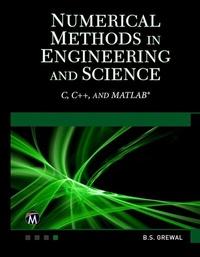
Numerical Methods Fundamentals
1st Edition
Published on 13. June 2023
450 pages
978-1-68392-870-6 (ISBN)
Description

The book is designed to cover all major aspects of applied numerical methods, including numerical computations, solution of algebraic and transcendental equations, finite differences and interpolation, curve fitting, correlation and regression, numerical differentiation and integration, matrices and linear system of equations, numerical solution of ordinary differential equations, and numerical solution of partial differential equations. It uses a numerical problem-solving orientation with numerous examples, figures, and end of chapter exercises. Presentations are limited to very basic topics to serve as an introduction to more advanced topics.
All prices
More details
Language
English
Place of publication
Herndon, VA
United States
Target group
Professional and scholarly
US School Grade: College Graduate Student
File size
7,45 MB
ISBN-13
978-1-68392-870-6 (9781683928706)
Copyright in bibliographic data and cover images is held by Nielsen Book Services Limited or by the publishers or by their respective licensors: all rights reserved.
Schweitzer Classification
Other editions
Additional editions

R. V. Dukkipati
Numerical Methods Fundamentals
Book
06/2023
1st Edition
Mercury Learning & Information
€71.95
Article not available at the moment
R. V. Dukkipati
Numerical Methods Fundamentals
E-Book
06/2023
1st Edition
Mercury Learning and Information
from
€71.95
Available for download
Person
R. V. Dukkipati is a Professor and Chair of Mechanica1 Engineering at Fairfield University, as well as a consultant in the field of road vehicle accident reconstruction. He is a member of the Connecticut Academy of Sciences and Engineering (CASE), and a Fellow of both the American Society of Mechanical Engineers (ASME) and the Canadian Society for Mechanical Engineers (CSME).
Content
- Cover
- Half-Title
- Title
- Copyright
- Contents
- Preface
- Chapter 1: Numerical Computations
- 1.1 Taylor's Theorem
- 1.2 Number Representation
- 1.3 Error Considerations
- 1.3.1 Absolute and Relative Errors
- 1.3.2 Inherent Errors
- 1.3.3 Round-off Errors
- 1.3.4 Truncation Errors
- 1.3.5 Machine Epsilon
- 1.3.6 Error Propagation
- 1.4 Error Estimation
- 1.5 General Error Formula
- 1.5.1 Function Approximation
- 1.5.2 Stability and Condition
- 1.5.3 Uncertainty in Data or Noise
- 1.6 Sequences
- 1.6.1 Linear Convergence
- 1.6.2 Quadratic Convergence
- 1.6.3 Aitken's Acceleration Formula
- 1.7 Summary
- Exercises
- Chapter 2: Linear System of Equations
- 2.1 Introduction
- 2.2 Methods of Solution
- 2.3 The Inverse of a Matrix
- 2.4 Matrix Inversion Method
- 2.4.1 Augmented Matrix
- 2.5 Gauss Elimination Method
- 2.6 Gauss-Jordan Method
- 2.7 Cholesky's Triangularization Method
- 2.8 Crout's Method
- 2.9 Thomas Algorithm for Tridiagonal System
- 2.10 Jacobi's Iteration Method
- 2.11 Gauss-Seidel Iteration Method
- 2.12 Summary
- Exercises
- Chapter 3: Solution of Algebraic and Transcendental Equations
- 3.1 Introduction
- 3.2 Bisection Method
- 3.2.1 Error Bounds
- 3.3 Method of False Position
- 3.4 Newton-Raphson Method
- 3.4.1 Convergence of the Newton-Raphson Method
- 3.4.2 Rate of Convergence of the Newton-Raphson Method
- 3.4.3 Modified Newton-Raphson Method
- 3.4.4 Rate of Convergence of the Modified Newton-Raphson Method
- 3.5 Successive Approximation Method
- 3.5.1 Error Estimate in the Successive Approximation Method
- 3.6 Secant Method
- 3.6.1 Convergence of the Secant Method
- 3.7 Muller's Method
- 3.8 Chebyshev Method
- 3.9 Aitken's ?2 Method
- 3.10 Comparison of Iterative Methods
- 3.11 Summary
- Exercises
- Chapter 4: Numerical Differentiation
- 4.1 Introduction
- 4.2 Derivatives Based on Newton's Forward Integration Formula
- 4.3 Derivatives Based on Newton's Backward Interpolation Formula
- 4.4 Derivatives Based on Stirling's Interpolation Formula
- 4.5 Maxima and Minima of a Tabulated Function
- 4.6 Cubic Spline Method
- 4.7 Summary
- Exercises
- Chapter 5: Finite Differences and Interpolation
- 5.1 Introduction
- 5.2 Finite Difference Operators
- 5.2.1 Forward Differences
- 5.2.2 Backward Differences
- 5.2.3 Central Differences
- 5.2.4 Error Propagation in a Difference Table
- 5.2.5 Properties of the Operator ?
- 5.2.6 Difference Operators
- 5.2.7 Relation Between the Operators
- 5.2.8 Representation of a Polynomial Using Factorial Notation
- 5.3 Interpolation with Equal Intervals
- 5.3.1 Missing Values
- 5.3.2 Newton's Binomial Expansion Formula
- 5.3.3 Newton's Forward Interpolation Formula
- 5.3.4 Newton's Backward Interpolation Formula
- 5.3.5 Error in the Interpolation Formula
- 5.4 Interpolation with Unequal Intervals
- 5.4.1 Lagrange's Formula for Unequal Intervals
- 5.4.2 Hermite's Interpolation Formula
- 5.4.3 Inverse Interpolation
- 5.4.4 Lagrange's Formula for Inverse Interpolation
- 5.5 Central Difference Interpolation Formulae
- 5.5.1 Gauss's Forward Interpolation Formula
- 5.5.2 Gauss Backward Interpolation Formula
- 5.5.3 Bessel's Formula
- 5.5.4 Stirling's Formula
- 5.5.5 Laplace-Everett Formula
- 5.5.6 Selection of an Interpolation Formula
- 5.6 Divided Differences
- 5.6.1 Newton's Divided Difference Interpolation Formula
- 5.7 Cubic Spline Interpolation
- 5.8 Summary
- Chapter 6: Curve Fitting, Regression, and Correlation
- 6.1 Introduction
- 6.1.1 Approximating Curves
- 6.2 Linear Equation
- 6.3 Curve Fitting With a Linear Equation
- 6.4 Criteria for a "Best" Fit
- 6.5 Linear Least-Squares Regression
- 6.6 Linear Regression Analysis
- 6.6.1 MATLAB Functions: polyfit and polyval
- 6.7 Interpretation of a and b
- 6.8 Standard Deviation of Random Errors
- 6.9 Coefficient of Determination
- 6.10 Linear Correlation
- 6.11 Linearization of Nonlinear Relationships
- 6.12 Polynomial Regression
- 6.13 Quantification of Error of Linear Regression
- 6.14 Multiple Linear Regression
- 6.15 Weighted Least-Squares Method
- 6.16 Orthogonal Polynomials and Least-Squares Approximation
- 6.17 Least-Squares Method for Continuous Data
- 6.18 Approximation Using Orthogonal Polynomials
- 6.19 Gram-Schmidt Orthogonalization Process
- 6.20 Fitting a Function Having a Specified Power
- 6.21 Summary
- Exercises
- Chapter 7: Numerical Integration
- 7.1 Introduction
- 7.1.1 Relative Error
- 7.2 Newton-Cotes Closed Quadrature Formula
- 7.3 Trapezoidal Rule
- 7.3.1 Error Estimate in Trapezoidal Rule
- 7.4 Simpson's 1/3 Rule
- 7.4.1 Error Estimate in Simpson's 1/3 Rule
- 7.5 Simpson's 3/8 Rule
- 7.6 Boole's and Weddle's Rules
- 7.6.1 Boole's Rule
- 7.6.2 Weddle's Rule
- 7.7 Romberg's Integration
- 7.7.1 Richardson's Extrapolation
- 7.7.2 Romberg Integration Formula
- 7.8 Summary
- Exercises
- Chapter 8: Numerical Solution of Ordinary Differential Equations
- 8.1 Introduction
- 8.2 One-Step Methods or Single-Step Methods
- 8.2.1 Picard's Method of Successive Approximation
- 8.2.2 Taylor's Series Method
- 8.3 Step-by-Step Methods or Marching Methods
- 8.3.1 Euler's Method
- 8.3.2 Modified Euler's Method
- 8.3.3 Runge-Kutta Methods
- 8.3.4 Predictor-Corrector Methods
- 8.4 Summary
- Exercises
- Bibliography
- Appendix A: Partial Fraction Expansions
- Case-I: Partial Fraction Expansion when Q(s) has Distinct Roots
- Case-II: Partial Fraction Expansion when Q(s) has Complex Conjugate Roots
- Appendix B: Basic Engineering Mathematics
- B.1 Algebra
- B.1.1 Basic Laws
- B.1.2 Sums of Numbers
- B.1.3 Progressions
- B.1.4 Powers and Roots
- B.1.5 Binomial Theorem
- B.1.6 Absolute Values
- B.1.7 Logarithms
- B.2 Trigonometry
- B.2.1 Trigonometric Identities
- B.3 Differential Calculus
- B.3.1 List of Derivatives
- B.3.2 Expansion in Series
- B.4 Integral Calculus
- B.4.1 List of the Most Common Integrals
- Appendix C: Cramer's Rule
- Exercises
- Answers to Selected Exercises
- Index
