

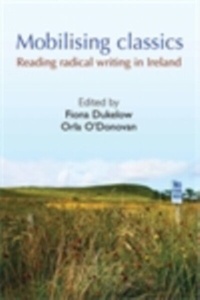
Mobilising Classics
Reading Radical Writing in Ireland
1st Edition
Published on 16. May 2016
232 pages
978-0-7190-9501-6 (ISBN)
Available for download
Description

The terms patriarchy, institutional racism, sustainable development and alienation may be familiar but this familiarity is often removed from the analytical contexts in which these ideas emerged. This book provides a series of rich reflections on the interaction between the radical ideas associated with these and other authors, and political action in Ireland.
The classic texts that comprise the focal point for each chapter were selected by the contributors, many of whom straddle the boundaries of academia and activism. Each essay provides an account of the contributor's personal encounters with the text, opens up the key mobilising ideas and considers how the text has the potential invigorate the political imagination of contemporary oppositional politics.
This book will be of interest to students in the social sciences, especially sociology and Irish studies and will appeal to those interested or involved in political activism of any variety. -- .
The classic texts that comprise the focal point for each chapter were selected by the contributors, many of whom straddle the boundaries of academia and activism. Each essay provides an account of the contributor's personal encounters with the text, opens up the key mobilising ideas and considers how the text has the potential invigorate the political imagination of contemporary oppositional politics.
This book will be of interest to students in the social sciences, especially sociology and Irish studies and will appeal to those interested or involved in political activism of any variety. -- .
More details
Language
English
Place of publication
Manchester
United Kingdom
Target group
College/higher education
Professional and scholarly
Edition type
Digital original
ISBN-13
978-0-7190-9501-6 (9780719095016)
Copyright in bibliographic data and cover images is held by Nielsen Book Services Limited or by the publishers or by their respective licensors: all rights reserved.
Schweitzer Classification
Other editions
Additional editions
Book
11/2010
Manchester University Press
€26.80
Shipment within 15-20 days
Persons
Fiona Dukelow and Orla O'Donovan are Lecturers in the School of Applied Social Studies at University College Cork. -- .
Content
Introduction. Orla O'Donovan and Fiona Dukelow
1. Opening Up Thomas Paine's The Rights of Man. Bernadette McAliskey
2. Opening Up William Thompson's Practical Education for the South of Ireland. Eileen O'Carroll
3. Opening Up James Connolly's Labour in Irish History. Fintan Lane
4. Opening Up Robert Tressel's The Ragged Trousered Philanthropists. Rosie Meade
5. Opening Up Simone de Beauvoir's The Second Sex. Fiona Dukelow
6. Opening Up Thomas Szasz's The Myth of Mental Illness. Orla McDonnell
7. Opening Up Kwame Ture and Charles Hamilton's Black Power: The Politics of Liberation. Robbie McVeigh
8. Opening Up Paulo Freire's Pedagogy of the Oppressed. Mark Garavan
9. Opening Up Ivan Illich's Tools for Conviviality. Orla O'Donovan
10. Opening Up Adrienne Rich's On Compulsory Heterosexuality and Lesbian Existence. Tina O'Toole
11. Opening Up the Brundtland Committee's Our Common Future. Hilary Tovey
Concluding Remarks. Fiona Dukelow and Orla O'Donovan -- .
1. Opening Up Thomas Paine's The Rights of Man. Bernadette McAliskey
2. Opening Up William Thompson's Practical Education for the South of Ireland. Eileen O'Carroll
3. Opening Up James Connolly's Labour in Irish History. Fintan Lane
4. Opening Up Robert Tressel's The Ragged Trousered Philanthropists. Rosie Meade
5. Opening Up Simone de Beauvoir's The Second Sex. Fiona Dukelow
6. Opening Up Thomas Szasz's The Myth of Mental Illness. Orla McDonnell
7. Opening Up Kwame Ture and Charles Hamilton's Black Power: The Politics of Liberation. Robbie McVeigh
8. Opening Up Paulo Freire's Pedagogy of the Oppressed. Mark Garavan
9. Opening Up Ivan Illich's Tools for Conviviality. Orla O'Donovan
10. Opening Up Adrienne Rich's On Compulsory Heterosexuality and Lesbian Existence. Tina O'Toole
11. Opening Up the Brundtland Committee's Our Common Future. Hilary Tovey
Concluding Remarks. Fiona Dukelow and Orla O'Donovan -- .

