

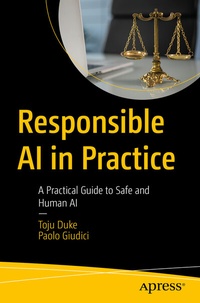
Responsible AI in Practice
Description

This book is the first practical book on AI risk assessment and management. It will enable you to evaluate and implement safe and accurate AI models and applications. The book features risk assessment frameworks, statistical metrics and code, a risk taxonomy curated from real-world case studies, and insights into AI regulation and policy, and is an essential tool for AI governance teams, AI auditors, AI ethicists, machine learning (ML) practitioners, Responsible AI practitioners, and computer science and data science students building safe and trustworthy AI systems across businesses, organizations, and universities.
The centerpiece of this book is a risk management and assessment framework titled "Safe Human-centered AI (SAFE-HAI)," which highlights AI risks across the following Responsible AI principles: accuracy, sustainability and robustness, explainability, transparency and accountability, fairness, privacy and human rights, human-centered AI, and AI governance. Using several statistical metrics such as Area Under Curve (AUC), Rank Graduation Accuracy, and Shapley values, you will learn to apply Lorenz curves to measure risk and inequality across the different principles and will be equipped with a taxonomy/scoring rubric to identify and mitigate identified risks.
This book is a true practical guide and covers a real-world case study using the proposed SAFE-HAI framework. The book will help you adopt standards and voluntary codes of conduct in compliance with AI risk and safety policies and regulations, including those from the NIST (National Institute of Standards and Technology) and EU AI Act (European Commission).
What You Will Learn
- Know the key principles behind Responsible AI and associated risks
- Become familiar with risk assessment frameworks, statistical metrics, and mitigation measures for identified risks
- Be aware of the fundamentals of AI regulations and policies and how to adopt them
- Understand AI governance basics and implementation guidelines
Who This Book Is For
AI governance teams, AI auditors, AI ethicists, machine learning (ML) practitioners, Responsible AI practitioners, and computer science and data science students building safe and trustworthy AI systems across businesses, organizations, and universities
More details
Other editions
Additional editions
Persons
Toju Duke has more than 18 years of experience spanning across advertising, retail, not-for profit, and tech, She is a popular speaker, author, thought leader, and advisor on Responsible AI. Toju worked at Google for 10 years where she spent the last three years as Program Manager on Responsible AI, leading various Responsible AI programs across Google's product and research teams, and with a primary focus on large-scale models and Responsible AI processes. She is also the founder of Diverse AI, a community interest organization with a mission to support and champion under-represented groups to build a diverse and inclusive AI future. In 2023, she published Building Responsible AI Algorithms: A Framework for Transparency, Fairness, Safety, Privacy, and Robustness (Apress). She provides consultation and advice on Responsible AI practices worldwide.
Content
Part I: Introduction.- Chapter 1: Responsible AI and AI Governance.- Part II: Technical risks (Internal to an organisation).- Chapter 2. Accuracy.- Chapter 3. Robustness and Security.- Chapter 4: Explainability.- Part III: Ethical risks (External).- Chapter 5. Fairness and Human Rights.- Chapter 6: Privacy.- Chapter 7: Sustainability.- Chapter 8: Human-Centered AI.- Part IV: Governance and Case studies.- Chapter 9: Governance Processes.- Chapters 10: Case Study.
