

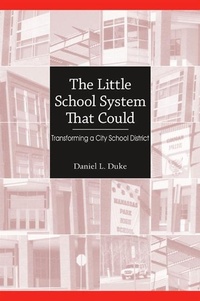
The Little School System That Could
Description

The Little School System That Could is a story about transformation. In 1995, equipped with not much more than a vision of the quality education that urban students deserved, Tom DeBolt, the new superintendent of the Manassas Park School System, set into motion a series of reforms that transformed the district. By 2005 every school was accredited, passing rates on state tests had doubled, and the school system was attracting national attention. Daniel L. Duke examines the district's ten-year turnaround, from four organizational perspectives and addresses the critical role of professional and political leadership in overcoming the challenges of low morale, scarce resources, changing demographics, and dysfunctional school-community relations.
Daniel L. Duke is Professor of Educational Leadership at the University of Virginia. He is the author of many books, including Education Empire: The Evolution of an Excellent Suburban School System and coeditor (with Margaret Grogan, Pamela D. Tucker, and Walter F. Heinecke) of Educational Leadership in an Age of Accountability: The Virginia Experience, both also published by SUNY Press.
More details
Other editions
Additional editions
Person
Daniel L. Duke is Professor of Educational Leadership at the University of Virginia. He is the author of many books, including Education Empire: The Evolution of an Excellent Suburban School System and coeditor (with Margaret Grogan, Pamela D. Tucker, and Walter F. Heinecke) of Educational Leadership in an Age of Accountability: The Virginia Experience, both also published by SUNY Press.
Content
List of Tables
Preface
Timeline
1. Introduction
Understanding Systemic Change
Doing Organizational History
Why Is the Manassas Park Story Important?
Organization of the Book
2. The Birth of a School System
A New City and a New School System
A Plethora of Postpartum Problems
Schooling in an Unsupportive Environment
Cause for Hope
3. An Improbable Choice for an Impossible Job
The Cards DeBolt Was Dealt
Delivering on the Promise
Envisioning the New High School
From Brainstorming to Bricks
Raising Achievement in an Era of Accountability
4. Excellence Begins Early
Where Will It Be and Can We Afford It?
Planning the New Elementary School
What About Learning?
5. A Foundation for Sustained Success
It Takes More Than a Leader to Make a Leadership Team
Charting a Course to Significance
The Final Ingredient for Success
6. A Maturing Culture of High Achievement
Multiple Indications of Success
Features of Manassas Park's New Organizational Culture
7. A Future Full of Questions
How Will Manassas Park Cope with Changing Demographics?
Will Local Revenue for Education Continue to Be Adequate?
How Long Will the Political Alliance Hold?
Will Student Achievement Continue to Improve?
What Will Happen When Tom DeBolt Leaves?
8. Understanding the Process of School System Transformation
The Power of Politics
The Impact of Re-culturing
The Necessity of Structure
The Potential of People
A Systematic Approach to Systemic Change
9. The Significance of Manassas Park's Transformation
Lesson 1: School Systems Can Be Turned Around
Lesson 2: A Change Process Characterized by Accelerating Incrementalism
Lesson 3: School System Change Benefits from Local Adaptation
Lesson 4: Size Probably Matters
Lesson 5: Don't Underestimate the Importance of Improved Facilities
Lesson 6: The Necessity of Broad-based Community Support
Lesson 7: Transformation Starts at the Top
Lesson 8: Transforming a School System Can Transform a Community
Notes
References
Index
