


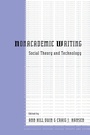
Nonacademic Writing
Social Theory and Technology
1st Edition
Published on 5. November 2013
408 pages
978-1-136-68950-5 (ISBN)
Description

In this volume, methodological, cultural, technological, and political boundaries felt by writers are analyzed, translated, and challenged in a way that will appeal to researchers, theorists, graduate students, instructors, and managerial audiences. Instead of extracting rules from previous research, the contributors, working from multidisciplinary perspectives, describe and analyze the social and technological contexts surrounding nonacademic writing. Their essays present a formative rather than summative outlook toward future research on nonacademic writing.
Collectively, these chapters articulate a unique perspective toward nonacademic writing that considers:
* The centrality of emerging communications technologies in nonacademic writing research and the need for a socio-technological perspective. New technologies reshape the concept of text and significantly impact the writing process and written products in nonacademic settings.
* The relationship between the academy and the workplace. A number of chapters challenge us -- sometimes from opposing perspectives -- to scrutinize our role as writing educators in preparing students for the workplace. Should we support the interests of corporate employers, or should we resist those interests? Should we enculturate students in workplace writing practices by placing them in these environments, or should we examine the tacit knowledge gained by workplace professionals and deliver this via classroom instruction?
* New theory, new research agendas. Contributors from diverse fields offer new theoretical lenses or use established lenses in innovative ways, expanding the agenda for nonacademic writing research.
This volume represents the vision the social landscape demands for research and pedagogy in nonacademic writing.
Collectively, these chapters articulate a unique perspective toward nonacademic writing that considers:
* The centrality of emerging communications technologies in nonacademic writing research and the need for a socio-technological perspective. New technologies reshape the concept of text and significantly impact the writing process and written products in nonacademic settings.
* The relationship between the academy and the workplace. A number of chapters challenge us -- sometimes from opposing perspectives -- to scrutinize our role as writing educators in preparing students for the workplace. Should we support the interests of corporate employers, or should we resist those interests? Should we enculturate students in workplace writing practices by placing them in these environments, or should we examine the tacit knowledge gained by workplace professionals and deliver this via classroom instruction?
* New theory, new research agendas. Contributors from diverse fields offer new theoretical lenses or use established lenses in innovative ways, expanding the agenda for nonacademic writing research.
This volume represents the vision the social landscape demands for research and pedagogy in nonacademic writing.
Reviews / Votes
"...the authors contribute some quite strong essays, with several ground breaking pieces."-TCQ Reviews
"...offers a collection of essays that develop insights into a wide variety of nonacademic writing situations."
-College, Composition and Communication
"...provides a useful overview of the navigation skills needed to present information and interact with others in corporate settings..."
-Technical Communication
"The revolutionary character of Duin and Hansen's volume is that it finds a group of authors who are willing to question the very academic/non-academic distinction that has thus far kept technical communication suppressed. The contributors use high-powered academic theories to discuss workplace writing and literacy, and practices from the workplace to understand classroom behavior....The articles are, at the very least, provocative, useful for class discussion....As a director of a technical communication program, I have longed for a volume like this, one that could be used as an advanced undergraduate or graduate anthology helping students understand the possibilities of technical communication as an intellectual pursuit. I think this volume will be seen as a 'breakthrough' or 'coming of age' for technical communication in the 90s..."
-David Kaufer
Carnegie Mellon University
More details
Language
English
Place of publication
London
United Kingdom
Publishing group
Taylor & Francis Ltd
Target group
Professional and scholarly
Product notice
Reflowable
File size
17,72 MB
ISBN-13
978-1-136-68950-5 (9781136689505)
Copyright in bibliographic data and cover images is held by Nielsen Book Services Limited or by the publishers or by their respective licensors: all rights reserved.
Schweitzer Classification
Other editions
Additional editions
Book
11/1995
Routledge
€86.70
Shipment within 10-20 days
Book
11/1995
Routledge
€223.21
Article not available at the moment
Persons
Ann Hill Duin
Content
Contents: M.M. Cooper, Foreword. Preface. A.H. Duin, C.J. Hansen, Setting a Sociotechnological Agenda in Nonacademic Writing. C.G. Herndl, The Transformation of Critical Ethnography Into Pedagogy, or the Vicissitudes of Traveling Theory. E. Tebeaux, Nonacademic Writing Into the 21st Century: Achieving and Sustaining Relevance in Research and Curricula. M.M. Lay, The Computer Culture, Gender, and Nonacademic Writing: An Interdisciplinary Critique. J. Ackerman, S. Oates, Image, Text, and Power in Architectural Design and Workplace Writing. R.E. Burnett, "Some People Weren't Able to Contribute Anything but Their Technical Knowledge": The Anatomy of a Dysfunctional Team. D. Winsor, Writing Well as a Form of Social Knowledge. J. Allen, C. Thompson, Social Theories, Workplace Writing, and Collaboration: Implications and Directions for Research. C.F. Smith, Understanding Institutional Discourse in the U.S. Congress, Present and Past. S. Stotsky, Participatory Writing: Literacy for Civic Purposes. S.A. Selber, D. McGavin, W. Klein, J. Johnson-Eilola, Issues in Hypertext-Supported Collaborative Writing. C.J. Bonk, T.H. Reynolds, P.V. Medury, Technology Enhanced Nonacademic Writing: A Social and Cognitive Transformation. C.J. Hansen, Contextualizing Technology and Communication in a Corporate Setting. C.L. Selfe, R.J. Selfe, Jr., Writing as Democratic Social Action in a Technological World: Politicizing and Inhabiting Virtual Landscapes.
