

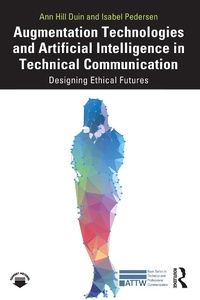
Augmentation Technologies and Artificial Intelligence in Technical Communication
Designing Ethical Futures
1st Edition
Published on 1. June 2023
282 pages
978-1-000-88924-6 (ISBN)
Description

This book enables readers to interrogate the technical, rhetorical, theoretical, and socio-ethical challenges and opportunities involved in the development and adoption of augmentation technologies and artificial intelligence.
The core of our human experience and identity is forever affected by the rise of augmentation technologies that enhance human capability or productivity. These technologies can add cognitive, physical, sensory, and emotional enhancements to the body or environment. This book demonstrates the benefits, risks, and relevance of emerging augmentation technologies such as brain-computer interaction devices for cognitive enhancement; robots marketed to improve human social interaction; wearables that extend human senses, augment creative abilities, or overcome physical limitations; implantables that amplify intelligence or memory; and devices, AI generators, or algorithms for emotional augmentation. It allows scholars and professionals to understand the impact of these technologies, improve digital and AI literacy, and practice new methods for their design and adoption.
This book will be vital reading for students, scholars, and professionals in fields including technical communication, UX design, computer science, human factors, information technology, sociology of technology, and ethics. Artifacts and supplemental resources for research and teaching can be found at https://fabricofdigitallife.com and www.routledge.com/9781032263755.
The core of our human experience and identity is forever affected by the rise of augmentation technologies that enhance human capability or productivity. These technologies can add cognitive, physical, sensory, and emotional enhancements to the body or environment. This book demonstrates the benefits, risks, and relevance of emerging augmentation technologies such as brain-computer interaction devices for cognitive enhancement; robots marketed to improve human social interaction; wearables that extend human senses, augment creative abilities, or overcome physical limitations; implantables that amplify intelligence or memory; and devices, AI generators, or algorithms for emotional augmentation. It allows scholars and professionals to understand the impact of these technologies, improve digital and AI literacy, and practice new methods for their design and adoption.
This book will be vital reading for students, scholars, and professionals in fields including technical communication, UX design, computer science, human factors, information technology, sociology of technology, and ethics. Artifacts and supplemental resources for research and teaching can be found at https://fabricofdigitallife.com and www.routledge.com/9781032263755.
Reviews / Votes
"Augmentation Technologies and Artificial Intelligence in Technical Communication: Designing Ethical Futures is a must-read for every technical communication professional who anticipates working alongside or communicating about augmentation technologies and artificial intelligence. Drawing on their extensive research and project experience with these technologies, co-authors Ann Hill Duin and Isabel Pedersen guide researchers, instructors and practicing professionals in the field through this emerging technology ecosystem, raise awareness of the affordances, benefits, and ethical dilemmas posed by these technologies, and explore specific applications of augmentation technologies and AI in the work of technical communicators, in teaching, and in influencing the future direction of the field. This is an ideal book for a textbook or for a study group on these technologies." - Saul Carliner, Concordia University, Canada."With this book, Duin and Pedersen provide an essential resource for those who work and study in the many areas of augmentation technology (AT) and artificial intelligence (AI). They bring technical & professional communication (TPC) firmly into this field. The authors have organized the rich landscape of resources in AT and AI to date-taxonomies, standards, policies, definitions, examples, and applications. They include ethical elements that are also critical to that landscape-human rights, accountability, security, safety, transparency, and explainability. In other words, this book is a repository of resources and a touchstone for future work in AT and AI . . . for TPC professionals as well as others working in the field." - Dr. Pam Estes Brewer, Mercer University, USA.
More details
Series
Edition
1. Auflage
Language
English
Place of publication
London
United Kingdom
Publishing group
Taylor & Francis Ltd
Target group
College/higher education
Professional and scholarly
Product notice
Reflowable
Illustrations
16 Tables, black and white; 15 Line drawings, black and white; 16 Halftones, black and white; 31 Illustrations, black and white
ISBN-13
978-1-000-88924-6 (9781000889246)
Copyright in bibliographic data and cover images is held by Nielsen Book Services Limited or by the publishers or by their respective licensors: all rights reserved.
Schweitzer Classification
Other editions
Additional editions
Ann Hill Duin | Isabel Pedersen
Augmentation Technologies and Artificial Intelligence in Technical Communication
Designing Ethical Futures
Book
06/2023
1st Edition
Routledge
€63.60
Shipment within 10-20 days
Ann Hill Duin | Isabel Pedersen
Augmentation Technologies and Artificial Intelligence in Technical Communication
Designing Ethical Futures
Book
06/2023
1st Edition
Routledge
€232.00
Shipment within 10-20 days
Persons
Ann Hill Duin is Professor in the Department of Writing Studies at the University of Minnesota.
Isabel Pedersen is Professor in the Faculty of Social Science and Humanities at Ontario Tech University.
Isabel Pedersen is Professor in the Faculty of Social Science and Humanities at Ontario Tech University.
Content
Section 1: Understand (rhetorics of) Augmentation Technologies 1. Augmentation Technologies and AI - An Ethical Design Futures Framework 2. Dimensions, Scope, and Classification for Augmentation Technologies 3. Agency, Affordances, and Enculturation of Augmentation Technologies Section 2: Build Literacies 4. Competencies, Design Considerations, and New Roles for Work with Augmentation Technologies and AI 5. Socio-ethical Consequences and Design Futures Section 3: Design Ethical Futures 6. Pedagogical Direction for Cultivating Augmentation Technology and AI Literacies 7. Professional Direction for Human-AI Interaction 8. Strategic and Tactical Approaches to Designing Ethical Futures for Augmentation Technologies and AI
