

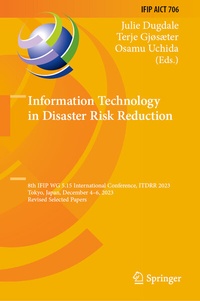
Information Technology in Disaster Risk Reduction
Description

This volume constitutes the refereed and revised post-conference proceedings of the 8th IFIP WG 5.15 International Conference on Information Technology in Disaster Risk Reduction, ITDRR 2023, held in Tokyo, Japan, during December 4-6, 2023.
The 18 full papers were carefully reviewed and selected from 26 submissions. The papers were organized in topical sections as follows: Evacuation and Emergency Management; Situational Awareness; Social Media; Information Systems; Geographic Information System (GIS); and Healthcare.
More details
Other editions
Additional editions
Content
.- Evacuation and Emergency Management.
.- Risk and Control Assurance Framework for Emergency Management Projects.
.- Digitalized Co-production of Emergency Response: Dispatch and on-site work by volunteer first responders.
.- Proposing a Simple Method of Creating Tsunami Evacuation Simulations: Aiming to Empower Residents for Feasible Measures.
.- Performance Evaluation of Flood Level Estimation Method using State-space Model with Time-series Monitoring Data.
.- Situational Awareness.
.- Snowed In and Cut Off: How a Norwegian Municipality Dealt with a Power Outage.
.- Situational Disabilities in Emergency Management - Validation of Realistic Scenarios for Training and Awareness-raising.
.- TeamAware: Profile-based Interoperability Framework for First Responders.
.- Social Media.
.- Archiving Social Media Discussions in Time and Space: A focus on refugees from Middle East and related war conflicts during Jan 2015 - Apr 2016.
.- Location Extraction in Disaster Tweets with a Model Trained on Past Data: Diverse Analysis.
.- Analysis of Japanese Tweets on the Russian Military Invasion of Ukraine Focusing on Frequently Used Words and Emotional Expressions.
.- Information Systems.
.- The Paradox Of Information Systems In Crisis: Walking The Tight Rope Between Rigidity & Flexibility.
.- Digital Supply Chain Roles in the Power Industry.
.- A Multi-modal Approach towards Public Alerting and Effective Communication in Disaster Scenarios: Implementation in the Indian Context.
.- Geographic Information System (GIS).
.- Identification of Undesignated Evacuation Sites Location by Mobile Spatial Statistics.
.- Derivation of Evacuation Routes to Avoid Narrow Road Adopting Physarum Solver.
.- Evaluation of Sentinel-1 GRD data with GEE for Floods mapping in Rubkona, South Sudan.
.- Healthcare.
.- A Novel Proof of Concept Forecasting Model for Pandemics - A Case Study in New Zealand.
.- Sensorized Maternal Health Interventions in Marginalized Communities: The Role of Surveillant Assemblages in Maintaining Compliance within Disaster-affected Healthcare Systems.
