

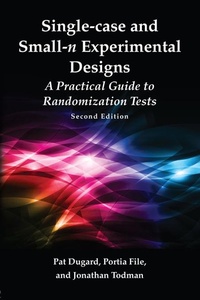
Single-case and Small-n Experimental Designs
A Practical Guide To Randomization Tests, Second Edition
2nd Edition
Published on 27. April 2012
304 pages
978-1-136-58848-8 (ISBN)
Description

This practical guide explains the use of randomization tests and provides example designs and macros for implementation in IBM SPSS and Excel. It reviews the theory and practice of single-case and small-n designs so readers can draw valid causal inferences from small-scale clinical studies. The macros and example data are provided on the book's website so that users can run analyses of the text data as well as data from their own studies.
The new edition features:
More explanation as to why randomization tests are useful and how to apply them.
More varied and expanded examples that demonstrate the use of these tests in education, clinical work and psychology.
A website with the macros and datasets for all of the text examples in IBM SPSS and Excel.
Exercises at the end of most chapters that help readers test their understanding of the material.
A new glossary that defines the key words that appear in italics when they are first introduced.
A new appendix that reviews the basic skills needed to do randomization tests.
New appendices that provide annotated SPSS and Excel macros to help readers write their own or tinker with the ones provided in the book.
The book opens with an overview of single case and small n designs -- why they are needed and how they differ from descriptive case studies. Chapter 2 focuses on the basic concepts of randoization tests. Next how to choose and implement a randomization design is reviewed including material on how to perform the randomizations, how to select the number of observations, and how to record the data. Chapter 5 focuses on how to analyze the data including how to use the macros and understand the results. Chapter 6 shows how randomization tests fit into the body of statistical inference. Chapter 7 discusses size and power. The book concludes with a demonstration of how to edit or modify the macros or use parts of them to write your own.
Ideal as a text for courses on single-case, small n design, and/or randomization tests taught at the graduate level in psychology (especially clinical, counseling, educational, and school), education, human development, nursing, and other social and health sciences, this inexpensive book also serves as a supplement in statistics or research methods courses. Practitioners and researchers with an applied clinical focus also appreciate this book's accessible approach. An introduction to basic statistics, SPSS, and Excel is assumed.
The new edition features:
More explanation as to why randomization tests are useful and how to apply them.
More varied and expanded examples that demonstrate the use of these tests in education, clinical work and psychology.
A website with the macros and datasets for all of the text examples in IBM SPSS and Excel.
Exercises at the end of most chapters that help readers test their understanding of the material.
A new glossary that defines the key words that appear in italics when they are first introduced.
A new appendix that reviews the basic skills needed to do randomization tests.
New appendices that provide annotated SPSS and Excel macros to help readers write their own or tinker with the ones provided in the book.
The book opens with an overview of single case and small n designs -- why they are needed and how they differ from descriptive case studies. Chapter 2 focuses on the basic concepts of randoization tests. Next how to choose and implement a randomization design is reviewed including material on how to perform the randomizations, how to select the number of observations, and how to record the data. Chapter 5 focuses on how to analyze the data including how to use the macros and understand the results. Chapter 6 shows how randomization tests fit into the body of statistical inference. Chapter 7 discusses size and power. The book concludes with a demonstration of how to edit or modify the macros or use parts of them to write your own.
Ideal as a text for courses on single-case, small n design, and/or randomization tests taught at the graduate level in psychology (especially clinical, counseling, educational, and school), education, human development, nursing, and other social and health sciences, this inexpensive book also serves as a supplement in statistics or research methods courses. Practitioners and researchers with an applied clinical focus also appreciate this book's accessible approach. An introduction to basic statistics, SPSS, and Excel is assumed.
Reviews / Votes
"The presentation is good, and the authors give a practical resource for those who must work with the specific designs in the text."-Technometrics "This new edition provides an excellent treatment of both the design and the analysis of single-case and small-n designs. It emphasizes the importance of matching the design to the analysis, and uses the many strengths of randomization tests to overcome problems with standard parametric procedures applied to small-sample studies." - David C. Howell, University of Vermont, USA
"This book provides statistical methods appropriate for small n studies--studies that may be messy, exploratory, and fail many of the assumptions of classical methods. A must-read for researchers conducting field research in educational and training environments." - Gregory K.W.K. Chung, UCLA/CRESST, USA
"Although we have known for many years that single case experimental designs are essential for the evaluation of an individual's response to treatment, most of us do not employ randomization strategies when planning this treatment. We need to change and this book will enable us to do just that. I urge all clinical and neuro psychologists interested in treating patients to purchase this book." - Barbara A Wilson, Oliver Zangwill Centre, Ely, UK
"I'm very excited about this book. ... The authors ... bring up the issues that I've found [students] to struggle with. ... This text will align well with NIH's and NIMH's move towards translational research and focus on evidenced-based treatment validity. ...The authors have an incredibly clear, thoughtful writing style. ... This text will "bridge the gap" between required course content and the reality that students will face in the field. ... I plan to buy it, use it in my class, and tell everyone I can about it." - Marie S. Hammond, Tennessee State University, USA
"The text ... fills a gap in the scholarly literature desperately needed in the behavior analytic scientific community. ... [There] are no directly competing texts that go into such depth ... for single-subject research designs as they are used specifically within clinical psychology and behavior analysis. ... [It is] an invaluable ... reference." - Michele Ennis Soreth, Rowan University, USA
More details
Edition
2nd edition
Language
English
Place of publication
London
United Kingdom
Publishing group
Taylor & Francis Ltd
Target group
College/higher education
Edition type
Revised edition
File size
5,24 MB
ISBN-13
978-1-136-58848-8 (9781136588488)
Copyright in bibliographic data and cover images is held by Nielsen Book Services Limited or by the publishers or by their respective licensors: all rights reserved.
Schweitzer Classification
Other editions
Additional editions
Pat Dugard | Portia File | Jonathan Todman
Single-case and Small-n Experimental Designs
A Practical Guide To Randomization Tests, Second Edition
Book
10/2011
2nd Edition
Routledge
€71.80
Shipment within 15-20 days
Pat Dugard | Portia File | Jonathan Todman
Single-case and Small-n Experimental Designs
A Practical Guide To Randomization Tests, Second Edition
Book
10/2011
2nd Edition
Routledge
€197.90
Shipment within 15-20 days
Persons
Pat Dugard taught statistics at the University of Abertay Dundee until 1999 and has also taught courses at the Open University. She now concentrates on writing. She received her PGDip in Mathematical Statistics from the University of Cambridge.
Portia File is a psychologist and computer scientist experienced in teaching university courses on research methods. She taught at University of Abertay Dundee from 1983 until 2007. She received her PhD in Cognitive Psychology from the University of Texas at Austin in 1975.
Jonathan Todman is a Clinical Psychologist in the Pain Management Programme at NHS Greater Glasgow and Clyde in Glasgow, Scotland. He received his Clinical Psychology Doctorate from Edinburgh in 2010.
Portia File is a psychologist and computer scientist experienced in teaching university courses on research methods. She taught at University of Abertay Dundee from 1983 until 2007. She received her PhD in Cognitive Psychology from the University of Texas at Austin in 1975.
Jonathan Todman is a Clinical Psychologist in the Pain Management Programme at NHS Greater Glasgow and Clyde in Glasgow, Scotland. He received his Clinical Psychology Doctorate from Edinburgh in 2010.
Content
Preface. 1. Single-case and Small-n Designs in Context. 2. Understanding Randomization Tests. 3. Obtaining the Data: Choosing the Design. 4. Obtaining the Data: Implementing the Design. 5. Analyzing the Data: Using the Macros. 6. Analyzing the Data: Wider Considerations. 7. Size and Power. 8. Going Further. Appendixes: 1. Basic Skills for Randomization Tests. 2. SPSS Macros. 3. Excel Macros.
