

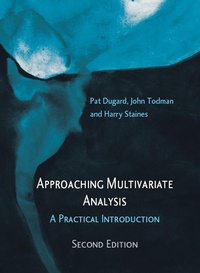
Approaching Multivariate Analysis, 2nd Edition
Description

This book provides a non-mathematical introduction to multivariate methods, with an emphasis on helping the reader gain an intuitive understanding of what each method is for, what it does and how it does it. The first chapter briefly reviews the main concepts of univariate and bivariate methods and provides an overview of the multivariate methods that will be discussed, bringing out the relationships among them, and summarising how to recognise what types of problem each of them may be appropriate for tackling. In the remaining chapters, introductions to the methods and important conceptual points are followed by the presentation of typical applications from psychology and medicine, using examples with fabricated data.
Instructions on how to do the analyses and how to make sense of the results are fully illustrated with dialogue boxes and output tables from SPSS, as well as details of how to interpret and report the output, and extracts of SPSS syntax and code from relevant SAS procedures.
This book gets students started, and prepares them to approach more comprehensive treatments with confidence. This makes it an ideal text for psychology students, medical students and students or academics in any discipline that uses multivariate methods.
Reviews / Votes
"This book provides a very informative text in a style that is very readable and easily understood by 'non-statisticians'." - Dr David Pritchard"I would particularly recommend this text to postgraduate students, but also to anyone who is looking for a way into understanding multivariate statistics." - Alice Jones in The Psychologist
"The authors have done an excellent job, adding two new chapters and creating medical examples to supplement this new edition. In common with the earlier chapters, these are very nicely structured and easy to follow. The new material on using SPSS syntax is extremely useful and is the only source that I know of that provides the reader with this information." - David Giles, Department of Psychology, University of Winchester, UK
"The straightforward approach found in this book, as well as the absence of unnecessary formulas to explain the use of an analysis, will appeal to the reader who is looking for an attainable and consistent answer to a practical issue." - Dennis W.T. Nilsen, Professor of Medicine, University of Bergen, Norway
"This book manages to give a sound statistical account while giving a wealth of useful advice to the researcher wishing to put the technique into practice." - David Clark-Carter, Professor of Psychological Research Methods, Staffordshire University, UK "This book provides a very informative text in a style that is very readable and easily understood by 'non-statisticians'." - Dr David Pritchard
"I would particularly recommend this text to postgraduate students, but also to anyone who is looking for a way into understanding multivariate statistics." - Alice Jones in The Psychologist
"The authors have done an excellent job, adding two new chapters and creating medical examples to supplement this new edition. In common with the earlier chapters, these are very nicely structured and easy to follow. The new material on using SPSS syntax is extremely useful and is the only source that I know of that provides the reader with this information." - David Giles, Department of Psychology, University of Winchester, UK
"The straightforward approach found in this book, as well as the absence of unnecessary formulas to explain the use of an analysis, will appeal to the reader who is looking for an attainable and consistent answer to a practical issue." - Dennis W.T. Nilsen, Professor of Medicine, University of Bergen, Norway
"This book manages to give a sound statistical account while giving a wealth of useful advice to the researcher wishing to put the technique into practice." - David Clark-Carter, Professor of Psychological Research Methods, Staffordshire University, UK
More details
Other editions
Additional editions

Persons
Pat Dugard worked until 1999 at the University of Abertay Dundee teaching statistics and providing statistical support and consultancy for researchers in psychology, engineering and other areas. Since then she has worked on two books with John Todman, with Open University and WEA students, and done statistical work for community groups and for engineers at Abertay.
John Todman lectured in the Psychology Department at the University of Dundee, first as a Lecturer, then as Senior Lecturer, then as a Professor. During that period he taught in addition to aspects of cognitive psychology, Design and Analysis at undergraduate and postgraduate levels. His research has been primarily in the areas of computer-aided communication for people without speech, and in computer anxiety. Sadly, John died just as this edition of the book had been completed.
Harry Staines has lectured statistics to a wide variety of students (including psychologists and nurses), led research groups and supervised postgraduate research students at the University of Abertay Dundee for over 20 years. He left his job as Professor of Applied Statistics in 2007 to work in the pharmaceutical industry designing and analyzing clinical trials. He also provides statistical support to medical researchers and QCMD.
