

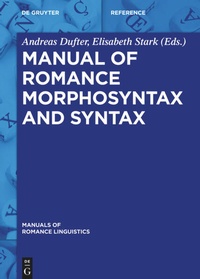
Manual of Romance Morphosyntax and Syntax
Description

This volume offers theoretically informed surveys of topics that have figured prominently in morphosyntactic and syntactic research into Romance languages and dialects. We define syntax as being the linguistic component that assembles linguistic units, such as roots or functional morphemes, into grammatical sentences, and morphosyntax as being an umbrella term for all morphological relations between these linguistic units, which either trigger morphological marking (e.g. explicit case morphemes) or are related to ordering issues (e.g. subjects precede finite verbs whenever there is number agreement between them). All 24 chapters adopt a comparative perspective on these two fields of research, highlighting cross-linguistic grammatical similarities and differences within the Romance language family. In addition, many chapters address issues related to variation observable within individual Romance languages, and grammatical change from Latin to Romance.
More details
Other editions
Additional editions
Persons
Content
- Intro
- Manuals of Romance Linguistics
- Table of Contents
- Abbreviations
- 1. Introduction
- The verbal domain
- 2. Subjects
- 3. Objects
- 4. Argument structure and argument structure alternations
- 5. Clitic pronouns
- 6. Voice and voice alternations
- 7. Auxiliaries
- 8. Causative and perception verbs
- 9. Copular and existential constructions
- The clausal and sentential domains
- 10. Infinitival clauses
- 11. Tense, aspect, mood
- 12. Negation and polarity
- 13. Dislocations and framings
- 14. Focus Fronting
- 15. Cleft constructions
- 16. Interrogatives
- 17. Exclamatives, imperatives, optatives
- 18. Coordination and correlatives
- The nominal domain
- 19. Gender and number
- 20. Determination and quantification
- 21. Adjectival and genitival modification
- 22. Relative clauses
- Typological aspects
- 23. Syntheticity and Analyticity
- 24. Basic constituent orders
- List of Contributors
- Index
