

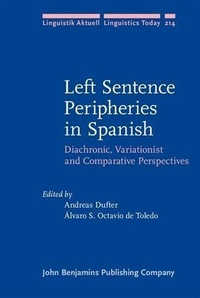
Left Sentence Peripheries in Spanish
Diachronic, Variationist and Comparative Perspectives
1st Edition
Published on 31. July 2014
VIII, 423 pages
978-90-272-7029-0 (ISBN)
Description

Since the advent of syntactic cartography, left sentence peripheries have begun to take center stage in linguistic research. Following the lead of Rizzi (1997), much work on left peripheries has been focused on Italian, whereas other Romance languages have attracted somewhat less attention. This volume offers a well-balanced set of articles investigating left sentence peripheries in Spanish. Some articles explore the historical evolution of left dislocation and fronting operations, while others seek to assess the extent - and the limits - of variation found between different geographical varieties and registers of the contemporary language. Moreover, the volume comprises several case studies on the interfaces between syntax, semantics, and information structure, and the implications of these for pragmatic interpretation and the organization of discourse. Cross-linguistic and typological perspectives are also provided in due course in order to position the analyses developed for Spanish within a larger research context.
More details
Other editions
Additional editions
Andreas Dufter | Alvaro S. Octavio de Toledo y Huerta
Left Sentence Peripheries in Spanish
Diachronic, Variationist and Comparative Perspectives
Book
07/2014
John Benjamins Publishing Co
€111.30
Shipment within 10-15 days
Persons
Content
- Left Sentence Peripheries in Spanish
- Editorial page
- Title page
- LCC data
- Table of contents
- Preface
- Introduction
- 1. From Latin to Spanish
- 2. Aspects of Modern Spanish clause structure
- 3. Syntax and its interfaces with semantics and pragmatics
- 4. Spanish and its closest relatives
- References
- Section 1. Left Sentence Peripheries in Old Spanish
- Chapter 1. Left Dislocation phenomena in Old Spanish
- 1. Introduction
- 2. Structural properties of Left Dislocations in Modern Spanish
- 2.1 Category of left-dislocate and case-marking
- 2.2 Resumptive constituents
- 2.3 Recursivity
- 2.4 Distribution
- 2.5 Island sensitivity
- 3. Left Dislocations in Old Spanish
- 3.1 Corpus
- 3.2 Left Dislocations relative to other word order phenomena
- 3.3 Structural properties
- 4. Conclusions
- Corpora
- References
- Chapter 2. Revisiting stylistic fronting in Old Spanish
- 1. Introduction
- 2. Properties of Stylistic Fronting
- 2.1 Clause-boundedness
- 2.2 Focus not required
- 2.3 Relativized Minimality
- 2.4 Head movement
- 2.5 The subject gap restriction
- 2.6 The subject gap restriction in null-subject languages
- 3. Previous explanations
- 3.1 The trigger for SF synchronically
- 3.2 The loss of SF diachronically
- 4. Towards an explanation
- 4.1 Theoretical considerations
- 4.2 Empirical considerations
- 4.3 Feature-driven movement
- 5. Conclusion
- References
- Appendix
- Questionnaire
- Chapter 3. Left forever
- 1. Pronoun redundancy: Basic synchronic data
- 2. Doubling and focus
- 3. Clitic doubling in the Middle Ages
- 4. The attraction to the left position
- 5. Clitic doubling as agreement
- 6. Concluding remarks
- References
- Medieval sources
- References
- Section 2. Syntactic variation in Modern Spanish
- Chapter 4. Spanish predicative verbless clauses and the left periphery
- 1. Introduction
- 2. The grammar of Spanish Predicative Verbless Clauses
- 2.1 The XP-predicate
- 2.2 The DP-subject
- 2.3 Syntactic structure
- 2.4 The information structure of Spanish Predicative Verbless Clauses
- 3. Previous syntactic accounts
- 3.1 Right-dislocated DP
- 3.2 Subject-Predicate movement
- 3.3 Two independent clauses
- 3.4 Small clause analysis
- 4. Toward a new proposal
- 5. Conclusion
- References
- Chapter 5. Fronting and contrastively focused secondary predicates in Spanish
- 1. Introduction
- 2. Contrastive focus and fronting in Spanish
- 3. Secondary predicates and information structure
- 4. Empirical study
- 4.1 Method and setup
- 4.2 Results
- 4.3 Discussion
- 5. Conclusion
- References
- Chapter 6. The left periphery of Spanish comparative correlatives
- 1. Introduction
- 2. Analysis
- 2.1 The correlative tanto ... cuanto ...
- 2.2 The role of the comparative degree heads más 'more' and menos 'less'
- 3. The left periphery
- 3.1 Focusing tanto más
- 3.2 The position of the correlative sentence
- 4. Further consequences of the proposal
- References
- Chapter 7. The article at the left periphery
- 1. Introduction
- 2. Previous analyses
- 2.1 Some problems of the above analyses
- 3. Verbs that combine with clausal arguments
- 3.1 Verbs that take clausal subjects
- 3.2 Verbs that take clausal complements
- 4. Verbs that can combine with el que clauses
- 5. Informative properties of el que clauses
- 5.1 Presuppositions and informative notions
- 6. Conclusions
- References
- Section 3. Syntax, semantics, and pragmatics
- Chapter 8. Evidentiality and illocutionary force
- 1. Introduction
- 1.1 The data
- 2. The data. An overview of root complementizers
- 2.1 Two new cases of root que in Spanish
- 2.2 Spanish root que and insubordination
- 3. Reportative que. An indirect evidential
- 3.1 Evidentiality
- 3.2 A description of reportative que
- 3.3 Evidence for que as an indirect reportative evidential
- 3.4 The nature of evidential que. Dialectal variation and a preliminary analysis
- 4. Matrix que in echoic structures. Another case of insubordination?
- 4.1 Description of the data
- 4.2 Echoic que vs. evidential que
- 5. Conclusion
- References
- Chapter 9. On the grammaticalization of the Assertion Structure
- 1. Introduction
- 2. The specificational pseudo-cleft
- 2.1 Some preliminaries
- 2.2 The specificational pseudo-cleft in standard and colloquial Peninsular Spanish
- 3. Caribbean Spanish bare-copular constructions
- 3.1 A reduced bi-clausal structure with ellipsis
- 3.2 The propositional nature of the copular structure
- 3.3 Some apparent arguments against a bi-clausal analysis
- 3.4 Scope relations
- 3.5 An argument for an ellipsis-based analysis (in lieu of focus movement)
- 3.6 Summary
- 4. Extending the analysis of Caribbean Spanish bare-copula structures to certain 'marked' word order cases
- 5. Conclusion
- References
- Chapter 10. Informational status and the semantics of mood in Spanish preposed complement clauses
- 1. Introduction
- 2. Mood selection in preposed complement clauses: Explanatory approaches
- 3. Mood in preposed complement clauses: A corpus-based analysis
- 3.1 Mood in preposed que-clauses
- 3.2 El hecho de que 'the fact that'
- 3.3 A unified account of mood alternation in preposed complement clauses and its relationship to the general semantics of mood in Spanish
- 4. A glance at historical evolutions
- 5. Conclusions
- References
- Chapter 11. Fronting and irony in Spanish
- 1. Introduction
- 2. Irony
- 2.1 Irony as echoic use
- 2.2 Are there linguistic cues for irony?
- 3. Fronting
- 3.1 Kinds of fronting
- 3.2 Verum Focus-Inducing Fronting
- 4. Irony and VFF
- 4.1 Why VFF favors irony
- 4.2 The need for additional cues
- 4.3 Other emphatic constructions
- 5. VSX and the lack of informational partition
- 6. Conclusions
- References
- Section 4. Spanish among the Romance languages
- Chapter 12. Left periphery in discourse
- 0. Introduction
- 1. Discourse units: The Basel Model
- 1.1 The information structure of discourse: From Functional Sentence Perspective to models of discourse units
- 1.2 The Basel Model
- 2. The Frame Unit
- 3. Frame Units and discourse functions: The case of discourse connectives
- 3.1 Discourse markers and discourse functions
- 3.2 Frame units and discourse markers
- 4. Some thoughts on discourse markers and text information structure in contrastive studies
- 5. Conclusions
- References
- Chapter 13. A comparative look at Focus Fronting in Romance
- 1. Introduction
- 2. Focus Fronting in Sardinian
- 2.1 Syntax of Focus Fronting in Sardinian
- 2.2 Interpretation of Focus Fronting in Sardinian
- 2.3 Summary: The properties of Focus Fronting in Sardinian
- 3. Focus Fronting in other Modern Romance languages and varieties
- 3.1 Sicilian
- 3.2 Spanish
- 3.3 Italian
- 4. Focus Fronting in Old Romance
- 4.1 Old Spanish
- 4.2 Old Catalan
- 4.3 Old Italian
- 5. Focus Fronting/SF in non-Romance
- 6. Summary
- References
- Primary Sources
- Research Literature
- Index
