

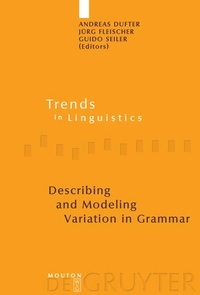
Describing and Modeling Variation in Grammar
Description

While variation within individual languages has traditionally been focused upon in sociolinguistics, its relevance for grammatical theory has only recently been acknowledged. On the methodological side, there is an ongoing competition between large-scale statistical analyses and investigations that rely more heavily on introspection and elicited grammaticality judgements.
The aim of this volume is to bridge the 'cultural gap' between empirical-variationist and formal-theoretical approaches in linguistics. The volume offers case studies that seek to combine corpus-based and competence-based approaches to the description of variation. In doing so, it opens up new avenues for locating and analyzing variability, both at the level of the individual speaker and between speakers of different dialects and generations. The contributions document the plurality of current research into models of grammatical competence that live up to the challenge of variationist data. More specifically, parameter-based (e.g. Minimalist), constraint-based (e.g. Optimality Theoretic), and usage-based (e.g. Construction Grammar) approaches to variation are discussed.
The volume therefore is of interest to a broad public within linguistics, including syntacticians of different theoretical persuasion, morphologists and sociolinguists. While a majority of contributions addresses facets of variation in English and German, the volume also includes variationist studies written by specialists of French, Dutch, Icelandic, and Uralic.
More details
Other editions
Additional editions
Persons
Content
2 - Table of contents [Seite 7]
3 - Introduction [Seite 9]
4 - Methodological considerations on grammar variation. The right periphery as an OV/VO deciding parameter more so than the left periphery: Gradience in the verb cluster [Seite 29]
5 - Variation as lexical choice: have, got and the expression of possession [Seite 67]
6 - Variation in Icelandic morphosyntax [Seite 89]
7 - The predicative as a source of grammatical variation [Seite 107]
8 - Morphological variation:A declarative approach [Seite 125]
9 - Different notions of variation and their reflexes in Swiss German relativization [Seite 143]
10 - From documentation to grammatical description: Prepositional phrases in Ruhrdeutsch [Seite 171]
11 - Can we factor out free choice? [Seite 191]
12 - Empirical syntax: Idiolectal variability in two- and three-verb clusters in regional standard Dutch and Dutch dialects [Seite 211]
13 - Towards a multivariate model of grammar: The case of word order variation in Dutch clause final verb clusters [Seite 233]
14 - Synchronic variation in diachronic perspective: Question formation in Québec French [Seite 263]
15 - Agreement in English dialects [Seite 279]
16 - Semi-modal variation [Seite 305]
17 - Variation in Komi object marking [Seite 333]
18 - How lexicalization reflected in hyphenation affects variation and word-formation [Seite 369]
19 - Variation in German adjective inflection: A corpus study [Seite 397]
20 - Backmatter [Seite 415]
