

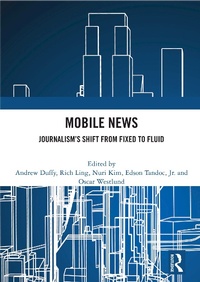
Mobile News
Journalism's Shift from Fixed to Fluid
1st Edition
Published on 17. December 2020
190 pages
978-1-000-21409-3 (ISBN)
Description

The rise of the smartphone has shifted news from fixed publication to a flow of updateable information. The chapters in this book investigate the implications for audiences, industry and society as news becomes mobile.
Wherever we go, news from anywhere can reach us on our smartphones. And wherever we are, we can search up information specific to that place. News is produced by mobile journalists (MoJos) as well as by citizens armed with smartphones, reporting breaking news from crisis zones where information is uncertain, or hyperlocal news from neighbourhoods where little happens. Mobile technology allows citizens to engage deeply with a cause or to skim headlines so they know a little about a lot of things. News is distributed on mobile networks and consumed by mobile audiences as they make their daily way through time and space coloured by their mobile devices. It is consumed in the niches of life. It intersects with place in new ways as geolocated news. It pursues us wherever we are through push notifications. And news has moved from fixed to fluid, a flow of updateable information rather than a regularly issued product. In this book, the contributors take varied viewpoints on mobility and news, its impact on what news is, how journalists produce it and how it fits into everybody's everyday life.
The chapters in this book were originally published as a special issue of Digital Journalism.
Wherever we go, news from anywhere can reach us on our smartphones. And wherever we are, we can search up information specific to that place. News is produced by mobile journalists (MoJos) as well as by citizens armed with smartphones, reporting breaking news from crisis zones where information is uncertain, or hyperlocal news from neighbourhoods where little happens. Mobile technology allows citizens to engage deeply with a cause or to skim headlines so they know a little about a lot of things. News is distributed on mobile networks and consumed by mobile audiences as they make their daily way through time and space coloured by their mobile devices. It is consumed in the niches of life. It intersects with place in new ways as geolocated news. It pursues us wherever we are through push notifications. And news has moved from fixed to fluid, a flow of updateable information rather than a regularly issued product. In this book, the contributors take varied viewpoints on mobility and news, its impact on what news is, how journalists produce it and how it fits into everybody's everyday life.
The chapters in this book were originally published as a special issue of Digital Journalism.
More details
Edition
1. Auflage
Language
English
Place of publication
London
United Kingdom
Publishing group
Taylor & Francis Ltd
Target group
College/higher education
ISBN-13
978-1-000-21409-3 (9781000214093)
Copyright in bibliographic data and cover images is held by Nielsen Book Services Limited or by the publishers or by their respective licensors: all rights reserved.
Schweitzer Classification
Other editions
Additional editions

Book
04/2022
1st Edition
Routledge
€55.79
Shipment within 15-20 days
Book
10/2020
1st Edition
Routledge
€192.21
Shipment within 15-20 days
Persons
Andrew Duffy, Rich Ling, Nuri Kim and Edson Tandoc, Jr. came together on a three-year research project into news as it is created, distributed and consumed on smartphones. They are colleagues at the Wee Kim Wee School at Nanyang Technological University, Singapore, specialising variously in news journalism, mobile communications technology and political communication, and their impact in society.
Oscar Westlund is professor at Oslo Metropolitan University, Norway, with a specialisation in journalism, media management and news media consumption for proprietary news media platforms. As a visiting scholar he was involved in the project that led to this book, and he was also editor of Digital Journalism, where these chapters originally appeared.
Oscar Westlund is professor at Oslo Metropolitan University, Norway, with a specialisation in journalism, media management and news media consumption for proprietary news media platforms. As a visiting scholar he was involved in the project that led to this book, and he was also editor of Digital Journalism, where these chapters originally appeared.
Content
1. News: Mobiles, Mobilities and Their Meeting Points
Andrew Duffy, Rich Ling, Nuri Kim, Edson Tandoc Jr. and Oscar Westlund
2. Witnessing a Disaster: Public Use of Digital Technologies in the 2015 South Indian Floods
Subin Paul and Sujatha Sosale
3. The Effects of Mobile Push Notifications on News Consumption and Learning
Natalie Jomini Stroud, Cynthia Peacock and Alexander L. Curry
4. Mapping the Mobile DNA of News. Understanding Incidental and Serendipitous Mobile News Consumption
Kristin Van Damme, Marijn Martens, Sarah Van Leuven, Mariek Vanden Abeele and Lieven De Marez
5. Value Emergence in the Usage of Mobile News Alerts
Leena Maekelae, Mika Boedeker and Nina Helander
6. The Persistence of the Popular in Mobile News Consumption
Jacob L. Nelson
7. Mobile but Not Mobilized? Differential Gains from Mobile News Consumption for Citizens' Political Knowledge and Campaign Participation
Jakob Ohme
8. What's New about WhatsApp for News? A Mixed-Method Study on News Outlets' Strategies for Using WhatsApp
Karin Boczek and Lars Koppers
9. Making the 21st Century Mobile Journalist: Examining Definitions and Conceptualizations of Mobility and Mobile Journalism within Journalism Education
Matthew N. Bui and Rachel E. Moran
10. Understanding Mobile News: Looking beyond the Lockscreen
Leopoldina Fortunati and John O'Sullivan
11. Digital Journalism after Mobility
Gerard Goggin
Andrew Duffy, Rich Ling, Nuri Kim, Edson Tandoc Jr. and Oscar Westlund
2. Witnessing a Disaster: Public Use of Digital Technologies in the 2015 South Indian Floods
Subin Paul and Sujatha Sosale
3. The Effects of Mobile Push Notifications on News Consumption and Learning
Natalie Jomini Stroud, Cynthia Peacock and Alexander L. Curry
4. Mapping the Mobile DNA of News. Understanding Incidental and Serendipitous Mobile News Consumption
Kristin Van Damme, Marijn Martens, Sarah Van Leuven, Mariek Vanden Abeele and Lieven De Marez
5. Value Emergence in the Usage of Mobile News Alerts
Leena Maekelae, Mika Boedeker and Nina Helander
6. The Persistence of the Popular in Mobile News Consumption
Jacob L. Nelson
7. Mobile but Not Mobilized? Differential Gains from Mobile News Consumption for Citizens' Political Knowledge and Campaign Participation
Jakob Ohme
8. What's New about WhatsApp for News? A Mixed-Method Study on News Outlets' Strategies for Using WhatsApp
Karin Boczek and Lars Koppers
9. Making the 21st Century Mobile Journalist: Examining Definitions and Conceptualizations of Mobility and Mobile Journalism within Journalism Education
Matthew N. Bui and Rachel E. Moran
10. Understanding Mobile News: Looking beyond the Lockscreen
Leopoldina Fortunati and John O'Sullivan
11. Digital Journalism after Mobility
Gerard Goggin
