

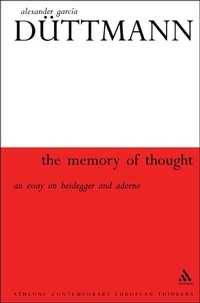
Memory Of Thought
1st Edition
Published on 6. December 2002
350 pages
978-1-84714-452-2 (ISBN)
Description

A reconstruction of aspects of the philosophy of Adorno and Heidegger. This title reconstructs the philosophy of Adorno and Heidegger in the light of the importance that these thinkers attach to two proper names: Auschwitz and Germanien. In Adorno's dialectical thinking, Auschwitz is the name of an incommensurable historical event that seems to put a provisional end to history as a negative totality. In Heidegger's thinking of Being, Germanien is a name inscribed in an historical mission on which the fate of Western civilization seems to depend: it thus becomes the name of a positive totality of history.
More details
Series
Edition
1. Auflage
Language
English
Place of publication
London
United Kingdom
Publishing group
Bloomsbury Publishing PLC
Target group
Professional and scholarly
ISBN-13
978-1-84714-452-2 (9781847144522)
Copyright in bibliographic data and cover images is held by Nielsen Book Services Limited or by the publishers or by their respective licensors: all rights reserved.
Schweitzer Classification
Other editions
Additional editions
Alexander Garcia Duettmann
Memory Of Thought
Book
12/2002
Mansell Publishing
€113.70
Shipment within 15-20 days
Person
Alexander Garcia Duttmann is Professor of Philosophy and Visual Culture at Goldsmiths University of London, UK, and author of The Gift of Language and Memory of Thought, published in the Athlone Contemporary European Thinkers series.
Content
- Intro
- Contents
- Abbreviations
- Introduction: Of (From) Germania - after (to) Auschwitz
- PART I. GUILTS AND DEBTS
- 1 Fate and Sacrifice
- Adorno's comparison
- Guilt repeated
- Recourse to Benjamin
- Bare life
- Originary guilt of law
- Omens, presentiments, signals
- The named head
- Gift and oblivion
- Rationality of cunning
- Equality as inequality
- Sacrifice and the principle of equivalence
- Reconciliation postponed
- Space and time
- A rational overview
- Nietzsche's 'spirit of vengeance'
- Sacrifice as appropriation
- The commanding name
- Purifying rage
- Dialectic of sacrifice, promise of happiness
- Similarity to the animal
- Image
- The 'minimal meaninglessness' of language
- Art and philosophy
- Progress in the realm of spirit
- The caesura of remembrance
- Holding course
- 2 Dialectics and the Ban on Images
- Selfhood
- Determinate negation
- Particularity of Judaism
- Christian love
- Negative dialectics
- The origin of performative contradiction
- Dialectics without dialectic: the vertiginous
- 3 Constellation and De-constitution
- The non-identical speaks
- Movement and difference
- Double reading
- Language as event
- Undecidedness
- The death of intention
- Enigma and solution, question and answer
- Falling
- The cunning of the name
- Stupidity of the subject
- Too much talk: fatefulness of enlightenment
- Mimesis
- Constructing the totality
- The new barbarism
- Writing after Auschwitz
- Jaspers on the question of guilt
- The crisis of spirit
- A telling historical sign
- The question of guilt as an introduction to metaphysics
- National consciousness and guilt
- Double bind
- You shall never be remembered
- PART II. INAUGURATIONS
- 1 Counter-Turning of the Beginning
- Storm
- Beginning, greatness, stand
- Imminence
- Blindness of the philosopher
- Genius of forgetting
- Poetry and thought
- The power and force of language, the truth of a people
- Concepts and political determination
- The incalculable
- The most dangerous of gifts
- On poetry: the over-poetic
- What begins in and as language
- Aestheticisation of polities' or 'politicisation of aesthetics'?
- Having time
- The 'Graeco-German mission'
- Naming the name
- Original language and 'the final solution'
- The word 'being'
- History and the multiplication of languages
- Repetition
- 2 Rise and Downfall
- Semblance of regression
- Repudiation and celebration of destruction
- Simplifications: learning from a 'national catastrophe'
- A delaying pseudo-rational reasoning
- Shock
- Revolution and revolt
- Commemoration
- Experience, lived sensation, reflection
- Angel of history
- Political theology
- De-cision
- The thrust of thatness
- The essence of the work of art
- Preserving and offering
- 3 Keeping to the Names
- The saying of words
- Originary historical transmission
- The midst of being'
- Metaphysical neighbours
- Dualism and duality
- The essence of historical existence
- The legitimising power of the name
- Stability of sense
- Given as endowment and given as task
- The names of Dionysos
- A key figure
- Dionysian messianism'?
- Remembrance: 'empty readiness for subjugation' or 'posture of resistance?'
- Meaning, naming, saying
- The soul's hoard of images
- There is (need)
- Afterword: The Reeling Philosopher
- Notes
- Bibliography
- Index
- A
- B
- C
- D
- E
- F
- G
- H
- I
- J
- K
- L
- M
- N
- O
- P
- R
- S
- T
- U
- V
- W
- Z
